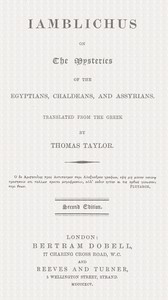
The various translations and original works of Thomas Taylor, though still in request by the more zealous students of ancient philosophy and occult science, have now become so scarce and expensive that it is only within the power of comparatively wealthy collectors to obtain them. This is a matter for regret, inasmuch as it cannot be affirmed that his writings have been, or are likely to be superseded, or that they are without value. They can hardly be neglected without loss by those who desire to understand the systems of philosophy which satisfied the spiritual needs of the antique world. It is not possible, even for the most fervent believer in modern “progress,” to dismiss the speculations of the ancient philosophers as antiquated notions which have had their day and no longer possess interest or value. The names of Socrates, Plato, and Aristotle can never grow dim with age, nor is it possible to conceive a time when men shall cease to study and reverence them. As the disciple, the translator, and the expounder of these and of other sages of antiquity, Thomas Taylor deserves to be held in honour and remembrance, and it would be a misfortune if his labours remained unknown because of the scarcity of his books. It is for this reason that the present reprint has been undertaken; and it is hoped that it will meet with such a measure of success as may encourage the republication of various other works by the same author. It has been printed in handsome style and published at a moderate price in order that it may be regarded as a desirable addition to the scholar’s library, while yet it will not tax severely the means of the not too wealthy student. For the rest it is only necessary to say that this reprint is, in size, number of pages, type, and general get-up, an almost exact facsimile of the original edition, which was first printed in 1821. No alterations or additions have been made in or to the original text, as it is thought that those who care for Taylor’s writings will prefer to have them in their integrity. Should it be found possible, however, to continue the series it is intended to prefix to a future volume an essay on Taylor, which will contain a biography of him, and a critical estimate of his writings.
May, 1895.
INTRODUCTION.
It appears to me that there are two descriptions of persons by whom the present work must be considered to be of inestimable worth, the lovers of antiquity and the lovers of ancient philosophy and religion. To the former of these it must be invaluable, because it is replete with information derived from the wise men of the Chaldeans, the prophets of the Egyptians, the dogmas of the Assyrians, and the ancient pillars of Hermes; and to the latter, because of the doctrines contained in it, some of which originated from the Hermaic pillars, were known by Pythagoras and Plato, and were the sources of their philosophy; and others are profoundly theological, and unfold the mysteries of ancient religion with an admirable conciseness of diction, and an inimitable vigour and elegance of conception. To which also may be added, as the colophon of excellence, that it is the most copious, the clearest, and the most satisfactory defence extant of genuine ancient theology.
This theology, the sacred operations pertaining to which called theurgy are here developed, has for the most part, since the destruction of it, been surveyed only in its corruptions among barbarous nations, or during the decline and fall of the Roman empire, with which, overwhelmed with pollution, it gradually fell, and at length totally vanished from what is called the polished part of the globe. This will be evident to the intelligent reader from the following remarks, which are an epitome of what has been elsewhere more largely discussed by me on this subject, and which also demonstrate the religion of the Chaldeans, Egyptians, and Greeks to be no less scientific than sublime.
In the first place, this theology celebrates the immense principle of things as something superior even to being itself; as exempt from the whole of things, of which it is nevertheless ineffably the source; and does not, therefore, think fit to enumerate it with any triad[1] or order of beings. Indeed it even apologizes for giving the appellation of the most simple of our conceptions to that which is beyond all knowledge and all conception. It denominates this principle however, the one and the good; by the former of these names indicating its transcendent simplicity, and by the latter its subsistence as the object of desire to all beings. For all things desire good. At the same time, however, it asserts that these appellations are in reality nothing more than the parturitions of the soul, which, standing as it were in the vestibules of the adytum of deity, announce nothing pertaining to the ineffable, but only indicate her spontaneous tendencies towards it, and belong rather to the immediate offspring of the first God than to the first itself. Hence, as the result of this most venerable conception of the supreme, when it ventures not only to denominate it, though ineffable, but also to assert something of its relation to other things, it considers this as preeminently its peculiarity, that it is the principle of principles; it being necessary that the characteristic property of principle, after the same manner as other things, should not begin from multitude, but should be collected into one monad as a summit, and which is the principle of all principles.
The scientific reasoning from which this dogma is deduced is the following. As the principle of all things is the one, it is necessary that the progression of beings should be continued, and that no vacuum should intervene either in incorporeal or corporeal natures. It is also necessary that every thing which has a natural progression should proceed through similitude. In consequence of this, it is likewise necessary that every producing principle should generate a number of the same order with itself, viz. nature, a natural number; soul, one that is psychical (i. e. belonging to soul); and intellect an intellectual number. For if whatever possesses a power of generating, generates similars prior to dissimilars, every cause must deliver its own form and characteristic peculiarity to its progeny; and before it generates that which gives subsistence to progressions, far distant and separate from its nature, it must constitute things proximate to itself according to essence, and conjoined with it through similitude. It is, therefore, necessary from these premises, since there is one unity, the principle of the universe, that this unity should produce from itself, prior to every thing else, a multitude of natures characterized by unity, and a number the most of all things allied to its cause; and these natures are no other than the Gods.
According to this theology, therefore, from the immense principle of principles, in which all things causally subsist, absorbed in superessential light, and involved in unfathomable depths, a beauteous progeny of principles proceed, all largely partaking of the ineffable, all stamped with the occult characters of deity, all possessing an overflowing fulness of good. From these dazzling summits, these ineffable blossoms, these divine propagations, being, life, intellect, soul, nature, and body depend; monads suspended from unities, deified natures proceeding from deities. Each of these monads, too, is the leader of a series which extends from itself to the last of things, and which, while it proceeds from, at the same time abides in, and returns to, its leader. And all these principles, and all their progeny, are finally centred and rooted by their summits in the first great all-comprehending one. Thus all beings proceed from, and are comprehended in, the first being: all intellects emanate from one first intellect; all souls from one first soul; all natures blossom from one first nature; and all bodies proceed from the vital and luminous body of the world. And, lastly, all these great monads are comprehended in the first one, from which both they and all their depending series are unfolded into light. Hence this first one is truly the unity of unities, the monad of monads, the principle of principles, the God of Gods, one and all things, and yet one prior to all.
No objections of any weight, no arguments but such as are sophistical, can be urged against this most sublime theory, which is so congenial to the unperverted conceptions of the human mind, that it can only be treated with ridicule and contempt in degraded, barren, and barbarous ages. Ignorance and impious fraud, however, have hitherto conspired to defame those inestimable works[2] in which this and many other grand and important dogmas can alone be found; and the theology of the ancients has been attacked with all the insane fury of ecclesiastical zeal, and all the imbecile flashes of mistaken wit, by men whose conceptions on the subject, like those of a man between sleeping and waking, have been turbid and wild, phantastic and confused, preposterous and vain.
Indeed, that after the great incomprehensible cause of all, a divine multitude subsists, cooperating with this cause in the production and government of the universe, has always been, and is still, admitted by all nations and all religions, however much they may differ in their opinions respecting the nature of the subordinate deities, and the veneration which is to be paid to them by man; and however barbarous the conceptions of some nations on this subject may be, when compared with those of others. Hence, says the elegant Maximus Tyrius, “You will see one according law and assertion in all the earth, that there is one God, the king and father of all things, and many Gods, sons of God, ruling together with him. This the Greek says, and the Barbarian says, the inhabitant of the continent, and he who dwells near the sea, the wise and the unwise. And if you proceed as far as to the utmost shores of the ocean, there also there are Gods, rising very near to some, and setting very near to others.”[3]
The deification, however, of dead men, and the worshiping men as Gods, formed no part of this theology, when it is considered according to its genuine purity. Numerous instances of the truth of this might be adduced, but I shall mention for this purpose, as unexceptionable witnesses, the writings of Plato, the Golden Pythagoric Verses,[4] and the Treatise of Plutarch on Isis and Osiris. All the works of Plato, indeed, evince the truth of this position, but this is particularly manifest from his Laws. The Golden verses order that the immortal Gods be honoured first, as they are disposed by law; afterwards the illustrious Heroes, under which appellation the author of the verses comprehends also angels and dæmons, properly so called; and in the last place, the terrestrial dæmons, i. e. such good men as transcend in virtue the rest of mankind. But to honour the Gods as they are disposed by law, is, as Hierocles observes, to reverence them as they are arranged by their demiurgus and father; and this is to honour them as beings not only superior to man, but also to dæmons and angels. Hence, to honour men, however excellent they may be, as Gods, is not to honour the Gods according to the rank in which they are placed by their Creator; for it is confounding the divine with the human nature, and is thus acting directly contrary to the Pythagoric precept. Plutarch too, in his above mentioned treatise, most forcibly and clearly shows the impiety of worshiping men as Gods.[5]