About this book
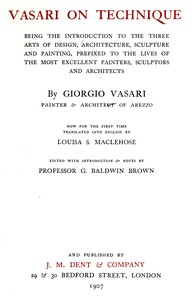
Vasari on Technique is a scholarly treatise that opens with a meticulous inventory of stone types, porphyry, serpentine, breccia, travertine, and many others, before launching into a systematic exposition of the three visual arts. The work is framed as an introductory essay to Vasari’s famed Lives, and the opening pages lay out the editor’s and translator’s efforts to render the 16th‑century Italian text into clear English, complete with footnotes, plates, and a modern chapter‑numbering system. The table of contents reveals a dense structure: chapters on architecture’s materials and orders, detailed instructions for masonry, vaulting, mosaics, and fountains; followed by extensive sections on sculpture, from model making in wax and clay to bronze casting and wood carving; and finally a comprehensive guide to design and painting, covering drawing, perspective, colour theory, fresco, tempera, and oil techniques. The book thus serves as a technical companion to the biographies of the era’s greatest artists.
Written in a formal, didactic voice that mirrors the Renaissance master’s own instructional tone, the translation retains Vasari’s literal phrasing while smoothing archaic Italian idioms for modern readers. The style is encyclopedic, peppered with scholarly annotations that clarify obscure references and measurements such as the “braccio” and “palmo.” Specialists in art history, conservation, or historic architecture will appreciate its exhaustive detail, as will students of Renaissance technique seeking primary source insight into the material practices that shaped early modern art.