Public-domain ebook
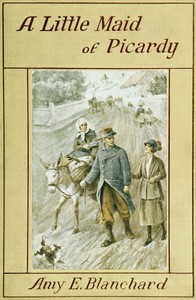
A little maid of Picardy
English415 downloads on Project GutenbergDownload EPUB
Public-domain ebook sourced from Project Gutenberg #73722.
Public-domain ebook
English415 downloads on Project GutenbergDownload EPUB
Public-domain ebook sourced from Project Gutenberg #73722.
The opening · free to read
sang Lucie as she sat on a stone bench under a sheltering cherry tree. The “tra la la” suddenly ceased at a stir of the branches on the other side. Lucie glanced up with a twinkle in her eyes and changed the song to “Way down upon the Swanee river.”
“Lucie, Lucie, what are those funny words you sing?” called some one from over the wall.
“_Ma foi_, what ignorance!” returned Lucie with an uplift of her eyebrows. “As if one could not tell. Did you never hear ‘the Old Folks at Home’?”
“What is this ‘Ole folk zat ome?’ I do not know,” returned the voice.
Lucie laughed. “Come over, come over, Annette, and I will teach it to you. It will be droll to hear you sing it.”
Annette climbed nimbly to the top of the stone wall, and presently dropped to her feet, avoiding bushes and vines in order to make her way to where Lucie was sitting. “It is droll enough to hear you sing it,” she remarked. “It is in English of course.”
“American English; a song my mother often sings and which every one knows over there in the United States.”
“And you will teach it to me, this song? I shall like to sing it for grandfather. How he will be amused when he hears it.”
“Then repeat after me.”
This Annette essayed to do, but her efforts brought such peals of laughter from Lucie that she stopped with a pout. “How you are a silly one,” exclaimed she. “Me, I am all French. Can I then be expected to know English? If you will perhaps write the words for me I may then be able to say them, but when you speak so fast and run the words together at such a rate I cannot follow you.” She produced a piece of paper and a stub of pencil. Lucie carefully wrote out the first line, handed the paper back to Annette and waited with a gleeful smile.
“Vay don oopon ze Svanay reebair,” began Annette reading slowly. Then down fluttered the paper. “I cannot,” she cried. “This English is a monster! a Turkey! a pig! a thing impossible. I do not see how you can understand or speak it.”
“I speak it as well as I do French,” returned Lucie proudly. “Mamma wishes that I shall, for one day, behold! we go to her home to that same United States, then before my relations I shall not feel ashamed. I should consider myself a silly one if I could not understand them nor they me.”
“For me then there will arise no occasion for feeling shame, and therefore there is no need to learn this tongue, for I have no relatives in that country,” returned Annette complacently. “Would you not, Lucie, prefer to be all French. Is it not a sorrow to you that you are part English?”
“No, no,” Lucie shook her head. “I am not English, and I am very proud of my American blood and that I have American aunts and uncles. As for my mother, she tells me that she became French when she married a Frenchman, so this is now her country as well as my father’s and mine. I adore my France where I was born and where I hope I may die when my hour comes. It is the land of my father, my mother, my dear old grandfather. No, you cannot say I am English, Annette.”
This outbreak entirely satisfied Annette, who quite willingly changed the subject when her friend proposed that they should go further into the garden to see a certain rose now blooming gloriously. “Is it not magnificent?” Lucie asked as they stopped before the bush.
Annette viewed it with admiration. “It is truly,” she acknowledged, “more beautiful than my grandfather’s. Now he will be envious, that poor grandfather, for ours has not half the number of blooms.”
“They are very droll, those two old ones, your grandfather and mine,” remarked Lucie. “To hear them argue over a bed of cabbages one would think them the most important things in the world. They are never so happy as when they are discussing the merits of their gardens. For my part I cannot see that one is better than the other. They grow; there is enough and more than enough for our use, so what does it matter? Here comes Paulette now to gather vegetables. Shall we help her to pick the peas, Annette?”
“And shell them afterward?”
“Why yes, if you will.”
Paulette, rugged of feature, brown of skin, sharp-eyed and capable, came forward with a basket on her arm. She wore a stuff skirt, a huge apron, a stout sacque and a little cap. Her face was rather grave and stern until she smiled, then her expression showed a kindly humor.
“May we help you gather the peas, Paulette?” asked Lucie, balancing herself on one foot.
Paulette scanned the vines. “Yes, if you will be careful to pick only the well-filled pods. One may not take those not fully matured. Guard well against that.”
“We know and we will be careful,” returned Lucie and forthwith the three set to work, the girls using their aprons to hold the gathered pods, Paulette giving them once in a while a sharp eye to see that they performed their task properly.
At last when peas, carrots, onions, lettuce had been gathered Paulette carried them into the house and the little girls sat down again on the stone bench to shell the peas. Paulette meantime bustled in and out to bring water, to wash the lettuce and swing it around and around in a wire basket that it might be freed from all moisture, to scrape the little potatoes, to pick over the herbs for the ragout. The warm air was scented with odors from the garden, the rose-bushes, the clambering vines and mellowing fruit. The two girls chattered away like magpies about pleasant, homely things: their lessons, their pets, the growing garden, the good curé, the kind nuns. Outside the white wall the noises from the long street seemed only sociable sounds. Carts rattled along, children called to one another, men tramped home from the factories to their midday meal, stopping their whistling or singing to greet some friend. All this made a pleasant accompaniment to the drone of bees, and the drowsy crooning of hens in the chicken yard. There were homely, suggestive sounds, too, from the kitchens.
The two little girls, Lucie Du Bois and Annette Le Brun, were great friends, as might be surmised since they were next door neighbors. Lucie, her father and mother, her grandfather, Paulette, their maid and her son Jean, occupied a comfortable, square house whose red-tiled roof could be seen when winter stripped the leaves from the trees, but which in summer was almost hidden by green. A white stucco wall separated the garden from that of the Le Bruns, but the wall was not an impassable barrier, for the two girls, by means of a ladder, or, when the ladder was lacking, by means of overhanging branches, were able to climb back and forth.
Dark-haired, brown-eyed Annette lived with her grandparents. She was a bright, ardent little soul, adoring her best friend, Lucie, who excelled her in imagination and sometimes surprised her by her vivid way of telling things. Lucie, too, had dark eyes like her father’s, but her hair was a soft golden brown like her mother’s. She was about fourteen, Annette a year older. While the latter had legends of the saints at her tongue’s end, Lucie had far wider information concerning more modern tales. She never tired of hearing from her mother stories of the Indians and of her pioneer forefathers. These stories she would retell to Annette, who listened wide-eyed. Moreover there was a small collection of her mother’s girlhood books which Lucie was permitted to have and from which she gained a knowledge not only of her mother’s native tongue, but of things American. Therefore to Annette she was a very superior person whose companionship she greatly enjoyed, and preferred to that of any other girl she knew.
The big factory with the tall chimney over to the west belonged to the Du Boises; that on the other side of the town to the Le Bruns. Grandfather Du Bois had retired from active business, but still made a daily visit to the rooms where clattering machines whizzed and whirled all day long. He liked to talk over affairs with his son who had taken his place in the business. Monsieur Le Brun still remained head of his firm, having no son to succeed him, though he often spoke of the day when Annette should marry and a petit fils should relieve him of his cares.
The task of shelling the peas was far from being a disagreeable one, for while their fingers split the fresh pods and raked the pale green globes from them, the two girls chattered incessantly and at last began the subject which they often discussed but never failed to enjoy. This time it was Annette who began by asking: “Have you really made up your mind which saint you prefer?”
“For me it is Saint Elizabeth of Hungary or Saint Ursula,” replied Lucie. “I adore that story of the loaves of bread turned into roses, and I also like Saint Ursula for she was of Brittany. It must have been wonderful to see her leading her eleven thousand virgins.”
“You would like to do that sort of thing, wouldn’t you, my Lucie? Have you no saint of your own country that you would like above all others?”
“My own country? France is my country.”
“I mean that country of the United States that you are always talking about.”
“How you are foolish,” returned Lucie crossly. “Why do you try to separate me from the land of my birth? I think you are very unkind. I don’t believe you want to acknowledge me as a compatriot.”
Annette looked a trifle abashed. She had really meant only to tease. “Well,” she began to hunt around for an excuse, “you are continually telling me of its wonders, and you speak of the characters in those story books as if you were intimately acquainted with them, that Jo and her sisters in that ‘Leetle Veemen’ you so like.”
“Of course I am intimately acquainted with them, for I have read that book many times. One may have friends anywhere, but that does not mean one must adopt their countries.”
This argument proved Lucie’s case and Annette changed the subject back again to the favorite saints. “If you will have a sweet saint of France there is Saint Genevieve,” she remarked. “It was she whose prayers delivered Paris from Attila the Hun, you remember.”
“Yes, she is very nice,” Lucie acknowledged somewhat flippantly, not being in a mood to accept any suggestion, “but you see every one knows about her. I should like to have as my favorite some one more uncommon. I think I shall ask Sister Marie Ottilia to find me a saint that I can feel very near to because she has not too many followers.” She set the subject aside with an air of finality, and Annette felt that this time she had really gone too far in her desire to tease.
The two were silent till at last Lucie said: “There, Annette, these are the last. I will take them in. The pods Paulette can give to the animals. See, already my pigeons are coming for a share of the peas. I can give them only a few, for Paulette will scold if she thinks I am wasting them. She has a sharp eye for food, that Paulette. Wait for me, Annette, I will bring a book.”
Emboldened by this overture of peace Annette ventured to say: “Not ‘Leetle Veemen.’ I cannot understand that.”
Lucie paused with the brown basin of peas in her hand and threw a laughing glance over her shoulder. “Perhaps you would better like something of Dickens,” she said.
The book keeps going
Reading is free forever. Sign up and watch scenes appear while you read.



Scenes Storieta drew for other classics.
New illustrated classics
Once or twice a month: the latest books to get full character casts, scene art, and free comic editions. No account needed.