About this book
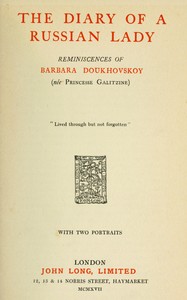
The diary presents itself as a sprawling memoir of Varvara Dukhovskaia, a Russian noblewoman whose recollections were first excerpted in a celebrated Russian periodical under the title “Fragments of the Diary of a Russian woman in Erzeroum.” The opening pages explain that the author’s education, keen observation, and literary study give her prose a light, clear style, while a contemporary poet’s endorsement frames the work as an “exceptional and original character” worthy of publication for charitable purposes. The book is organized into more than forty chapters that trace her life from early childhood in the estate of Dolgik, through multiple trips abroad, society appearances, and extensive travels across Europe, Asia, and the Americas, culminating in a chronicle of her husband’s gubernatorial duties in Siberia. The introductory chapter already immerses the reader in vivid childhood memories, her attachment to a wet‑nurse, mischievous episodes with tutors, and the opulent world of a princely family, setting the tone for a richly detailed personal history.
Written in a first‑person voice that blends the frankness of a child’s diary with the reflective poise of an adult memoir, the style is conversational yet peppered with the occasional French phrase, reflecting the author’s bilingual upbringing. The narrative captures the sensibilities of late‑nineteenth‑century Russian aristocracy, offering insights into social customs, travel experiences, and domestic life. Readers who enjoy immersive travel literature, cultural histories of the Russian Empire, or intimate portraits of a bygone elite will find this work rewarding, as it combines personal anecdote with a broader panorama of the era’s geography and society.