About this book
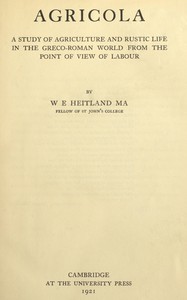
William Emerton Heitland’s Agricola is a scholarly survey of Greco‑Roman agriculture that frames its inquiry around the lived experience of farm labourers. The opening pages make clear that the author’s ambition is to fill a gap in classical studies: the scarcity of statistical data and the absence of a worker‑centred perspective. He thanks a circle of academic mentors, Buckland, Coulton, Glover, Housman, and outlines a meticulous structure that moves from early Greek evidence through Roman law, literature and imperial practice, ending with Byzantine sources. The introductory essay argues that, despite the fragmentary nature of the evidence, the agricultural sector was the backbone of ancient economies, and that its labour conditions, from slave toil to free coloni, merit the same scrutiny afforded to modern wage‑earners.
The work is written in the measured, citation‑heavy prose of early‑20th‑century British academia, with frequent references to classical authors, jurists and epigraphic material. Its tone is that of a careful historian rather than a narrative storyteller, appealing to readers who relish detailed source analysis and comparative economic history. Specialists in classical studies, economic historians, and anyone interested in the intersection of agriculture, law and social structure in antiquity will find Heitland’s methodical approach rewarding.