Public-domain ebook
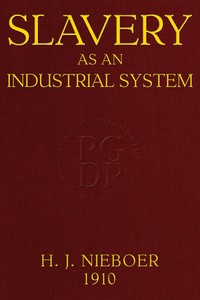
Slavery as an industrial system: Ethnological researches.
Language: en5,862 downloads on Project Gutenberg
Subjects
Public-domain ebook sourced from Project Gutenberg #74463.
Public-domain ebook
Language: en5,862 downloads on Project Gutenberg
Subjects
Public-domain ebook sourced from Project Gutenberg #74463.
The work is a scholarly ethnological treatise that treats slavery as an industrial system within “savage” societies. In the preface, H. J. Nieboer explains that the second edition retains the original plan while expanding the chapter on the geographical distribution of slavery, incorporating newer data and the critiques of noted scholars such as Tönnies, Vierkandt and Westermarck. The book proceeds methodically, beginning with a precise definition of slavery, distinguishing it from related phenomena such as the status of women, children, serfs and debtor‑slaves, then mapping its occurrence across a wide range of tribal groups, from North‑American peoples to African, Pacific and Asian societies. Each section follows a comparative, inductive approach, weighing “positive” and “negative” cases and linking the presence of slavery to economic factors, subsistence strategies, property, and the condition of women.
Written in early‑20th‑century academic prose, the volume reflects the rigorous, footnote‑laden style of its era, with frequent references to contemporary theorists and a strong emphasis on systematic classification. Readers interested in the history of anthropology, comparative sociology, or the evolution of labor relations in pre‑modern societies will find Nieboer’s exhaustive cataloguing and analytical depth rewarding, while those seeking a narrative history should look elsewhere.
Preparing this second edition, I saw that the general plan of the book could remain the same. The details, however, wanted improvement in many respects. The chapter treating of the geographical distribution of slavery among savage tribes has been much enlarged, as the information of which I disposed was far more complete now than when the book was originally written. The theoretical part, I hope, has also much improved. A closer study of the subject has led me to alter some passages and make several additions. …
Keep reading free · chapter 1 needs no account