The opening · free to read
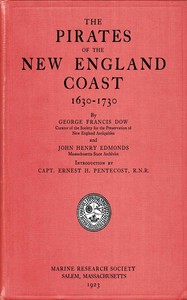
There is scarcely a sandy beach on New England’s long and deeply indented coastline that has not connected with it some traditionary tale of the landing of pirates or their buried treasure. Many of these half-forgotten tales may have had an origin in the operations of early smugglers or in the evasion of the British Navigation Acts, but it is undoubtedly true that pirates did frequent this coast, beginning with the early days of its settlement, and during their periodical appearances, robbed and destroyed shipping almost at will. In gathering material relating to this subject no attempt has been made to include the traditionary lore. The public records of the time supply an astonishing amount of detailed information, but the principal source for first-hand information on the operations of pirate vessels during the first twenty-five years of the eighteenth century, the period when piracy was most frequent and least controlled, is the “History of the Pirates” by Capt. Charles Johnson. It has been claimed that the author at one time sailed in a pirate ship and therefore wrote from a personal knowledge of many of the events described. It seems impossible that anyone could have obtained such a circumstantial narrative of illicit life on the open sea unless he had lived in intimate personal acquaintance with a number of those who took part in the stirring actions recounted. Some of his tales are so extraordinary that they seem improbable--impossible of belief. And yet, the portion of his history relating to the North Atlantic coast has been verified by original records and items of current news in the newspapers and found to be a truthful relation in all essential details. With so much corroborative evidence at hand it is only fair to concede the probability that other portions of his “History,” not verified at this time, are also based upon fact.
The account of piracy to be found in the following chapters is based upon original documents in the Massachusetts State Archives, in the records of the Vice-Admiralty Courts, the Courts of Assistants and the Quarterly Courts. Printed accounts of trials have supplied valuable information and many details that have greatly enriched the narrative have been gleaned from newspapers published at the time. Intermingled are personal anecdotes and details recorded by Captain Johnson, of captures, murders and injuries inflicted upon the officers and crews of plundered merchant vessels.
Many friends have aided in the preparation of this volume. Capt. Ernest H. Pentecost, R.N.R., of Topsfield, has freely placed at our disposal his collection of voyages and books on piracy and related subjects. He also has critically examined the manuscript and given it the benefit of his technical knowledge of things nautical. Mr. John W. Farwell of Boston has generously permitted the reproduction of portions of several rare maps in his fine collection of early charts and maps. Mr. Julius H. Tuttle, Librarian of the Massachusetts Historical Society, and Mr. George Parker Winship, Librarian of the Harry Elkins Widener Collection, Harvard College Library, have kindly allowed the reproduction of early engravings and title pages of rare books. Cordial thanks also are due to Mr. Howard M. Chapin, Librarian of the George L. Shepley Library, Providence; Mr. Charles H. Taylor, Mr. William W. Cordingley, the Bostonian Society and the Society for the Preservation of New England Antiquities, all of Boston; the Peabody Museum of Salem; and to all others who in any way have furthered the production of this volume.
The book keeps going
Keep reading, and see it illustrated
Reading is free forever. Sign up and watch scenes appear while you read.
Scenes Storieta drew for other classics.