Public-domain ebook
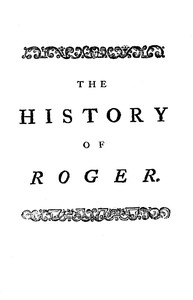
Honesty the best policy: or, The history of Roger
by Anonymous
Language: en359 downloads on Project Gutenberg
Subjects
In: Humour·Novels·British Literature
Public-domain ebook sourced from Project Gutenberg #76013.
Public-domain ebook
by Anonymous
Language: en359 downloads on Project Gutenberg
Subjects
In: Humour·Novels·British Literature
Public-domain ebook sourced from Project Gutenberg #76013.
The opening · free to read
ROGER.
Roger was born of honest parents in Yorkshire, and very well to pass, who gave him a good education; and tho’ he had no liking to any of the professions, yet was not without his share of the greek and latin; from which he got this advantage, that he could spell better than most farmers in the parish, and knew the signification of words, as well as if he had been bred at Cambridge, and turn’d out master of arts. He seemed to have no design of pushing his fortune in the wide world; but sat down early on his own farm, followed husbandry, and improving a headland or two he had near him, which were quite run out of heart by the slovenly management of his ancestors, who had, most of them, too much wit to mind their business, and let things run to wreck strangely.
ROGER looked into every thing himself, ditched, fenced, and limed, but never burn’d his land, and soon grew a topping farmer.
There was a cousin of his, who had a power of special farms in the West-riding, great royalties, and stately woods. Roger prevailed on him to put the management of them into his hands; and he not only preserved and enlarged them, but made the family interest better than ever it was. This got Roger great credit in his own parish, and all the manor about him; they began to find out he was a prudent, managing man; and resorted to him for advice at vestries, leets, and quarter-sessions. Whoever he recommended for overseers, waywardens, headboroughs, or the like, were sure to be chosen, and always behaved honestly.
In the mean time, he followed his farming, and kept a warm house in the old-fashion’d way; and seldom stirred abroad, unless to make up differences among neighbours, or to meet the hundred for applotting the land-tax; and by his good will would never have gone farther, or meddled out of the parish and manor, if the neighbours had let him sit still. But it happened, at this time, that Slyboots, the Secretary, got a commission to be Lord-lieutenant of the county; and besides arraying the militia, came with a power (as all the county believed) to get new taxes laid on at the sessions, and double the county charges. The neighbours, one and all, entreated Roger to go to the county town, and oppose those new rates. Tho’ he thought there was no such design, yet he chearfully went, and very plainly told the governor his mind in private, and warned him of trying what he could never compass. Now, whether it was that Slyboots had no projects in his head of that kind, or found he could not bring them to bear, certain it is he did no hurt to the county, and has ever since appeared to be an honest man. But what alarmed them was his character for sense, and cunning, and politicks. And, to be sure, they were not out in their notion of him; for he could bambouzle Old-nick himself, if he sat about it, and make him do journey-work; much more could he outwit the poor country folks, which makes me believe he never set about it in earnest. It is impossible else he could have missed it; for he could out-drink, out-talk, out-joke every man in the province, and could make a fool, at any time, of the best Norfolk Attorney, if he would let him parly with him. Besides, he was, at all times, so good-humoured and free, and pushed his bottle so joviously among his acquaintance, that it was beyond the power of honest men to resist or refuse him any thing. The whole secret of his behaviour in Yorkshire was, that old Suck-fist, who governed every thing at court, wanted a pretence to ruin him, as he found Slyboots too hard for him, and too smoaky to be bantered. Now, says Suck-fist to himself, if he does things beyond his commission, the county will complain of him, and I’ll back them; if he be negligent in doing his business, I’ll get him turn’d off. But Slyboots cunningly put the business on a couple of mooncalves, Balaam the Parson, and Numps the Seneschal, who he knew could do nothing, and then laid the blame on them; and, in his merry moods, would compare himself to a famous rope-dancer, then in town, who walked the slack-rope with two lubberly porters tyed to her heels.
But, whatever were Slyboots’s intentions, he could make no hand of Roger, who drank with him, laughed with him, shook hands and parted for the country, where he took to his old way of living, and said nothing of the matter; for tho’ Roger has often prevented things being done that would bear hard on the farmers, yet he never vapoured, or bounced, or took on him, which was so much the worse for him; for the less he said of himself, the more others talked, and agreed, one and all, that he was the only man to serve them on occasion, as well in the county at large, as in the parish.
It happened the headborough, who had been chosen many years successively to that place, died, and every body’s eyes were on Roger to succeed him. The east and west-ridings would hear of nobody else, ’till Roger honestly told them, there was a farmer in the north-riding who could serve them better than he, at that time, and would do all he could to have him into the place; and he was chosen without opposition, but in a little time died too. Then Roger had no excuse, and took the office briskly upon himself, tho’ his improvements at the farm must stop, and he knew he should have but little pocket-money out of the place, after buying new cloaths, and treating the constables every quarter-session.
SLYBOOTS was now gone out of the county, and the next who came into the commission had a different character, and told them positively, at the meeting of the session, he wanted nothing, and only desired they would take care of themselves. No body ever doubted his word; but, however, Roger thought there was no hurt in keeping a good luck out, and well he did so; for some people had taken in their heads, that the county was harrassed by quarter-sessions, and it would be a great easement to have no more, but agree then what rates should be paid every year, and let the people stay at home, and mind their plowing and sowing. This contrivance was ingenious enough, and many of the justices were for it; but the de—l a bitt could they answer some objections. Suppose, says one, the County Treasurer should squander the money, who will call him to account? If the constables don’t do their duty, who will fine them? If the army moroded, built sconces, kicked the neighbours, ruined the game, where should they be tyed? To all which questions, and a thousand more, there was but this answer: That the county governors would always be honest men; that the county treasurer would scorn to pocket their money; the constables should be the best sort of people in the world; and the soldiers as quiet as so many lambs. Almost half the justices closed with these reasons; but Roger and his friends thought it possible, that once in an age there might be a crook-finger’d treasurer, a knavish constable, or a swaggering captain, and of the two, were rather of opinion the experiment ought not to be made, and so outvoted the justices who were for it. No body charged the governor with having a hand in this, or tampering with the justices, tho’ it was thought he could not have misliked it, as it would have saved him a world of trouble. The same people, a little while after, observed how unwholesome the fashion was of wearing woollen cloaths, that linen coats were much better, and would come cheaper, as that manufacture was in plenty all over the north; and wanted a rule to be made, that the exciseman should cutt the skirts off every coat made of wool, and the boys have liberty to squirt the kennel on them, as they do now on callicoes and cambricks; but Roger seldom changed the fashion of his cloaths, and told the projectors it would certainly throw the whole county into agues, and bring such fits on them as all the powder in Mexico could never cure: So that project was never mentioned more; and, from that time, Roger had so gained the good opinion of the justices, that for some years, all whims and projects seemed to be at an end, as they found he would never give into them. But all the while _Roger_’s credit with the justices was looked on with an evil eye, by many of the top men in the county, as well as neighbours in his own parish, who were trying under-hand to lessen it; but the first who set up openly against him was Nim, the corporal. He was a cunning shaver, and a notable Jack at all trades. He was first a foot Soldier, and a good duty-man, only he would play cards too often on guard. He was always at putt and all fours, got most of his Comrade’s pay, and, in the end, stripped all his acquaintance. He was on the point of getting a halbert when he quitted the army. He married a rich widow; then another rich widow. He got by selling, got by buying, and every way money flowed in a-pace. He had lately bought a fine farm from _Roger_’s cousin, and almost bounded him. With this encrease of interest, he thought himself big enough to attack Roger in his head quarters. Besides, he had concerns in other counties, monies in bank, and was twice the better man, as we say. He was moreover one of the quorum. He had a son, who was sent to see the world early, and learn fashions, and a clever person of a man he was, and a beau among the play-houses and dancing-schools. Nim laid a design to aggrandize his family, by marrying him to a daughter of the new deputy, who was quite a different kind of man either than Slyboots, or the last deputy; he seemed to desire nothing but peace and plenty, and was as plain and downright as any ordinary Gaffer; his friends would fain have him take state upon him, but he could not away with it. Nim brushed up to him, told him how many farms he had; how many tenants; what an interest he had among the justices; that if he would let him manage his affairs he might walk the fields from morning to night, and not trouble himself with business. He liked the proposal, (for he hated gaffing and disputing) and closed _Nim_’s request to marry his daughter to his son and heir. Nim was now sure he had the game in his hand, and resolved to take the first opportunity to have a tryal of skill with Roger. It happened one of the _Verdurer_’s died in the East-riding, and another must be chosen to keep the king’s game. Tho’ _Roger_’s interest was less in that Riding than in the two other, yet he would not let his bone go without a snap or two. Nim told the deputy there should be no struggle, that not one of the pack would venture to shew his teeth against him, that he would carry it off with a Tally-hoh. Roger laugh’d in his sleeve, and knew he had the better interest, (tho’ he did not chuse to talk in dog-language) and very quietly put his own man in the _verdurer_’s place. This was a deadly blow to Nim; he saw the substantial farmers were for Roger. If he could’n’t carry his point in his own royalty and Riding, what must he do in other parts? So he resolved to join with Roger ’till a better time offered, and indeed was quite desperate when he came to terms. It was not long ’till an accident fell out that revived his hopes; it happened, critically, that the parson of the minster died by a surfeit of pork; it was a main good parish, with a swinging glebe; he had prebends, and petty canons in his disposal, could rule the vestry, recommend overseers, and govern quite down to curates, clerks and sextons; which, with his power of benediction, made him altogether one of the top men in the county. Nim resolved to avail himself of this opportunity, and recommend one to the deputy, to come in the place of old Trulliber, who should join him against Roger.
The book keeps going
Reading is free forever. Sign up and watch scenes appear while you read.



Scenes Storieta drew for other classics.
New illustrated classics
Once or twice a month: the latest books to get full character casts, scene art, and free comic editions. No account needed.