Public-domain ebook
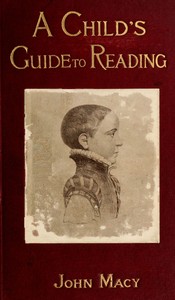
A child's guide to reading
Language: en1,306 downloads on Project Gutenberg
Subjects
In: How To ...·Teaching & Education
Public-domain ebook sourced from Project Gutenberg #76079.
Public-domain ebook
Language: en1,306 downloads on Project Gutenberg
Subjects
In: How To ...·Teaching & Education
Public-domain ebook sourced from Project Gutenberg #76079.
This work is a practical handbook that treats reading as a skill to be cultivated rather than a list of juvenile titles. From the outset the author, John Albert Macy, makes clear that the guide is aimed at young readers who will eventually tackle the great writers, Browning, Carlyle, Tolstoy, Plato, Æschylus, by first climbing “easy upward slopes” of lesser works. The opening pages set up a metaphor of a literary guide, likening the role of a seasoned reader to a Maine woodsman who points out good fishing spots and sturdy trees while insisting that the traveler must do his own work. The book proceeds through a systematic series of chapters on fiction, poetry, history, biography, essays, foreign classics, and even science and philosophy, each accompanied by extensive lists of recommended titles. Its purpose is to encourage independent judgment, to avoid rigid “must‑read” mandates, and to help the reader develop the habits of discernment that will serve a lifelong love of literature.
Macy’s voice is conversational yet scholarly, echoing the late‑19th‑century essayist who blends moral instruction with witty observation. The prose is dense with references to contemporary critics such as Frederic Harrison, Schopenhauer, Emerson, and Thoreau, giving the text a distinctly Victorian‑American flavor. Readers who enjoy thoughtful, almost mentor‑like discussions of how to approach the canon, particularly those interested in the history of reading, the philosophy of education, or the formation of personal libraries, will find this guide rewarding. It appeals to mature adolescents, college students, and adults seeking a structured yet flexible roadmap through the world’s literary treasures.
The opening · free to read
This is a Child’s Guide to Literature and not a Guide to Juvenile Books. The larger part of the books discussed in the various chapters and included in the supplementary lists were written for adult readers, and nearly all of them are at least as interesting to the reader of forty as to the reader of fourteen. The great writers are the goal and the child is the traveler. That is why in a Child’s Guide appear the names of Browning, Carlyle, Tolstoi, Meredith, Gibbon, Darwin, Plato, Æschylus. A normal child will not be reading those masters, certainly not all of them, but he will be reading toward them; and between the greatest names will be found lesser writers who make easy upward slopes for young feet that are climbing to the highest. In the supplementary lists will be found very little of what is admittedly ephemeral, and still less of that kind of “Juvenile” which has not sufficient literary quality to outlast the most childish interests and tastes. On the other hand, if we have any feeling for the abundant human nature of children, we cannot invite them to fly, nor pretend that we have ourselves flown, to the severe heights of Frederic Harrison’s position when he advises that we read only authors of the first rank in every subject and every nation. That ideal, which, to be sure, in his excellent essay on the “Choice of Books” is tempered by his humanity and good sense, is at too chilly an altitude for a Child’s Guide, or, I should think, for any other guide written with appreciation of what kind of advice ordinary humanity can or will benefit by.
In the advice offered by some very wise men to young and old readers there is much that is amusingly paradoxical. Schopenhauer, like Frederic Harrison, enjoins us to devote our reading time exclusively to the works of those great minds of all times and countries which overtop the rest of humanity. Yet Schopenhauer is giving that advice in a book which he certainly hopes will find readers and which, however great we may consider him, his modesty would not allow him to rank among the works of the greatest minds of all ages. Emerson counsels us to read no book that is not at least a year old. But he is himself writing a book of which he and his publishers undoubtedly hope to sell a few copies before a year has passed. Thoreau tells us that our little village is not doing very much for culture, and then he frightens us away from our poets by one of those “big” ideas with which he and the other preachers of his generation liked to make us children ashamed of ourselves. “The works of the great poets,” he says, “have never yet been read by mankind, for only great poets can read them.” Well, Thoreau, whatever else he was, was not a great poet, and yet he seems to have read the great ones and to have understood them while he was still a young man. It is nearer the truth to say that anybody can read the great poets. That is the lesson, if there is one, which this Guide seeks to inculcate.
There should be a chapter in this book about the Bible and religious writings. But practical considerations debarred it. The American parent, though quite willing to intrust to others many matters relating to the welfare of his children, usually prefers to give his own counsels as to the spirit in which the Bible should be read and what other religious works should be read with it.
The book keeps going
Reading is free forever. Sign up and watch scenes appear while you read.



Scenes Storieta drew for other classics.
New illustrated classics
Once or twice a month: the latest books to get full character casts, scene art, and free comic editions. No account needed.