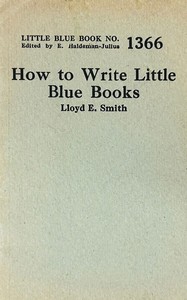
Telling would-be contributors to the five-cent pocket series How to Write Little Blue Books, is, by rights, the editor’s--E. Haldeman-Julius’s--job. For he is the man who ultimately accepts the manuscript, if it is acceptable, and he signs the check which each author awaits with eager anticipation. But he says that going into the details of how manuscripts should be written for this ever growing series does not appeal to him. So far he has preferred to find and buy the product of those writers who are able, without more than a preliminary word or two, to turn out exactly what he wants. So he has delegated me to do the job for him, and he has charged me to be explicit, exhaustive, and extremely understandable.
For editorial problems of the Little Blue Books are peculiar. There is no other series to be compared with The Little Blue Books. Certainly not in the English language, and similar series in foreign languages are not quite the same, and are, of course, not of interest to writers in English. E. Haldeman-Julius has told the complete story of ten years of publishing the Little Blue Books, from editing some two thousand manuscripts to the complete list of more than fourteen hundred titles in print as I write, in his book, The First Hundred Million.[1] The 100,000,000 refers to the total number of Little Blue Books printed and sold at the time the book was written. I urge every would-be Little Blue Book writer to get a copy of this book, if possible, and read it from cover to cover. Entirely aside from its technical interest, the book is thoroughly readable as a unique contribution to the psychology of the American reading public.
[1] The First Hundred Million, by E. Haldeman-Julius, cloth bound, $3 postpaid, Haldeman-Julius Co., Girard, Kansas.
As for my own qualifications to tell how Little Blue Books must be written, to be acceptable for publication in this world famous series, they are two. For more than three years I have been the Assistant Editor of the Haldeman-Julius Publications, and I have encountered at first hand the editorial and publishing problems peculiar to them. I have corresponded with many Little Blue Book writers; I have whipped many a manuscript into shape for the typesetters; I have scheduled thousands of Little Blue Books, in hundreds of large editions, for publication. My second qualification is that I am a Little Blue Book writer myself, and have been for some six years. Up to the moment of writing, more Little Blue Books bear my name (laying aside my cloak of modesty for the moment) than any other single contributor’s name, not excepting Joseph McCabe, who is a far more redoubtable writer than I, having to his credit the colossal enterprise of The Key to Culture,[2] in forty 30,000-word volumes, in addition to his fifty-five or so Little Blue Books. Ergo, I ought to know something about the subject.
[2] The Key to Culture, by Joseph McCabe, an outline of all knowledge, 40 5½ × 8½ volumes, bound in stiff card covers, 64 pages each, $7.50 postpaid, Haldeman-Julius Co., Girard, Kansas.
Justification for the present Little Blue Book will appear, if at all, in the sales record of this particular number a year or two from now. Judging from the inquiries that pour into Girard on every mail, it should not be hard to dispose of an edition of 10,000 copies every year. Not that all the buyers of the book will become Little Blue Book contributors--for many will want to read this book out of a natural curiosity; others will find that the work of writing for the series is not suited to their capabilities; others will simply be unable to meet the high standard required--but the interest in the subject is, I am sure, large enough to make the book worth writing.
Certainly it is a clear sign of the unique character of the Little Blue Book series that it becomes advisable to include within the series, as a unit of the whole, a book telling how more books should be written! What other publisher has ever added to his list a book telling, in substance, How to Write Books For Me?
But there is another reason for writing this book. As the Little Blue Books have progressed, undergoing many changes in editorial policy, widening their scope with the growth of their audience, problems have arisen which merit different treatment from problems which have confronted other editors and other publishers. As a series, the Little Blue Books have reached the point where definite rules must be laid down and strictly adhered to in the preparation of further titles for publication. Particular avenues of expansion are opening up, for which special writers must be found, or for which present writers may perhaps qualify if they are informed of the need. Hundreds of people would like to write at least one Little Blue Book, dealing perhaps with a subject very familiar to them; but it is impossible to tell each writer individually how to go about it. Many such contributors may not be professional writers, but because of their familiarity with a subject they may be able, if properly instructed, to deliver a satisfactory manuscript.
Even those writers who have already one or more published Little Blue Books to their credit may learn something from what the Assistant Editor has to say. The less editing we have to do in Girard, the better. It would be ideal if Little Blue Book writers could grasp the mechanical requirements of a Little Blue Book, and see it, to some extent, from an editorial viewpoint. They should understand something of the typography. They should familiarize themselves with the established style (spelling, punctuation, and the like) and follow it in their manuscript. Points such as these I will mention in due course.
Some General Principles
A prospective Little Blue Book title undergoes a severe scrutiny, and a careful, critical consideration of its possible popularity. The initial investment necessary to add a new title to the list is not justified until the first edition is sold out, and this first edition must be sold within a year of first publication. Such a requirement is beyond a doubt not always easy to meet.
Writers should understand one or two things very clearly when contemplating offering manuscript to the Little Blue Books. It is not the aim or function of the Little Blue Book series to promulgate original ideas. If you have written an essay on your own philosophy of life, it is not a suitable manuscript for the Little Blue Books--unless you are as famous as Thomas A. Edison or Luther Burbank, and perhaps not even then. Theses which deal exhaustively with the epithets of Percy Bysshe Shelley, or a critical analysis of the odd conjunctival constructions to be found in Emerson (if there are any!), or any similar work of scholarly scope but limited popular appeal, are strictly taboo. Such a work merits publication--if it deserves perpetuation in print--by publishers who can give the book suitable blurbs and feature it in their lists for a few months, and then, if necessary, forget it.
A Little Blue Book, when added to the list, is added in the hope that it will remain there for the life of the series. Mistakes are made, and titles are from time to time dropped. But these mistakes are fewer than they used to be, and every effort is made to avoid making such mistakes.
Don’t, therefore, dig out a pet manuscript that has been yellowing among your papers for years, in the hope that it will make a Little Blue Book! Don’t rush through your life story, or reminiscences of your childhood, or your solution of the social chaos, or your key to the universe, in any hastily conceived hope that E. Haldeman-Julius will grab it for a Little Blue Book--because he won’t do any such thing.
It is not the purpose of the Little Blue Books to provide a cheap means of giving the work of obscure authors to a supposedly breathlessly awaiting public. Little Blue Books are never published at the author’s expense, so please don’t take the trouble to suggest it. If it is unlikely that a title will sell sufficient copies to make it worth while to keep it in print, the title will not be added to the list at all. This is final. No amount of argument or financial persuasion can change this policy.
Nor is it possible for the Haldeman-Julius Company to set up and print booklets in Little Blue Book form for any individual. This comes under the general head of job printing, and the Haldeman-Julius Company does no job printing of any kind. It is impossible, due to the fact that all the available machinery is constantly running to keep pace with the world-wide demand for Little Blue Books and other Haldeman-Julius publications.
To come back to the general principles governing the selection and approval of future Little Blue Books, this series continually endeavors to live up to its other more high-sounding name: The University in Print. The present tendency of editorial selection is toward more books of self-education and self-improvement. Too many books on one subject are not wanted. Subjects that are not at present represented are likely to be in demand--more about this, and how to find out about it, anon. Treatment of specialized aspects of any subject is usually not desired.
Keep, so far as possible, to subjects of wide appeal. Anyone who has read The First Hundred Million, by E. Haldeman-Julius, will have a fairly clear idea of what this means. Further reprints, no matter how well edited, of the classics are not desired at present. Anthologies of poetry are not wanted, even though the poet is not already represented in the series; original poetry is out of the question! Original fiction is not desired, nor are collections of stories already published wanted--except in a few instances, perhaps, when the work of a Fannie Hurst or a Wilbur Daniel Steele may be added to round out the section devoted to present-day well-known writers.
Literary criticism is at present in disfavor in the editorial sanctum of the Little Blue Books. Critical surveys or literary outlines of any kind are hardly likely to meet with approval. There are several titles of this nature already in print, and they are apparently adequate to the present demands of the reading public.
History is a classification that is rather sparse in the Little Blue Book series. The right approach to the various phases of history has perhaps not yet been hit upon. However, it is safe to say that histories of various countries are not desired just now--the histories of Mexico and Japan already in the list are not doing so well as was hoped. The histories of the American Revolution, the American Civil War, and the World War, are doing better than any of the other historical titles. But with an Outline of United States History and Lives of United States Presidents already in the list, United States history is pretty well taken care of for the present.
Biography is well represented. Except for a few outstanding names here and there--a biography of Charles Lindbergh has just been added--further biographical titles are not desired. Of course, these negative suggestions that I am setting down here may change at any time, but it will be helpful, I think, for future Little Blue Book writers to have some notion of what is not wanted immediately. They will do much better to direct their efforts along the lines of expansion that are at present strong. Obviously, much more chance of acceptance lies in these desired directions. (For particulars of how to find out whether a title is likely to be acceptable, see the section following.)