Public-domain ebook
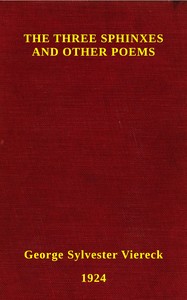
The three sphinxes, and other poems
Language: en287 downloads on Project Gutenberg
Subjects
In: Poetry·American Literature
Public-domain ebook sourced from Project Gutenberg #76846.
Public-domain ebook
Language: en287 downloads on Project Gutenberg
Subjects
In: Poetry·American Literature
Public-domain ebook sourced from Project Gutenberg #76846.
The opening · free to read
This volume, like its predecessor, “The Haunted House, and Other Poems,” No. 578, contains selections from “Nineveh and Other Poems,” “The Candle and the Flame,” “Songs of Armageddon,” in addition to a number of poems not previously published in book form. The second volume embraces a number of lyric ballads, being on the whole less intensely personal, if no less intensely passionate than volume one.
However, such differences are superficial. Wherever we touch a book, we touch a man. If we but search an author, we always discover a master key! Every manifestation of the Life Force is a confession. It is impossible to write a treatise on radio without revealing one’s self. The libido, however disguised, will always assert itself.
It was my original intention to divide my poetry into certain well defined psychological groups. There are clusters of thought and emotions, “complexes,” to use the vocabulary of psycho-analysis, which seem to occur again and again in my verse. Eros and Jesus, Lilith and Eve, constitute my chief lyric “complexes.”
Almost every poem owes its inspiration to one of these four fundamental types. However, no symbol is entirely adequate. At every step the complexes grow more complex. Frequently one merges into the other.
“The Three Sphinxes” visualizes the conflict between Jesus and Eros, between heavenly and earthly love; between Lilith and Eve, love, sweetly human, and “woman wailing for her demon lover.” The antagonism between Eros and Jesus appears in “Spring”: an attempt to synthesize the two conceptions enlivens the finale of “Jesus in New England.”
In “Children of Lilith,” we catch a glimpse of Lilith in the countenance of Eros. Both Lilith and Eve appear in “A Vision of Woman,” but no attempt is made to reconcile the irreconcilable. The Eve-Lilith conflict is the struggle between Helen of Troy and the blonde Marguerite. The desire to achieve a new synthesis of woman, dissolving the Eve-Lilith conflict, lends significance to “Dr. Faust’s Descent from Heaven.”
It would be necessary to play with divers combinations and permutations in order to make the grouping psychologically correct. This task is too pedantic for me. I leave it to the psycho-analysts and to the ingenuity of the reader. Perhaps I may change my mind some day when I publish my collected poems or my autobiography. Most of my books of verse are out of print. The two little volumes in the Pocket Series are the only form in which my verse is, at present, accessible.
GEORGE SYLVESTER VIERECK.
New York, June, 1924.
No puppet master pulls the strings on high, Portioning our parts, the tinsel and the paint: A twisted nerve, a ganglion gone awry, Predestinates the sinner and the saint.
Each, held more firmly than by hempen band, Slave of his entrails, struts across the scene: The malnutrition of some obscure gland Makes him a Ripper or the Nazarene.
I am aweary of these pleasant things, The gallant dalliance and the well-watched fire: Give me the magic of a thousand springs That shook the blood of young Assyrian kings, That stirs the young monk in his cell, and stings Crimson and hot! Wearing the crown of unassuaged desire, Break me or bless me--only love me not!
Come as a wanton red with rouge and wine And I shall weave out of my song for thee A purpler cloak than his Who, hating, loved that Lesbia. Come to me A saint--the halo shall be thine Of Beatrice.
There is no joy in tender loves or wise, No sweet in wrong: Come unto me with cruel, loveless eyes, O iron passion of the lords of song!
Before the image older than the world, Or ill or good, By Titan hand into the desert hurled, In the Egyptian sunset musing stood-- Long having travelled by fantastic roads Where in deep sands the tremulous footstep sinks-- The oldest and the youngest of the gods, Saying: “Upon my life has fallen thy shadow, O Sphinx!”
Replied the Sphinx: “O son of Aphrodite, Shall wisdom teach thee how the soul is won, Or the hot sands be balsam on thy lids? Behold approach from Thebes and Babylon, Huge birds grotesque against the falling gloom, My far-come younger sisters.” And a mighty Thunder of pinions shook the pyramids, And made the mummies mumble in their tomb.
The three stern sisters of the mystery Enduring and miraculously wrought In granite and in porphyry, Then, holding concourse in the desert, spake With the great sound of billows on the sea That rumble as they break: “Thou, Eros, art the eternal riddle, we Are but in stone the semblance of thy thought.”
Limbed like the panther, featured like a man, The wisest of the Sphinxes thus began, That still had waited where the river steams And winds the caravan: “In my brain’s cavern seven cubits span Dwell visions splendorous Of the great lords of song and thought and might, Who in the large eyes of Antinous Behold the Deeper Light, Upon my lashes gleams Still Shakespeare’s rhythmic tear; Here Plato musing dreamed his dreams Of spirit-passion; David here In the long night-watch sang of Jonathan.”
Then rose the wingèd Theban, figure dual Of maid and lion strangely wed; “I am the blood that tingles, and the jewel Of all the world’s desire adorns my head-- The lithe-limbed youths that fell for Helen’s sake Have died for me, The lads that wake To ripeness curse me as they ache Beneath my tyranny. My mandates sweet and cruel Nor prayer nor penance shall revoke: I am the flame, men’s bodies are the fuel, Men’s souls the smoke.”
The pinioned Sphinx of Babylon, Human in naught, Lord Eros thus addressed: “Wherever men have spat thy face upon Or sought strange pleasure in unholy quest, My breath had made them mad. I am the dream that Nero’s mother had Ere burned his natal star. I am the ghastly vision of de Sade: Astarte and Priapus wage War for my beauty monstrous, barren, bare; The Cretan knew me and from far My image fell upon the crimson page Of Swinburne and of Baudelaire.” The silence shivered as in tearless woe When they had done, the Foam-begotten broke Across his knee the sceptre and the bow: “The empyrean is beyond your reach, Your substance earth of earth, And even she that called on Plato’s name Bears soilure of a mortal birth. The triple mirror are you of my shame Half-beast are two, one wholly beast, in each Is something bestial, and your wings’ winds choke Within my heart the unadulterate flame.”
But the three Sphinxes mighty murmuring Thus answer made: “O Love, Turn thou thy wrath above, Where round God’s throne the cosmic sunsets fling The light that shall not fade. Beneath his feet the countless æons roll, His slow relentless purpose knows the goal Of things, and joining flesh and spirit made A beast the mansion of the soul.”
And lo, the spring’s breath faded from Love’s charm, The sunshine from his hair, And in his arm The arrows turned to rods. He heeded not the silent years that crawl Like uncouth spiders. Weary, cynical, Self-conscious, disenchanted stood he there, The oldest and the saddest of the gods.
From the cloistered halls of knowledge where fantastic lights are shed By a thousand twisted mirrors, and the dead entomb their dead, Let us walk into the city where men’s wounds are raw and red. Three gifts only Life, the strumpet, holds for coward and for brave, Only three, no more--the belly and the phallus and the grave!
When the slow disease of time writes on our face its horrid scrawl, These be good gifts, these be real, let what will the rest befall, Both the first gift and the second--but the last is best of all. Faith and hope and friends desert us ere the cerecloth’s folds are drawn; These remain while life remains and one remains when all are gone.
Who am I to judge the pander? Who are you to damn the thief? We are all but storm-tossed sailors stranded on the self-same reef. Strip us of our fine-cut garments, smite us with some primal grief, Then behold us writhing naked, chain-bound to our carcass, slave To the belly and the phallus and (more kind than God) the grave.
Why desire the stars in heaven, why ask more when we have these? Beast and bird shall be our comrades, we as they may live in ease. Not for us God’s angel choir and His cosmic silences! Lay not that we, too, are gods, since no god is strong to save From the hunger of the belly and the phallus and the grave.
Saints and sinners all are brothers, none is happy while a trace Of divine and half-forgotten distant music makes the race Dream of freedom in the trap that holds the good man and the base. Like the worm that eats our substance, longing eats our hearts: we crave For a life beyond the belly and the phallus and the grave.
Let us nurse no vain delusion! Feast on love and wine and meat, While girls’ breasts blush into rosebuds and the touch of flesh is sweet, For the earth, our buxom mother, loves the sound of dancing feet! Though God cursed us with a glimmer of His consciousness He gave Still the belly and the phallus and life’s final thrill--the grave!
And who knows but the Almighty in His heart may envy us? If a little draught of knowledge makes man’s life so dolorous, Then the crown of His omniscience is a crown of thorns, and thus Time that ends not broods on heaven, a gigantic incubus. We at least, through evolution climbing upward from the cave, Have the belly and the phallus and God’s kindest gift, the grave.
Within the graveyard of Montmartre Where wreath on wreath is piled, Where Paris huddles to her breast Her genius like a child, The ghost of Heinrich Heine met The ghost of Oscar Wilde.
The wind was howling desolate, The moon’s dead face shone bright; The ghost of Heinrich Heine hailed The sad wraith with delight: “Is it the slow worm’s slimy touch That makes you walk the night?
“Or rankles still the bitter jibe Of fool and Pharisee, When angels wept that England’s law Had nailed you to the Tree, When from her brow she tore the rose Of golden minstrelsy?”
Then spake the ghost of Oscar Wilde While shrill the night hawk cried: “Sweet singer of the race that bare Him of the Wounded Side, (I loved them not on earth, but men Change somehow, having died).
“In Pere La Chaise my head is laid, My coffin-bed is cool, The mound above my grave defies The scorn of knave and fool, But may God’s mercy save me from The Psychopathic School!
“Tight though I draw my cerecloth, still I hear the din thereof When with sharp knife and argument They pierce my soul above, Because I drew from Shakespeare’s heart The secret of his love....
“Cite not Krafft-Ebing, nor his host Of lepers in my aid, I was sufficient as God’s flowers And everything He made; Yea, with the harvest of my song I face Him unafraid.
“The fruit of Life and Death is His; He shapes both core and rind....” Cracked seemed and thin the golden voice, (The worm to none is kind), While through the graveyard of Montmartre Despairing howled the wind.
O bird grotesque and garrulous, In green and scarlet liveried, Thy ceaseless prattle hides from us The secret of thy dream indeed. But in thine eyeball’s mystic bead Are mirrored clear to them that read Vague, nameless longings, like the breed Of some exotic incubus.
The book keeps going
Reading is free forever. Sign up and watch scenes appear while you read.



Scenes Storieta drew for other classics.
New illustrated classics
Once or twice a month: the latest books to get full character casts, scene art, and free comic editions. No account needed.