Public-domain ebook
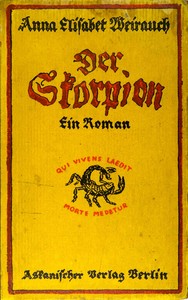
The scorpion
Language: en3,243 downloads on Project Gutenberg
Subjects
Public-domain ebook sourced from Project Gutenberg #77582.
Public-domain ebook
Language: en3,243 downloads on Project Gutenberg
Subjects
Public-domain ebook sourced from Project Gutenberg #77582.
The work is a psychological melodrama that follows the turbulent childhood of Myra Rudloff, a girl whose early life is marked by deceit, theft, and a succession of abusive relationships. The opening passages trace her pattern of lying and stealing, the loss of both parents, and her placement with an uncle who tolerates her criminal habits. Within the same breath the narrative introduces a “young lady”, a governess whose tender affection for Myra becomes entangled with a former hussar, von Hanston, and a series of volatile emotions that oscillate between love, jealousy, and violence. The prose details Myra’s obsessive need to dominate the adult world around her, from pilfering silverware to confronting the men who dominate her caretaker’s life, establishing a bleak portrait of a child caught in a cycle of manipulation and yearning.
Written in a dense, nineteenth‑century style, the novel’s language is ornate and heavily descriptive, reflecting the period’s penchant for elaborate psychological exposition. Its focus on a same‑sex affection between Myra and her governess, coupled with themes of familial oppression and moral ambiguity, will appeal to readers who enjoy intense character studies, gothic atmospheres, and early explorations of lesbian desire. Those who appreciate intricate, emotionally charged narratives rather than fast‑paced plots will find this text compelling.
The opening · free to read
According to her tale, Myra had even as a child exhibited a peculiar propensity to lying and stealing. In school she was considered stupid and lazy. As a young girl, she had run around with a remarkable woman, a fashionably dressed sharper, with a decidedly masculine manner. Misled, perhaps, by this friend, she had stolen her father’s silver service and pawned it. After a fit of downright insanity during which she tried to strangle her aunt, who had been the motherless child’s faithful guardian, she was dispatched to her Uncle George in a small town. There she stole everything not nailed down, very skillfully forced her uncle’s desk and, appropriating a large sum of money, fled.
Her father, a mental man of a most sensitive nature, did not long survive this news: he died of a stroke.
Myra’s mother had died in giving her life. “Luckily,” as Uncle George was wont to say bitterly.
But Myra did not share his opinion. She had a fantastic notion of what a mother is, and believed that her own mother’s premature death was the cause of all the misfortunes in her life.
For my part, I cannot say which view is correct. Certain it is, that Myra’s childhood would not have been as dismal and joyless as under Aunt Emily’s bony fingers; at the same time, even the gentlest of mothers’ hands could not have saved her from the bitterest struggles of her life. And when I recall the latter, I understand Uncle George’s “luckily” quite well. Doubtless he had a clearer picture of his sister than Myra could possibly have had.
Little Myra was not to go to school; her father, Franz Rudloff himself ordered it so. He had an almost morbid fear of anything that suggested “the common people.” It seemed to him as if his cool, high-ceilinged home would be contaminated with the exhalations of poorly ventilated class-rooms, as if his quiet walls would re-echo to hundreds of shrill voices, to hundreds of trampling feet, were he to send his daughter to school.
So a governess came to the house.
Aunt Emily was in secret opposition from the first. She had gone to school, and school had not harmed her in any way. Quite the contrary.
She was absolutely opposed to the idea that anybody in this world should have anything better than she had or had had. One of the few pleasures she permitted herself in life was that of “impartial justice,” as she called it. That is to say, if anyone is getting along undeservedly well, he must be made to suffer for his unmerited good fortune by some heavy blow of fate.
Other people have another name for this type of pleasure.
Aunt Emily was “against” the teacher. But Aunt Emily was much too much of a model to object when the master of the house expressed a desire. She knew that in such cases she must submit in silence. Not that poor Franz would ever have demanded it of her. Oh dear no! But it was the proper thing to do. So she pinched the corners of her mouth a little tighter and submitted in silence.
The teacher had such wavy, wayward hair that the brown curls refused to be laid flat and were always fluttering about her face. Moreover, she had the disposition which, according to the proverb, goes with such hair. All the men who had played a brief or a lengthy rôle in her life declared she would have made a ravishing lover. She was somewhat less qualified to educate a little girl.
Aunt Emily had not chosen her. That had been quite definitely Franz Rudloff’s and Myra’s concern. One thing father and daughter had in common—all their senses thirsted for beauty and harmony. They put a premium on externals, as Aunt Emily expressed it.
The governess, the “young lady,” had such a charming, girlish face, such gentle gestures and such a beautiful, vibrant voice.
But it was no sense of personal interest that attracted Franz Rudloff to the “young lady.” It was simply that if he must take a stranger into his house, he preferred that she be an agreeable creature. Perhaps he was, to a degree unsuspected by himself, heartily sick of a disagreeable one.
Myra’s case was different. She had never in all her life seen any human soul that so appealed to her. All her eager child’s heart, which neither love nor tenderness had ever filled, went out toward this stranger, this stranger who took her into her arms, who brushed the hair from her forehead with her gentle hands while her voice caressingly called her “darling” and “pet.” The prospect of having this person always near her was an inconceivable, a delirious joy.
She did not beg her father. Myra Rudloff never could beg, not even if it were a question of her life.
But when her father asked her if the “young lady” should come, she said, “Yes.” And the “young lady” came. But Aunt Emily pinched the corners of her mouth tighter and submitted in silence.
In the next three or four years, while the “young lady” remained in the house, Myra experienced all the tortures of unhappy love.
For the first few months everything went splendidly. That is the most unhappy part of an unhappy love—it always begins with an extravagant happiness.
The “young lady” was very fond indeed of Myra, and Myra was very fond indeed of the “young lady,” and they studied together and played together and went for walks together. It was a glorious time. But like all glorious times, of brief duration.
Surely some fiend suddenly cast the former lieutenant of hussars, von Hanston, in their path, that very lieutenant of hussars whom the “young lady” had loved ardently from the time when she was not a young lady at all, but was called Frieda Ellert and went to the seminary and danced at her first balls in the city where she was born.
This former lieutenant of hussars had no very clean record behind him. He had had to leave the service on account of debts, and had since tried his hand at a little of everything. He referred to his present occupation only in very ambiguous, albeit in very high-sounding, terms.
But that in no sense prevented the flame from kindling again in the “young lady’s” bosom, or Myra, “sweet little Myra, who was as good as gold,” from being a nuisance who was continually in the way.
At first, Myra was simply cross when her “brother” paid the “young lady” a visit and the child was sent to her bedroom, because the “young lady” could not receive a gentleman in a room where there was a bed. Later they changed all that.
It was enough to make anybody cross. And if the visits had continued and Myra had continued to be shut out, and if that cold, unfriendly tone which was habitual with the “young lady” these days, had continued, too, Myra’s burning love might have changed very quickly to hate—and all would have been well.
But the devil alone knows, that same devil who had washed up von Hanston on Victoria Louisa Square one morning, what von Hanston had up his sleeve. Some private worries, no doubt, or debts or another little love affair—at any rate, the “young lady” presently began to feel aggrieved, and to mope and to weep all night.
That was too much for Myra.
Myra Rudloff did not cry easily. She did not believe that a human being could cry unless he were suffering the extremes of agonized despair. Therefore, she would have torn her heart out of her breast to comfort anyone who was crying.
So when Frieda wept for her lieutenant of hussars, Myra suffered all the torments of Hell.
At first, since the “young lady” did not want to wake the child, she wept softly; in fact, wept herself to sleep in a quarter of an hour. But when she observed that Myra woke up, or perhaps did not dare go to sleep, and made an effort to remain awake, listening to every breath, then she felt quite free to give vent to her grief and let herself be comforted.
At the sound of the first sobs, Myra would jump out of her little bed and run in her bare feet across the bare floor. Then she would crouch at the “young lady’s” bedside and weep and shiver, and comfort her with her sweet, delicate child’s voice, and her gentle and good child’s hands.
And the “young lady” permitted herself to be caressed and comforted while she braced her feet against the foot of the bed, bent back her head, tore the pillows with her nails and cried, “The dog! The scoundrel! I can’t stand it any longer! I’ll die! He’s killing me!”
By the time that these scenes took place, Myra had already known for some while that these outbursts referred to the “brother,” and that this “brother” was no brother at all.
She felt such a furious torment of hatred against the man that she often pondered with fierce intensity how she could manage to do away with him.
These “nights of memories and of sighs” were bad. But they were by no means the worst. The worst was that the gentleman would appear again the next day and be received between laughter and tears, with open reproaches and hardly dissembled tenderness, and Myra would be sent to her room.
Then Myra would grind her teeth and dig her nails into her palms, and give way to the most torturing rage.
Myra was capable of much rudeness on these occasions. It was not her way to show sorrow when she was suffering. She preferred to be rude. Hence it is quite understandable that there were times when the “young lady” was furiously angry at her.
Had Myra been able to tell how she felt inside, she would have wept and said, “I love you and I am jealous. Doubly jealous because your love is bestowed on a man who torments you and whom you pretend to despise. I suffer because I have to love a creature who has so little pride and character.”
Myra went into the room, her room that she was not permitted to enter while that hated “scoundrel” was sitting there. She entered without knocking, she carried her head very high and set her tiny foot down very firmly.
The book keeps going
Reading is free forever. Sign up and watch scenes appear while you read.



Scenes Storieta drew for other classics.
New illustrated classics
Once or twice a month: the latest books to get full character casts, scene art, and free comic editions. No account needed.