Public-domain ebook
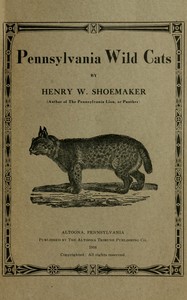
Pennsylvania wild cats
Language: en304 downloads on Project Gutenberg
Subjects
Public-domain ebook sourced from Project Gutenberg #77943.
Public-domain ebook
Language: en304 downloads on Project Gutenberg
Subjects
Public-domain ebook sourced from Project Gutenberg #77943.
The opening · free to read
When, through villainous bounty laws, the existence of one of the most useful animals in Pennsylvania is threatened, it seems high time for a voice of protest to be raised. Immediately the question will be asked, what is the use of the wild cat? Its values are manifold. In the mountainous districts, where hunters are few and far between, rabbits, unless kept in check by wild cats, would become so numerous that they would destroy vast numbers of growing trees by eating off their bark. As it is the aim of all good Pennsylvanians to aid in the reforestation of the desolated areas in the State--after the forest fire menace has been checked, the wild cat should be preserved to help along the arboreal millennium. In the settled neighborhoods, where farmer boys and city hunters keep rabbits killed off, there is little need for wild cats. And the cats have the common sense to stay away from such localities, though they have on rare occasions come near barnyards or hen-houses. Such cats are renegades to their race and should be killed. But the vast majority of wild cats follow out their lives hunting rabbits, rats, mice, shrews and other vermin. They prey on the rats and mice which destroy the eggs of game birds. They eat much carrion, and as such are invaluable forest scavengers. They are performing faithfully the duties for which the same God who created us made them to do. If rabbits become scarce, wild cats decrease, just as does the Canada Lynx of the North; bounty laws are unnecessary, wasteful and cruel, a sop thrown by crafty politicians to keep the mountaineer vote in line. If there were no rabbits in the mountains there would be no wild cats. Note carefully the sections of the State where cats are rare, all for the same cause--lack of food supply, when not wiped out by the mercenary bounty hunters. Those who slaughter wild cats wantonly are false to posterity, unacquainted with natural history, ignorant of the scheme of nature. There is some excuse to hunt wild cats for the sport, if no attempt is made to annihilate the species. It provides a grand chase for men and dogs, gives city men a love of the open, and when the cat escapes, furnishes fun for the cat. The wild cat is fairly valuable as a fur-bearer; its relative, the Canada Lynx, was much more so, but it is now totally extinct in Pennsylvania, at least the pure race. Therefore, as an aid to sylviculture, as a means of sport, and for its fur, the wild cat deserves protection. Its meat is considered very good. Such men as Dr. C. Hart Merriam and Prof. E. Emmons pronounce it most excellent. It was a favorite relish for the old pioneers in the Pennsylvania mountains and the Indians. Another cause for the protection of Lynx Rufus. And then there is the sentimental side, which side appeals only to the few. But it is real; animals have rights; they add to the sum total of the beauty and picturesqueness of this world of ours. We have no right to condemn a species to extermination that a Wise Power saw fit to create. It is presumption on our part. Who gave us such authority?
GIVE THE WILD CATS A CHANCE.
II. THE WILD CAT.
When, as a young boy, in 1897, the writer first paid a visit to Loganton, “the hunting capital” of Sugar Valley, Clinton County, and was invited to inspect the barber-shop trophy room of that prince of Pennsylvania wild cat hunters, Clem. F. Herlacher, the most noticeable object in the collection was a long-tailed, cat-like specimen which occupied the place of honor over the central mirror. “That is,” said Herlacher, pointing to the trophy, “what the first settlers called a ‘wild cat’; in reality it is the cub of the panther, felis couguar. The old-timers ofter ran across these huge kittens in the woods; they were always blundering into the traps, or their dogs were killing them, and they did resemble ‘cats,’ with their fluffy fur, broad faces, and long tails. But gradually the truth dawned on them when they found these ‘wild cats’ trailing along with mature pantheresses, or smaller-sized ones were taken from panther nests on rocky ledges. They were not wild cats at all, but half-grown or cub panthers. During the time when our forefathers were calling the cub panthers ‘wild cats,’ they were calling the true, stump-tailed wild cats ‘catamounts,’ making in that designation another absurd mistake. The true wild cat is the bay lynx, whereas the catamount is really the Northern or Canada lynx, always a rare animal in Pennsylvania, and unknown in most of the counties except in the ‘Northern Tier.’” At the close of this dissertation, the words of which became indelibly? impressed on the writer’s mind, Herlacher pointed to a second stuffed animal, on a shelf above another of the mirrors. “There,” he said, “is a true wild cat--_Lynx Rufus_--a fine specimen; it weighed thirty-five pounds when I killed it two years ago near ‘Captain Green’s Trench,’ in Green Gap, down the valley. See, it has a short tail, about six inches, is more distinctly mottled than the panther cub, its fur is shorter and smoother.” The writer then inquired where the panther cub had been obtained. Herlacher replied that he had on two successive years--1892 and 1893--secured panther cubs from a nest in the Panther Rocks, in Black Wolf or Treaster Valley, Mifflin County. He had trailed the old panthers on their regular crossing from Sugar Valley. It was in Treaster Valley that the noble Pennsylvania lion or panther made its last permanent abode in Pennsylvania, the cubs taken by Herlacher being, as far as known, the last panthers born in a wild state in the Keystone Commonwealth. As curios they were in great demand, but he regretted not having taken them alive. The great hunter had given away all but the one adorning the shelf above the central mirror. Later it became moth-eaten and was thrown away. Alas! for a priceless natural history specimen. And from the above it will be plain to the readers of these pages that the original “wild cat” was the panther cub, the wild cat of today is the bay lynx, the real catamount is the Canada lynx. But the next few chapters will go into these matters more in detail. Emmanuel Harman, of Mt. Zion, Clinton County, aged 84 years, and many others, have regaled the writer with the story of the wild-cat panther-cub blunder of the “pioneer naturalists.”
III. THE BOB CAT, OR CATAMOUNT.
C. W. Dickinson, experienced hunter and naturalist, of Smethport, McKean County, describes the true Pennsylvania wild cat (Lynx Rufus), sometimes called the Bob Cat, and erroneously called the Catamount, as follows: “The size of the average grown wild cat is: Length from nose to base of tail, 30 inches; tail 4 inches; weight, about 26 pounds. The longest cat I ever saw weighed tipped the scales at just 32 pounds. The wild cat only raises one litter of kittens annually, the time they are born being the 15th or 20th of April. The number of kits in the litter varies from two to five. The weight of a kitten at eight months after birth will be from thirteen to seventeen pounds. It takes them about three years to get their full growth. It is the opinion of many of the old hunters that the cat, as well as the panther, did not like to stay in a locality inhabited by the grey wolf, as the wolf usually roamed about in droves or squads of from two to ten or twelve in a pack. It seems that the cat family was deathly afraid of the wolf family. Their fear was due to the superior numbers of the wolf family traveling together. It was really surprising how fast the cat family increased in this locality after the wolf became extinct. There are three times as many wild cats in McKean County today as there were fifty years ago, notwithstanding they have been hunted hard since the bounty laws were enacted. Yet I do not think there is more than one cat now to where there were three fifteen years ago, while grouse and rabbits, both ‘snowshoe’ and ‘cottontail,’ are also decreasing. The wild cat is a great hunter. Naturally he is a night prowler. He is fond of ’coon, rabbit, ground-hog, all kinds of birds that he can catch, and he can capture a mouse as quickly as a house cat. Wild cats are handy with their paws; they have large nails, which are as sharp as needles.” The present range of the wild cat is practically the same as it was when S. N. Rhoads’ admirable work on Pennsylvania and New Jersey animals appeared in 1903, which was the entire State of Pennsylvania, except Allegheny, Armstrong, Beaver, Butler, Crawford, Erie, Mercer and Washington Counties in the west, and Bucks, Chester, Delaware, Montgomery and Philadelphia Counties in the east, thirteen out of sixty-seven counties, but its numbers are now sadly diminished since Rhoads made his researches. Preying as it does on sickly and weakly game birds, it was a tower of strength in combatting the “grouse disease” and the “quail blight,” and also kept in check the ravages of destructive rabbits and other small mammals. In every district where it has been extirpated the game birds and game animals have decreased with it, until it would look that tame or hand-raised game will alone survive the next quarter of a century. The folly of destroying the wolf, fox and wild cat will not be understood until it is too late. Nature decrees all forms of life or none--except the domesticated or semi-domesticated specimens of animals and birds. If the present bounty law, giving $6 for every wild cat’s scalp, is continued, few cats will be left in the State by 1921. They are wholly absent from many localities where they were fairly numerous five years ago. They are practically extinct in the Blue Mountains, the Bald Eagle Mountains, and the main chain of the Alleghenies. In Northeastern Pennsylvania a few are taken annually at Blooming Grove Preserve, in Pike County; in Clinton County some are trapped every year in Otzinachson Park--drawn thither by the rabbits and entrails of deer--but these preserves will be responsible for the destruction of all the cats in their respective localities; they will last longest in parts of McKean, and Cameron Counties, away from settlements, in the Seven Mountains in Centre and Mifflin Counties, and in Eastern Clinton County, in the Zimmerman country, unless destroyed by the increasingly frequent forest fires. There is a great diversity of coloring in specimens of Pennsylvania wild cats. They are mostly of a cinnamon brown color, black striped or spotted on the legs and shading into a white or marbled on the belly. Some are of a rich chestnut brown in color, beautifully spotted with black, while a few are of a grey-drab in color, the black markings resembling bars rather than dots. They usually have a white patch on the ears.
IV. THE BIG GREY WILD CAT, OR CANADA LYNX.
John G. Davis, old-time woodsman of McElhattan, Clinton County, gives the best description of a mammoth Canada Lynx (Lynx Canadensis) killed by John Pluff, at Hyner, in that County, in 1874. Pluff, who was a noted hunter in his day, died in January, 1914, in his 74th year. One evening when Pluff was at supper, he heard a commotion in his barnyard. Taking down his rifle he hurried out, only to notice a shaggy animal moving about among the feet of his young cattle. Courageously driving the steers into the barn, he came face to face with a gigantic Canada Lynx, or what was called, in Northern Pennsylvania, a “Big Grey Wild Cat,” or catamount, to distinguish it from the smaller and ruddier Bay Lynx. Taking aim at the monster’s jugular, Pluff fired, killing the big cat with a single ball. The shot attracted the neighbors, among them Davis, and they gazed with amazement at the giant carcass, the biggest cat killed in those parts since Sam Snyder slew his 10-foot panther on Young Woman’s Creek in 1858. The Canada Lynx measured four feet ten inches from tip of nose to root of tail (the tail measured four inches) and weighed seventy-five pounds. The next day being Thanksgiving, it was supplemented to the turkey feast, and all enjoyed the deliciously flavored white meat more than the conventional “Thanksgiving Bird.” This lynx was probably a straggler from the Northern Tier, as none of its kind have been about Hyner since. At the same time the Canada Lynx has been killed in many parts of Pennsylvania, as far south as the Seven Mountains and Somerset County, some claim, but never frequently. Jesse Logan, Indian hunter, of the Cornplanter Reservation in Warren County, who is now 107 years old, says that he cannot recall Canada Lynxes ever having been plentiful in any part of Northern Pennsylvania.[*] Clem Herlacher has killed a number of these animals in Clearfield and Cameron Counties, but in widely different localities and different dates. He describes the Canada Lynx as follows: “The two most remarkable characters of the Canada Lynx are the beautiful pencils of black hair which ornament the ears, and the perfect hairiness of the soles of the feet, which have no naked spots or tubercles like other species of the feline race. The catamount, which is the true Pennsylvania title for this animal, is of an ashen grey in color, with a ruff of stiff dark hair about its neck and looks ‘chuffier’ than the common wild cat; it most resembles an Old English Sheep Dog. I know nothing of its domestic habits, though I believe it formerly bred in some of our northern counties. Dr. Merriam says that it has two kittens at a birth. The biggest catamount I ever killed measured, exclusive of the tail, forty inches, the tail measured four inches, or an inch shorter than most wild cats. Catamounts were driven into Clinton and Mifflin Counties by forest fires from their northern range, but never remained long. I think that the Canada Lynx is now totally extinct in Pennsylvania. It was a fierce fighter, but I have heard of Seneca Indians who tamed it to follow them about like dogs. Among the Pennsylvania Dutch it was supposed to be endowed with the power to look through opaque bodies, hence the old expression of a person with keen sight being ‘lynx eyed.’” Rhoads records instances of catamounts taken in Cameron, Potter, Columbia, Forest, Lackawanna, Lycoming, McKean, Monroe, Pike, Wayne, Somerset and Tioga Counties. Jesse Harman and son Ed., accompanied by Sam Motter, “California Sam,” a noted trapper, took a catamount at the head of McElhattan Run, in Clinton County, early in 1903. Out of a dozen cats caught by these hunters that winter it was the only Canada Lynx. It weighed sixty-five pounds and measured exactly five feet from tip to tip.
The book keeps going
Reading is free forever. Sign up and watch scenes appear while you read.



Scenes Storieta drew for other classics.
New illustrated classics
Once or twice a month: the latest books to get full character casts, scene art, and free comic editions. No account needed.