Public-domain ebook
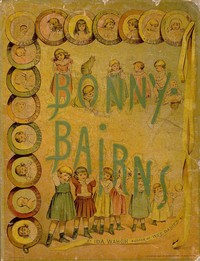
Bonny bairns
Language: en1,608 downloads on Project Gutenberg
Subjects
Public-domain ebook sourced from Project Gutenberg #78348.
Public-domain ebook
Language: en1,608 downloads on Project Gutenberg
Subjects
Public-domain ebook sourced from Project Gutenberg #78348.
Bonny Bairns is a collection of short, rhymed verses and gentle dialogues aimed at young readers, blending simple storytelling with playful illustration cues. The opening scene places a mother comforting her child, then drifts into a series of vignette‑like poems about garden flowers, mischievous kittens, hoop‑playing girls, and other everyday wonders. Each piece is introduced by a brief title and accompanied by a description of a picture, giving the sense of a picture‑book format where text and image work hand‑in‑hand. The work is organized by theme rather than a continuous narrative, offering a mosaic of childhood moments that range from the tender (“Two Years Old”) to the whimsical (“The Old Clock”) and the moral (“Say Please”).
The voice is unmistakably early‑20th‑century American, with a cadence that echoes nursery‑rhyme and a diction that mixes colloquial speech (“Kit‑Kate,” “Pstiss!”) with a modest moral tone. Its style is light‑hearted yet earnest, reflecting the era’s belief in gentle instruction through rhyme. Readers who enjoy simple, melodic poetry, picture‑book lovers, or anyone nostalgic for the sweet, didactic charm of historic children’s verse will find Bonny Bairns an inviting companion for quiet reading time.
The opening · free to read
“What, tears! my little one, how’s this?” Come, climb up in my lap, and tell me all about it. You will not love me? Will not kiss? It isn’t a nice world? Why, Dear, what makes you doubt it? First, then, your little cunning kit, That you believed was always good, and soft, and furry, Showed claws, scratched you, and fought, and bit, And all because you were in such a hurry, You could not wait for her to eat, But picked her up before her meal was over. “She ought to love you more than meat.” Well, so she ought, but then a cat’s not a good lover. And then, the fairy tale Ned told, It was so beautiful; you wanted it forever. Next day he said you were too old To think such nonsense could be true; that there were never Fairies, or brownies, or such stuff. And now you never can again believe it, As though your cat’s claws weren’t enough. “This horrid world! why do not people it.” Why Dear, my little brown-eyed Dear, I, great big I, am in just such a trouble. Don’t cry; why I have not one tear, And tears, maybe, will make us see things double. My kitten would not love me best, And when I stroked its fur the wrong way, showed its claws too. My fairy tale, it was confessed, No truer, Dear, than yours, and yet I thought it was true. Now you love me, and I’ll love you, And tell you all about a really, truly fairy-- About a little girl I knew, Whose name was just the same as--guess--as yours? Yes, Mary.
Down by the garden wall, There grew a flower, And it grew so tall That the sun, he kissed it, The breeze tried to twist it, The birds would insist it Was no flower at all.
Down by the garden wall, The bees and birds flew, And butterflies, all Seeing the flower too, One said ’twas a pitty, Another ’twas pretty, The birds said “Twit-twit tee, ’Twill most surely fall.”
Down by the garden wall, Some one came running, Not near so tall As the flow’r a sunning Itself in the sun, But no bud begun Was so sweet a one As this one so small.
Who, by the garden wall, Reached up to the flower On tiptoe; so small That o’er her would tower The blossom, so pink. Said some one, “I think You must need a drink, Sweet flower.” They call
You a weed by the wall, But better I know you, You’re no weed at all. To mamma I will show you, She’ll put you a vase in, Or fine China basin, Some lovely cool place in. Then come, flower tall.
What a big pussy-cat, Lapping up the milk, Does it say Mew, Mew, As other kits do? Has it fur soft as silk? And furry paws to pat?
What does Miss Milly think To see her milk gone? Shall we say Scat! Scat! To this great big cat? Shall we give it a bone Instead of milk to drink?
You’re not a really cat? So I see, my dear, With your curly pate, And your name’s Kit-Kate? I thought ’twas very queer, That cats grew big as that.
Don’t be a kitty-cat, My little Kit-Kate, Else, may be, you know, Your whiskers might grow. Upon my word, I’d hate To hear you say Pstiss! Spat!
Two little girls were out at play, The day was bright and sunny, Each saw the other one, and laughed, They must have thought it funny.
“Your hoop is very small,” said Grace. “And yours is big,” said Gussy. Grace said, “Suppose I change with you, I’m not the least bit fussy.”
And then both of them laughed again, Right in each other’s faces, And Grace took Gussie’s hoop to roll, So Gussy trundled Grace’s.
They ran and laughed, and laughed and ran, Their hoops went over, under; And when they said “Goodbye” they laughed, At what, I really wonder.
Have I a lover? I can’t say no, For some one always tells me so. And I let him? Of course, you see It does no harm to him or me.
Do we quarrel? Why, how you ask Me questions. Take me quite to task. We quarrel? Yes, we sometimes do; But then, we kiss and make up, too.
What does he look like? Is he tall? Blue eyes or brown? mouth large or small? His eyes are large and soft and grey, And he is quite tall, so they say.
He loves me dearly, and I’m sure His love is warm, and strong and pure; In all the world he loves me best, Thinks I’m the sweetest, prettiest.
He says he’ll have no wife but me; Wherever I am he must be; My steps he guards with loving care, When we go walking anywhere.
You think I’m proud of him, you say. Such are not found, dear, every day. I only hope when you are grown, You’ll have as true love for your own.
When will we marry? I must smile, You look so gravely all the while; I’m old enough to be his mother, Why, dear, he is your baby brother.
“No, not a bit of breakfast, For chickens big or small; Until you ask politely, No single grain shall fall. So, say Please, if you please, Any way you want to, With a cluck, cluck; peep, peep; Or cock-a-doodle-doo; With a caw-caw; quack, quack; Say any one of these; I am not particular. If it only means please.”
Mr. Rooster, Mrs. Hen, Set a good example, Show the other ones the way With a little sample Of your Please, if you please, Any way you choose to, Crow or cluck, peep or caw, Else I must refuse you; Breakfast will be dinner, Unless you all make haste; “And your dinner will be supper, Before you get a taste.”
Then up spoke Mr. Rooster, And crowed his very best; “Cluck, cluck,” said Mrs. Hen, and then Soon followed all the rest. It was “Caw! Caw! Cock-a-doo!” In voices high and deep, The big ones crowed and cawed, The little ones cried “Peep,” But everything meant “Please, We want our breakfast, please,” Till Nellie said “I never knew Of chicks polite as these.”
Trotity! trotity! trot! Curly haired little tot Must have some fresh air, ’Neath trees green and fair, Before the sun is too hot.
Rockity! rockity! rock! Baby-boy in a white frock, All over the floor, Like ships from the shore, Baby and I will rock.
Niddy-nid! niddy-nid! noddy! Such a sweet little body, Now curl in my lap, And take a good nap, Off to the land of noddy.
“Don’t be ’fraid, you butterfly, Please stay till mamma first sees you, You can go home by and bye, Take a little nap first, please do.”
I love you, dear butterfly, And I wish that I could kiss you, But I’m ’fraid almost to try. If you fly, mamma will miss you.
“Please be good till we get home, Then I’ll give some candy to you If mamma will give me some. You don’t want to fly now, do you?”
What shall we give to our baby? She is two years old to-day, She has learned to sing and prattle, To walk, to run, and to play; To kiss “good-night” and “good-morning,” To wave her hand to papa; To look for the stars in heaven, And the moon, “the stars’ mamma.”
What shall we bring to our baby, Who has learned to be so wise? Roses, pink as her cheeks are; Blue ribbons to match her eyes; A pin to fasten her frock with, Set round with tiny pearls, No whiter than her teeth are, The gold like her burnished curls.
A book all full of pictures-- For she is a picture too, With stories of dear little babies Who have done as she will do; And last of all, a dolly Without a blemish or flaw, As nearly as possible like her As she is like her mamma.
Sunshine of golden floods all the earth over, Gold in the heart of the rose, Bountiful blooms all the garden walls cover, Gold on the buttercup shows, Wealth on the swaying grass. What can be kinder, Than blossoms all day to the bee? Riches, and wealth, and fair gold for the finder, But never a little for me.
Ev’rywhere children cling close to their mother, Stars have their moon up above. “Kiss me good-night,” whispers sister and brother, “Good-night,” whispers dear mother-love. Mother-bird folds her wings over, to cover Little birds up in the tree, Love it is--love--and sweet love the world over, But never a little to me.
Rest for the bird, in her nest in the willow, Rest for the butterfly’s wings, So many tired heads find a heart-pillow, So many sweet, restful things. Fair little islands, all silent and lonely, Rest in the arms of the sea, I am so tired--why should it be only That never comes rest unto me?
To-morrow! to-morrow! when will it be here? When I asked mamma if it wasn’t real near, She said, “When both hands on the clock point again To twelve, why to-morrow will come to us then.”
This provoking old clock will not hurry a bit, I cannot see what is the matter with it, Perhaps ’tis so old that it has to go slow, Forgets about Christmas, or else does not know.
I wonder if I were to help it along-- Poor old thing--if any one could think it wrong, I know it will thank me for one little touch, It must be so tired of ticking so much.
I think I must do it, if Santa Claus came A little bit early, it would be a shame To find no one ready; he might go away, And never come back again, next Christmas Day.
The book keeps going
Reading is free forever. Sign up and watch scenes appear while you read.



Scenes Storieta drew for other classics.
New illustrated classics
Once or twice a month: the latest books to get full character casts, scene art, and free comic editions. No account needed.