Public-domain ebook
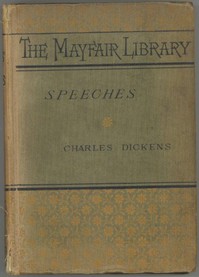
Speeches: Literary and Social
Language: en1,594 downloads on Project Gutenberg
Subjects
In: Essays, Letters & Speeches·British Literature
Public-domain ebook sourced from Project Gutenberg #824.
Public-domain ebook
Language: en1,594 downloads on Project Gutenberg
Subjects
In: Essays, Letters & Speeches·British Literature
Public-domain ebook sourced from Project Gutenberg #824.
This volume gathers a series of Charles Dickens’s public addresses, literary commentaries and autobiographical sketches, presenting the author not as a novelist but as a speaker and cultural commentator. It opens with a detailed portrait of Dickens’s early life, tracing his birth in Portsmouth, his family’s move to London after the 1815 post‑war cutbacks, and the formative influence of bustling urban scenes on his observational talent. The narrative quickly moves from his father’s hopes for a legal career to Dickens’s own entry into journalism, noting his work for The True Sun, The Mirror of Parliament, and the Morning Chronicle. From these beginnings the text follows his rapid rise as a reporter, his first published story in The Monthly Magazine, and his early forays into drama and opera, all illustrated with specific dates, titles and contemporaneous reactions.
The prose reflects the Victorian essayist’s blend of factual narration and lively anecdote, written in a measured, scholarly tone that still carries Dickens’s characteristic wit and affection for his subjects. Readers who enjoy literary history, 19th‑century cultural criticism, or the behind‑the‑scenes development of a great novelist will find this collection rewarding. It appeals especially to those interested in the social context of the period and the way Dickens’s own voice shaped public discourse, offering a vivid glimpse into the world that forged his enduring literary reputation.
The opening · free to read
INTRODUCTION.
CHARLES DICKENS was born at Landport, Portsmouth, on February 7, 1812. At that time his father, Mr. John Dickens, held an office in the Navy Pay Department, the duties of which obliged him to reside alternately at the principal naval stations of England. But on the conclusion of peace in 1815 a considerable reduction was made by Government in this branch of the public service. Mr. John Dickens, among others, was pensioned off, and he removed to London with his wife and children, when his son Charles was hardly four years of age.
No doubt the varied bustling scenes of life witnessed by Charles Dickens in his early years, had an influence on his mind that gave him a taste for observing the manners and mental peculiarities of different classes of people engaged in the active pursuits of life, and quickened a naturally lively perception of the ridiculous, for which he was distinguished even in boyhood.
It is curious to observe how similar opportunities of becoming acquainted practically with life, and the busy actors on its varied scenes, in very early life, appear to influence the minds of thinking and imaginative men in after-years. Goldsmith’s pedestrian excursions on the Continent, Bulwer’s youthful rambles on foot in England, and equestrian expeditions in France, and Maclise’s extensive walks in boyhood over his native county, and the mountains and valleys of Wicklow a little later, were fraught with similar results.
Charles Dickens was intended by his father to be an attorney. Nature and Mr. John Dickens happily differed on that point. London law may have sustained little injury in losing Dickens for “a limb.” English literature would have met with an irreparable loss, had she been deprived of him whom she delights to own as a favourite son.
Dickens, having decided against the law, began his career in “the gallery,” as a reporter on The True Sun; and from the first made himself distinguished and distinguishable among “the corps,” for his ability, promptness, and punctuality.
Remaining for a short term on the staff of this periodical, he seceded to The Mirror of Parliament, which was started with the express object of furnishing verbatim reports of the debates. It only lived, however, for two sessions.
The influence of his father, who on settling in the metropolis, had become connected with the London press, procured for Charles Dickens an appointment as short-hand reporter on the Morning Chronicle. To this period of his life he has made some graceful and interesting allusions in a speech delivered at the Second Anniversary of the Newspaper Press Fund, about five years ago.
It was in The Monthly Magazine of January, 1834, before he had quite attained his twenty-second year, that Charles Dickens made his first appearance in print as a story-teller. {7} Neither the editor of the magazine, nor the readers, nor even the ardent and gratified young author himself (who has described in the preface to the “Pickwick Papers” his sensations on finding his little contribution accepted), then dreamt that he would become in five short years from that time one of the most popular and widely-read of English authors, that his name would shortly become familiar as a household word, and that his praise would be on every tongue on both sides of the Atlantic.
Encouraged by his success, Charles Dickens continued to send sketches in the same vein, and for the next twelve months was a tolerably constant contributor to the Magazine. All, or nearly all, of these little papers were reprinted in the collection of Sketches by Boz; but as it will perhaps be interesting to some of our readers to trace their original appearance in the magazine, we give a list of them here:—
February, 1834, Horatio Sparkins. Marriage a-la-Mode. April „ The Bloomsbury Christening. May „ The Boarding-House. August „ Ibid. (No II.) {8a} September „ The Goings-on at Bramsby Hall. October „ The Steam Excursion. January, 1835. Passage in the Life of Mr. Watkins Tottle. February „ Ib. Chapter Second.
A similar series was afterwards contributed to the evening edition of The Morning Chronicle, {8b} then edited by Mr. John Black, and on which Dickens was engaged as parliamentary reporter.
While writing the “Sketches,” a strong inclination towards the stage induced Mr. Charles Dickens to test his powers as a dramatist, and his first piece, a farce called The Strange Gentleman, was produced at the St. James’s Theatre on the opening night of the season, September 29, 1836. The late Mr. Harley was the hero of the farce, which was received with great favour. This was followed by an opera, called The Village Coquettes, for which Mr. Hullah composed the music, and which was brought out at the same establishment, on Tuesday, December 6, 1836. The quaint humour, unaffected pathos, and graceful lyrics of this production found prompt recognition, and the piece enjoyed a prosperous run. The Village Coquettes took its title from two village girls, Lucy and Rose, led away by vanity, coquetting with men above them in station, and discarding their humble, though worthy lovers. Before, however, it is too late they see their error, and the piece terminates happily. Miss Rainforth and Miss Julia Smith were the heroines, and Mr. Bennet and Mr. Gardner were their betrothed lovers. Braham was the Lord of the Manor, who would have led astray the fair Lucy. There was a capital scene, where he was detected by Lucy’s father, played by Strickland, urging an elopement. Harley had a trifling part in the piece, rendered highly amusing by his admirable acting.
On March 6, 1837, was brought out at the St. James’s Theatre a farce, called Is She His Wife; or, Something Singular, in which Harley played the principal character, Felix Tapkins, a flirting bachelor, and sang a song in the character of Pickwick, “written expressly for him by Boz.”
Under the pseudonym of Timothy Sparks Charles Dickens published about this time a wholesome, wise, and cleverly written little pamphlet against Sabbatarianism, in which he cogently and forcibly advocated more liberal views respecting the observance of Sunday than generally obtain in this country. {10}
In March, 1836, appeared the first number of “Pickwick,” with illustrations by Seymour. It was continued in monthly shilling numbers until its completion, and this has been Mr. Dickens’s favourite and usual form of publication ever since. The success and popularity of the work—which, in freshness and vigour, he has never surpassed in his later and maturer writings—were unmistakeable. Several playwrights dramatised it, with more or less success; and a swarm of obscure scribblers flooded the town with imitations and sequels, which, like Avanelleda’s second part of “Don Quixote,” came mostly to grief, and were quickly forgotten.
Before the work had reached its third number, the talented artist who had undertaken the illustrations, and who has immortalised the features of Mr. Pickwick, was unfortunately removed by death, and Mr. Hablot Browne (the well-known Phiz) was chosen to replace him, and continued to illustrate most of Mr. Dickens’s novels for many years after. During the years 1837–1838, Mr. Dickens carried on the editorship of Bentley’s Miscellany, where his novel of “Oliver Twist” (illustrated by George Cruikshank) first appeared. To this magazine, during the time that he conducted it, he also contributed some humorous papers, entitled “Full Report of the Meetings of the Mudfog Association for the Advancement of Everything.” But, finding his editorial office irksome, he soon abandoned it.
During his engagement with Mr. Bentley, he edited and partly wrote the “Memoirs of Joseph Grimaldi,” {11} a book now almost forgotten, though not without passages of pathos and humour. Dickens, in the introductory chapter (dated February, 1838), gives the following account of his share in the work:—
“For about a year before his death, Grimaldi was employed in writing a full account of his life and adventures, and as people who write their own lives often find time to extend them to a most inordinate length, it is no wonder that his account of himself was exceedingly voluminous.
“This manuscript was confided to Mr. Thomas Egerton Wilks, to alter and revise, with a view to its publication. While he was thus engaged, Grimaldi died; and Mr. Wilks having, by the commencement of September (1837), concluded his labours, offered the manuscript to Mr. Bentley, by whom it was shortly afterwards purchased.
“The present editor of these volumes has felt it necessary to say thus much in explanation of their origin. His own share in them is stated in a few words. Being much struck by several incidents in the manuscript—such as the description of Grimaldi’s infancy, the burglary, the brother’s return from sea, and many other passages—and thinking that they might be related in a more attractive manner, he accepted a proposal from the publisher to edit the book, and has edited it to the best of his ability, altering its form throughout, and making such other alterations as he conceived would improve the narration of the facts, without any departure from the facts themselves.”
His next work was “Nicholas Nickleby,” published in monthly numbers. The following passage from the original preface, which is only to be found in the old editions, alludes to the great success that attended this story:—
“It only now remains for the writer of these pages, with that feeling of regret with which we leave almost any pursuit that has for a long time occupied us and engaged our thoughts, and which is naturally augmented in such a case as this, when that pursuit has been surrounded by all that could animate and cheer him on—it only now remains for him, before abandoning his task, to bid his readers farewell.”
This was followed by “Master Humphrey’s Clock,” the publication of which, in weekly numbers, with illustrations by Cattermole and Hablot Browne, was commenced in April, 1840. “Master Humphrey’s Clock” comprised the two novels of “The Old Curiosity Shop” and “Barnaby Rudge,” which are now published in a separate form, stripped of the introductory portion relating to Master Humphrey, and of the intercalary chapters in which Mr. Pickwick and the two Wellers appear again on the scene. It was pleasant to meet once more these familiar humorous creations, and it may be a matter for regret that this portion of the book has been consigned to oblivion. But the author considered that these passages served only to interrupt the continuity of the main story, and they were consequently eliminated.
These three characters (the Wellers and Mr. Pickwick) have all the same raciness and inexhaustible humour in this sequel as in the work in which we were first introduced to them. As the original edition of the work we are alluding to is now somewhat rare, the reader may not be displeased to have a few specimens laid before him. Here is Mr. Weller senior’s opinion of railways:—
“I con-sider,” said Mr. Weller, “that the rail is unconstitootional and an inwaser o’ priwileges, and I should wery much like to know what that ’ere old Carter as once stood up for our liberties and wun ’em too—I should like to know wot he vould say if he wos alive now, to Englishmen being locked up with widders, or with anybody, again their wills. Wot a old Carter would have said, a old Coachman may say, and I as-sert that in that pint o’ view alone, the rail is an inwaser. As to the comfort, vere’s the comfort o’ sittin’ in a harm cheer lookin’ at brick walls or heaps o’ mud, never comin’ to a public house, never seein’ a glass o’ ale, never goin’ through a pike, never meetin’ a change o’ no kind (horses or othervise), but alvays comin’ to a place, ven you come to one at all, the wery picter o’ the last, vith the same p’leesemen standing about, the same blessed old bell a ringin’, the same unfort’nate people standing behind the bars, a waitin’ to be let in; and everythin’ the same except the name, vich is wrote up in the same sized letters as the last name and vith the same colors. As to the _h_onour and dignity o’ travelling vere can that be vithout a coachman; and wot’s the rail to sich coachmen and guards as is sometimes forced to go by it, but a outrage and a insult? As to the pace, wot sort o’ pace do you think I, Tony Veller, could have kept a coach goin’ at, for five hundred thousand pound a mile, paid in adwance afore the coach was on the road? And as to the ingein—a nasty wheezin’, creaking, gasping, puffin, bustin’ monster, alvays out o’ breath, vith a shiny green and gold back, like a unpleasant beetle in that ’ere gas magnifier—as to the ingein as is alvays a pourin’ out red hot coals at night, and black smoke in the day, the sensiblest thing it does in my opinion, is, ven there’s somethin’ in the vay and it sets up that ’ere frightful scream vich seems to say, ‘Now here’s two hundred and forty passengers in the wery greatest extremity o’ danger, and here’s their two hundred and forty screams in vun!’” {15}
The book keeps going
Reading is free forever. Sign up and watch scenes appear while you read.



Scenes Storieta drew for other classics.
New illustrated classics
Once or twice a month: the latest books to get full character casts, scene art, and free comic editions. No account needed.