
Public-domain ebook
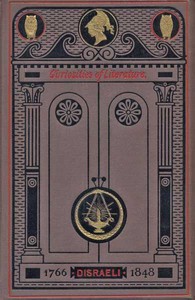
Curiosities of Literature, Vol. 1
Language: en8,065 downloads on Project Gutenberg
Subjects
In: Bibliomania·Essays, Letters & Speeches
Public-domain ebook sourced from Project Gutenberg #21615.
Public-domain ebook
Language: en8,065 downloads on Project Gutenberg
Subjects
In: Bibliomania·Essays, Letters & Speeches
Public-domain ebook sourced from Project Gutenberg #21615.
Curiosities of Literature, Vol. 1 is a compendium of literary anecdotes and reflections assembled by Isaac Disraeli, whose aim is to illustrate the often‑odd circumstances that have shaped the lives and works of writers. The volume opens with a vivid, almost theatrical quotation on the futility of idle ambition, then moves into a series of sketches ranging from the tragic death of Sydenham, whose misfortune inspired the Literary Fund, to the painstaking labours of Dr. Edmund Castell on his massive polyglot lexicon. Disraeli proceeds to catalogue the imprisonments of scholars such as Boethius, Grotius, and Cervantes, showing how confinement sometimes spurred their most enduring productions. The text continues with observations on the recreational habits of the learned, garden‑tending Descartes, chess‑playing philosophers, and the occasional burst of physical exercise, painting a portrait of the scholar’s life as a balance of toil and diversion.
The voice is that of a 19th‑century essayist, marked by erudite diction, frequent classical allusions, and a leisurely, discursive style that mirrors the very miscellany it describes. Readers who relish digressive scholarship, enjoy seeing famous authors reduced to human foibles, and appreciate a blend of anecdote, moral reflection, and occasional wit will find this volume rewarding. It appeals especially to those interested in the history of ideas, the sociology of literary production, and the quirky intersections of intellect and everyday life.
The opening · free to read
[Footnote 18: For some time previous to his death he was in so abject a state of poverty as to be dependent for subsistence upon the exertions of his faithful servant Antonio, a native of Java, whom he had brought with him from India, and who was accustomed to beg by night for the bread which was to save his unhappy master from perishing by want the next day. Camöens, when death at last put an end to a life which misfortune and neglect had rendered insupportable, was denied the solace of having his faithful Antonio to close his eyes. He was aged only fifty-five when he breathed his last in the hospital. This event occurred in 1579, but so little regard was paid to the memory of this great man that the day or month on which he expired remains unknown.--Adamson's Memoirs of Camöens, 1820.]
[Footnote 19: This melancholy event happened in 1788, fifteen years after the original projector of the Literary Fund, Mr. David Williams, had endeavoured to establish it. It appears that Mr. Floyer Sydenham was arrested "for a small debt; he never spoke after being arrested, and sunk under the pressure of his calamity." This is the published record of the event by the officers of the present fund; and these simple words are sufficiently indicative of the harrowing nature of the catastrophe; it was strongly felt that Mr. Williams' hopeful plan of preventing a second act so fatal should be encouraged. A small literary club took the initiative, and subscribed a few guineas to pay for such advertisements as were necessary to keep the intended objects of the founder before the public, and solicit its aid. Two years afterwards a committee was formed; another two years saw it take position among the established institutions of the country. In 1818 it obtained a royal charter. In its career it has relieved upwards of 1300 applicants, and devoted to that purpose 47,725_l._]
IMPRISONMENT OF THE LEARNED.
Imprisonment has not always disturbed the man of letters in the progress of his studies, but has unquestionably greatly promoted them.
In prison Boethius composed his work on the Consolations of Philosophy; and Grotius wrote his Commentary on Saint Matthew, with other works: the detail of his allotment of time to different studies, during his confinement, is very instructive.
Buchanan, in the dungeon of a monastery in Portugal, composed his excellent Paraphrases of the Psalms of David.
Cervantes composed the most agreeable book in the Spanish language during his captivity in Barbary.
Fleta, a well-known law production, was written by a person confined in the Fleet for debt; the name of the place, though not that of the author, has thus been preserved; and another work, "Fleta Minor, or the Laws of Art and Nature in, knowing the bodies of Metals, &c. by Sir John Pettus, 1683;" received its title from the circumstance of his having translated it from the German during his confinement in this prison.
Louis the Twelfth, when Duke of Orleans, was long imprisoned in the Tower of Bourges: applying himself to his studies, which he had hitherto neglected, he became, in consequence, an enlightened monarch.
Margaret, queen of Henry the Fourth, King of France, confined in the Louvre, pursued very warmly the studies of elegant literature, and composed a very skilful apology for the irregularities of her conduct.
Sir Walter Raleigh's unfinished History of the World, which leaves us to regret that later ages had not been celebrated by his eloquence, was the fruits of eleven years of imprisonment. It was written for the use of Prince Henry, as he and Dallington, who also wrote "Aphorisms" for the same prince, have told us; the prince looked over the manuscript. Of Raleigh it is observed, to employ the language of Hume, "They were struck with the extensive genius of the man, who, being educated amidst naval and military enterprises, had surpassed, in the pursuits of literature, even those of the most recluse and sedentary lives; and they admired his unbroken magnanimity, which, at his age, and under his circumstances, could engage him to undertake and execute so great a work, as his History of the World." He was assisted in this great work by the learning of several eminent persons, a circumstance which has not been usually noticed.
The plan of the "_Henriade_" was sketched, and the greater part composed, by Voltaire during his imprisonment in the Bastile; and "the Pilgrim's Progress" of Bunyan was performed in the circuit of a prison's walls.
Howell, the author of "Familiar Letters," wrote the chief part of them, and almost all his other works, during his long confinement in the Fleet prison: he employed his fertile pen for subsistence; and in all his books we find much entertainment.
Lydiat, while confined in the King's Bench for debt, wrote his Annotations on the Parian Chronicle, which were first published by Prideaux. He was the learned scholar alluded to by Johnson; an allusion not known to Boswell and others.
The learned Selden, committed to prison for his attacks on the divine right of tithes and the king's prerogative, prepared during his confinement his "History of Eadmer," enriched by his notes.
Cardinal Polignac formed the design of refuting the arguments of the sceptics which Bayle had been renewing in his dictionary; but his public occupations hindered him. Two exiles at length fortunately gave him the leisure; and the Anti-Lucretius is the fruit of the court disgraces of its author.
Freret, when imprisoned in the Bastile, was permitted only to have Bayle for his companion. His dictionary was always before him, and his principles were got by heart. To this circumstance we owe his works, animated by all the powers of scepticism.
Sir William Davenant finished his poem of Gondibert during his confinement by the rebels in Carisbrook Castle. George Withers dedicates his "Shepherds Hunting," "To his friends, my visitants in the Marshalsea:" these "eclogues" having been printed in his imprisonment.[20]
De Foe, confined in Newgate for a political pamphlet, began his "Review;" a periodical paper, which was extended to nine thick volumes in quarto, and it has been supposed served as the model of the celebrated papers of Steele.
Wicquefort's curious work "on Ambassadors" is dated from his prison, where he had been confined for state affairs. He softened the rigour of those heavy hours by several historical works.
One of the most interesting facts of this kind is the fate of an Italian scholar, of the name of Maggi. Early addicted to the study of the sciences, and particularly to the mathematics, and military architecture, he successfully defended Famagusta, besieged by the Turks, by inventing machines which destroyed their works. When that city was taken in 1571, they pillaged his library and carried him away in chains. Now a slave, after his daily labours he amused a great part of his nights by literary compositions; De Tintinnabulis, on Bells, a treatise still read by the curious, was actually composed by him when a slave in Turkey, without any other resource than the erudition of his own memory, and the genius of which adversity could not deprive him.
Among the Jesuits it was a standing rule of the order, that after an application to study for two hours, the mind of the student should be unbent by some relaxation, however trifling. When Petavius was employed in his Dogmata Theologica, a work of the most profound and extensive erudition, the great recreation of the learned father was, at the end of every second hour, to twirl his chair for five minutes. After protracted studies Spinosa would mix with the family-party where he lodged, and join in the most trivial conversations, or unbend his mind by setting spiders to fight each other; he observed their combats with so much interest, that he was often seized with immoderate fits of laughter. A continuity of labour deadens the soul, observes Seneca, in closing his treatise on "The Tranquillity of the Soul," and the mind must unbend itself by certain amusements. Socrates did not blush to play with children; Cato, over his bottle, found an alleviation from the fatigues of government; a circumstance, Seneca says in his manner, which rather gives honour to this defect, than the defect dishonours Cato. Some men of letters portioned out their day between repose and labour. Asinius Pollio would not suffer any business to occupy him beyond a stated hour; after that time he would not allow any letter to be opened, that his hours of recreation might not be interrupted by unforeseen labours. In the senate, after the tenth hour, it was not allowed to make any new motion.
Tycho Brahe diverted himself with polishing glasses for all kinds of spectacles, and making mathematical instruments; an employment too closely connected with his studies to be deemed an amusement.
D'Andilly, the translator of Josephus, after seven or eight hours of study every day, amused himself in cultivating trees; Barclay, the author of the Argenis, in his leisure hours was a florist; Balzac amused himself with a collection of crayon portraits; Peirese found his amusement amongst his medals and antiquarian curiosities; the Abbé de Marolles with his prints; and Politian in singing airs to his lute. Descartes passed his afternoons in the conversation of a few friends, and in cultivating a little garden; in the morning, occupied by the system of the world, he relaxed his profound speculations by rearing delicate flowers.
Conrad ab Uffenbach, a learned German, recreated his mind, after severe studies, with a collection of prints of eminent persons, methodically arranged; he retained this ardour of the Grangerite to his last days.
Rohault wandered from shop to shop to observe the mechanics labour; Count Caylus passed his mornings in the studios of artists, and his evenings in writing his numerous works on art. This was the true life of an amateur.
Granville Sharp, amidst the severity of his studies, found a social relaxation in the amusement of a barge on the Thames, which was well known to the circle of his friends; there, was festive hospitality with musical delight. It was resorted to by men of the most eminent talents and rank. His little voyages to Putney, to Kew, and to Richmond, and the literary intercourse they produced, were singularly happy ones. "The history of his amusements cannot be told without adding to the dignity of his character," observes Prince Hoare, in the life of this great philanthropist.
Some have found amusement in composing treatises on odd subjects. Seneca wrote a burlesque narrative of Claudian's death. Pierius Valerianus has written an eulogium on beards; and we have had a learned one recently, with due gravity and pleasantry, entitled "Eloge de Perruques."
Holstein has written an eulogium on the North Wind; Heinsius, on "the Ass;" Menage, "the Transmigration of the Parasitical Pedant to a Parrot;" and also the "Petition of the Dictionaries."
Erasmus composed, to amuse himself when travelling, his panegyric on Moria, or folly; which, authorised by the pun, he dedicated to Sir Thomas More.
The book keeps going
Reading is free forever. Sign up and watch scenes appear while you read.



Scenes Storieta drew for other classics.
New illustrated classics
Once or twice a month: the latest books to get full character casts, scene art, and free comic editions. No account needed.