More than thirty years ago, at the solicitation of my kinsman, H. C. McDowell, of Kentucky, I undertook to write a sketch of my war experience. McDowell was a major in the Federal Army during the civil war, and with eleven first cousins, including Gen. Irvin McDowell, fought against the same number of first cousins in the Confederate Army. Various interruptions prevented the completion of my work at that time. More recently, after despairing of the hope that some more capable member of my old command, the Rockbridge Artillery, would not allow its history to pass into oblivion, I resumed the task, and now present this volume as the only published record of that company, celebrated as it was even in that matchless body of men, the Army of Northern Virginia.
E. A. M.
INTRODUCTION BY CAPT. ROBERT E. LEE, JR.
The title of this book at once rivets attention and invites perusal, and that perusal does not disappoint expectation. The author was a cannoneer in the historic Rockbridge (Va.) Artillery, which made for itself, from Manassas to Appomattox, a reputation second to none in the Confederate service. No more vivid picture has been presented of the private soldier in camp, on the march, or in action. It was written evidently not with any commercial view, but was an undertaking from a conviction that its performance was a question of duty to his comrades. Its unlabored and spontaneous character adds to its value. Its detail is evidence of a living presence, intent only upon truth. It is not only carefully planned, but minutely finished. The duty has been performed faithfully and entertainingly.
We are glad these delightful pages have not been marred by discussion of the causes or conduct of the great struggle between the States. There is no theorizing or special pleading to distract our attention from the unvarnished story of the Confederate soldier.
The writer is simple, impressive, and sincere. And his memory is not less faithful. It is a striking and truthful portrayal of the times under the standard of one of the greatest generals of ancient or modern times. It is from such books that data will be gathered by the future historian for a true story of the great conflict between the States.
For nearly a year (from March to November, 1862) I served in the battery with this cannoneer, and for a time we were in the same mess. Since the war I have known him intimately, and it gives me great pleasure to be able to say that there is no one who could give a more honest and truthful account of the events of our struggle from the standpoint of a private soldier. He had exceptional opportunities for observing men and events, and has taken full advantage of them.
ROBERT E. LEE.
Between 1740 and 1750 nine brothers by the name of Moore emigrated from the north of Ireland to America. Several of them settled in South Carolina, and of these quite a number participated in the Revolutionary War, several being killed in battle. One of the nine brothers, David by name, came to Virginia and settled in the "Borden Grant," now the northern part of Rockbridge County. There, in 1752, his son, afterward known as Gen. Andrew Moore, was born. His mother was a Miss Evans, of Welsh ancestry. Andrew Moore was educated at an academy afterward known as Liberty Hall. In early life with some of his companions he made a voyage to the West Indies; was shipwrecked, but rescued, after many hardships, by a passing vessel and returned to the Colonies. Upon his return home he studied law in the office of Chancellor Wythe, at Williamsburg, and was licensed to practice law in 1774. In 1776 he entered the army as lieutenant, in Morgan's Riflemen, and was engaged in those battles which resulted in the capture of Burgoyne's army, and at the surrender of the British forces at Saratoga. For courage and gallantry in battle he was promoted to a captaincy. Having served three years with Morgan, he returned home and took his seat as a member of the Virginia legislature, taking such an active and distinguished part in the deliberations of that body that he was elected to Congress, and as a member of the first House of Representatives was distinguished for his services to such a degree that he was re-elected at each succeeding election until 1797, when he declined further service in that body, but accepted a seat in the Virginia House of Delegates. He was again elected to Congress in 1804, but in the first year of his service he was elected to the United States Senate, in which body he served with distinguished ability until 1809, when he retired. He was then appointed United States Marshal for the District of Virginia, which office he held until his death, April 14, 1821. His brother William served as a soldier in the Indian wars, and the Revolutionary War. He was a lieutenant of riflemen at Pt. Pleasant, and carried his captain, who had been severely wounded, from the field of battle, after killing the Indian who was about to scalp him--a feat of courage and strength rarely equaled. Gen. Andrew Moore's wife was Miss Sarah Reid, a descendant of Capt. John McDowell, who was killed by the Indians, December 18, 1842, on James River, in Rockbridge County. She was the daughter of Capt. Andrew Reid, a soldier of the French and Indian War.
Our author's father was Capt. David E. Moore, for twenty-three years the Attorney for the Commonwealth for Rockbridge County, and a member of the Constitutional Convention, 1850-51. His mother was Miss Elizabeth Harvey, a descendant of Benjamin Borden, and daughter of Matthew Harvey, who at sixteen years of age ran away from home and became a member of "Lee's Legion," participating in the numerous battles in which that distinguished corps took part.
Thus it will be seen that our author is of martial stock and a worthy descendant of those who never failed to respond to the call to arms; the youngest of four brothers, one of whom surrendered under General Johnston, the other three at Appomattox, after serving throughout the war. It is safe to say that Virginia furnished to the Confederate service no finer examples of true valor than our author and his three brothers.
HENRY ST. GEORGE TUCKER. Lexington, Va., December 20, 1906.
Washington College--lexington--virginia Military Institute
At the age of eighteen I was a member of the Junior Class at Washington College at Lexington, Virginia, during the session of 1860-61, and with the rest of the students was more interested in the foreshadowings of that ominous period than in the teachings of the professors. Among our number there were a few from the States farther south who seemed to have been born secessionists, while a large majority of the students were decidedly in favor of the Union.
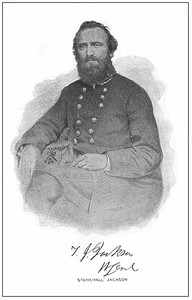
Our president, the Rev. Dr. George Junkin, who hailed from the North, was heart and soul a Union man, notwithstanding the fact that one of his daughters was the first wife of Major Thomas J. Jackson, who developed into the world-renowned "Stonewall" Jackson. Another daughter was the great Southern poetess, Mrs. Margaret J. Preston, and Dr. Junkin's son, Rev. W. F. Junkin, a most lovable man, became an ardent Southern soldier and a chaplain in the Confederate Army throughout the war.
At the anniversary of the Washington Literary Society, on February 22, 1861, the right of secession was attacked and defended by the participants in the discussion, with no less zeal than they afterward displayed on many bloody battlefields.
We had as a near neighbor the Virginia Military Institute, "The West Point of the South," where scores of her young chivalry were assembled, who were eager to put into practice the subjects taught in their school. Previous to these exciting times not the most kindly feelings, and but little intercourse had existed between the two bodies of young men. The secession element in the College, however, finding more congenial company among the cadets, opened up the way for quite intimate and friendly relations between the two institutions. In January, 1861, the corps of cadets had been ordered by Governor Wise to be present, as a military guard, at the execution of John Brown at Harper's Ferry. After their return more than the usual time was given to the drill; and target-shooting with cannon and small arms was daily practised in our hearing.
Only a small proportion of the citizens of the community favored secession, but they were very aggressive. One afternoon, while a huge Union flag-pole was being raised on the street, which when half-way up snapped and fell to the ground in pieces, I witnessed a personal encounter between a cadet and a mechanic (the latter afterward deserted from our battery during the Gettysburg campaign in Pennsylvania, his native State), which was promptly taken up by their respective friends. The cadets who were present hastened to their barracks and, joined by their comrades, armed themselves, and with fixed bayonets came streaming at double-quick toward the town. They were met at the end of Main street by their professors, conspicuous among whom was Colonel Colston on horseback. He was a native of France and professor of French at the Institute; he became a major-general in the Confederate Army and later a general in the Egyptian Army. After considerable persuasion the cadets were induced to return to their barracks.
Instead of the usual Saturday night debates of the College literary societies, the students either joined the cadets in their barracks at the Institute or received them at the College halls to harangue on the one absorbing topic.
On the top of the main building at the College was a statue of Washington, and over this statue some of the students hoisted a palmetto flag. This greatly incensed our president. He tried, for some time, but in vain, to have the flag torn down. When my class went at the usual hour to his room to recite, and before we had taken our seats, he inquired if the flag was still flying. On being told that it was, he said, "The class is dismissed; I will never hear a recitation under a traitor's flag!" And away we went.
Lincoln's proclamation calling for 75,000 men from Virginia, to whip in the seceded States, was immediately followed by the ordinance of secession, and the idea of union was abandoned by all. Recitation-bells no longer sounded; our books were left to gather dust, and forgotten, save only to recall those scenes that filled our minds with the mighty deeds and prowess of such characters as the "Ruling Agamemnon" and his warlike cohorts, and we could almost hear "the terrible clang of striking spears against shields, as it resounded throughout the army."
There was much that seems ludicrous as we recall it now. The youths of the community, imbued with the idea that "cold steel" would play an important part in the conflict, provided themselves with huge bowie-knives, fashioned by our home blacksmith, and with these fierce weapons swinging from their belts were much in evidence. There were already several organized military companies in the county. The Rockbridge Rifles, and a company of cavalry left Lexington April 17, under orders from Governor John Letcher, our townsman, who had just been inaugurated Governor of Virginia, to report at Harper's Ferry. The cavalry company endeavored to make the journey without a halt, and did march the first sixty-four miles in twenty-four hours.