The opening · free to read
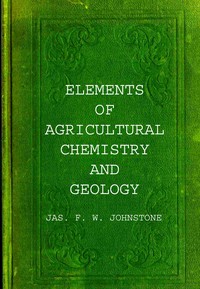
Edinburgh:
ADAM AND CHARLES BLACK.
1860.
ERRATUM.
Page 190, line 11, for "gallon" read "ton."
PRINTED BY R. AND R. CLARK, EDINBURGH.
Transcriber's note: Many of the tables needed to be split to fit space constraints. Minor typos have been corrected and footnotes moved to the end of the chapters. A word surrounded by underscores like this signifies the word is italics in the text. For numbers and equations, underscores before bracketed numbers in equations denote a subscript.
PREFACE.
The object of the present work is to offer to the farmer a concise outline of the general principles of Agricultural Chemistry. It has no pretensions to be considered a complete treatise on the subject. On the contrary, its aim is strictly elementary, and with this view I have endeavoured, as far as possible, to avoid unnecessary technicalities so as to make it intelligible to those who are unacquainted with the details of chemical science, although I have not hesitated to discuss such points as appeared essential to the proper understanding of any particular subject.
The rapid progress of agricultural chemistry, and the numerous researches prosecuted under the auspices of agricultural societies and private experimenters in this and other countries, render it by no means an easy task to make a proper selection from the mass of facts which is being daily accumulated. In doing this, however, I have been guided by a pretty intimate knowledge of the wants of the farmer, which has induced me to enlarge on those departments of the subject which bear more immediately on the every-day practice of agriculture; and for this reason the composition and properties of soils, the nature of manures, and the principles by which their application ought to be governed, have been somewhat minutely treated.
In all cases numerical details have been given as fully as is consistent with the limits of the work; and it may be right to state that a considerable number of the analyses contained in it have been made in my own laboratory, and that even when I have preferred to quote the results of other chemists, they have not unfrequently been confirmed by my own experiments.
UNIVERSITY OF GLASGOW, 1st November 1860.
CONTENTS.
The book keeps going
Keep reading, and see it illustrated
Reading is free forever. Sign up and watch scenes appear while you read.
Scenes Storieta drew for other classics.