Public-domain ebook
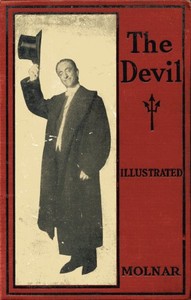
The Devil: A Tragedy of the Heart and Conscience
English4,195 downloads on Project GutenbergDownload EPUB
Public-domain ebook sourced from Project Gutenberg #25947.
Public-domain ebook
English4,195 downloads on Project GutenbergDownload EPUB
Public-domain ebook sourced from Project Gutenberg #25947.
The work is a melodramatic tragedy that pits personal desire against a looming moral threat, framing its conflict as a battle between good and evil that plays out in a single day of Viennese society. It opens with a didactic preface that promises a lesson for “all women and men,” then introduces a cast of artists, bankers, models and a mysterious figure who calls himself Dr. Millar. The narrative quickly moves to a dinner at the Hofmann residence, where the artist Karl Mahler learns that his former sweetheart Olga, now his friend’s wife, will sit for a portrait in his studio the next day. The ensuing tension, Olga’s uneasy recollection of a youthful kiss, Karl’s restless insomnia, and the ominous presence of a devil‑like suitor, sets the stage for a series of emotionally charged encounters that explore jealousy, regret, and the lure of temptation.
Written in the ornate, moral‑laden prose of the late‑19th‑century stage melodrama, the novel’s voice is both theatrical and introspective, with frequent asides, lyrical description, and dialogue that echoes the conventions of Victorian‑era romance and cautionary tales. Readers who enjoy intricate social dramas, period settings rich in detail, and stories that foreground inner conflict and ethical dilemmas will find this book engaging. It appeals especially to those who appreciate the blend of romance, art‑world intrigue, and a clear moral warning against the seductive power of evil.
The opening · free to read
Herman Hofmann, the wealthy banker, and his beautiful young wife, Olga, had as their guest at dinner Karl Mahler, an artist. Some years earlier, before Hofmann married, Mahler, befriended by his family, had been sent away to Paris to study art. Olga, at that time a dependent ward in the Hofmann family, and the poor young art student loved each other with the sweet, pure affection of boy and girl.
In the absence of Karl, Olga yielded to the pressing suit of Herman and the importunities of her own relatives, all poor, and became his wife. Karl returned to find the sweetheart whom he had kissed for the first time when he told her good-by, married to another. He was not greatly shocked at the discovery, the life of an art student in Paris having somewhat dimmed the memory of his boyhood's love, and neither he nor Olga alluded to their early romance.
For six years the two had been friends, although they never saw each other alone. Karl was a frequent visitor at their house and Herman was his devoted and loyal friend. Olga honestly believed that she loved her husband and had long ago forgotten her love for Karl. Lately she had interested herself in his future to the extent of proposing for him a bride, Elsa Berg, a beautiful and youthful heiress, and she had arranged a grand ball, to be given so that the two young people might be brought together.
In all the six years of her married life Olga had never visited Karl's studio. Karl had never even offered to paint her portrait. Although neither would confess it, some secret prompting made them fear to break down the barriers of convention, and they remained to each other chaperoned and safe. On this evening, however, when Karl was with them, the subject of a portrait of Olga came up for the first time, and Herman declared that it must be painted.
"She is more beautiful than any of your models or your patrons," he said to Karl.
Olga was strangely disturbed, she could not tell why. She blushed and looked at Karl, whom the proposition seemed to excite to strange eagerness. She did not trust herself to speak, but listened to the artist and her husband.
Neither Olga nor Karl could have defined the strange, conflicting emotions with which they separately received Herman's proposition. Unwillingly Olga's mind traveled swiftly back to the old days and her girlhood, and she recalled the day of Karl's departure, the day he took her in his arms and kissed her lips and said:
"I love you, Olga; I will not forget."
The memory thrilled her and the color flamed into her cheeks. Karl looked at her, so enraptured and absorbed that he could scarcely give attention to Herman, who rattled on about the portrait. It was finally settled that the first sitting should be the following day at Karl's studio, where Olga would be left with him alone.
It was there that Olga was then to encounter the materialization of the impulses she had been, only half unconsciously, struggling against for six years; the spirit of evil purpose against which good contends; the incarnation of the arch fiend in the attractive shape of a suave, polished, plausible, eloquent man of the world, whose cynicism bridged the years of married life; whose subtle suggestions colored afresh the faded dreams which she believed faintly remembered, and believed would come no more.
Karl left them with the promise of a sitting on the morrow.
Karl's fitful slumber was disturbed that night by vague half dreams which oppressed him when he arose. He was filled with misgiving, doubt, uncertainty. His thoughts, half formed, disturbing, were of Olga.
He tried to think of marriage with Elsa, but it was without enthusiasm. Warm, beautiful, affectionate, she made no impression on his heart, which seemed like ice.
He looked around the studio with aversion.
The pictures on the walls seemed no longer to represent the aspiration of the artist; they were mementos of the models who had posed and flirted and talked scandal within his walls.
He paced the floor restlessly, nervously, twisting his unlighted cigarette in his fingers until it crumbled, his mouth tight, his eyebrows drawn together. Then he seized his hat and overcoat and flung himself out of the door into the gathering winter storm.
For an hour he plunged through the snow, the chaos of the storm matching his mood. Almost exhausted, he turned back toward his home and entered. The room glowed warmly. In front of the inviting fire was the big arm-chair with its wide seat, comfortable cushions and high pulpit back. As he laid aside his greatcoat he stepped toward the chair, intending to bury himself in its depths and surrender to his mood. A shudder ran over him and he drew back, staring at the seat.
It was empty, his eyes assured him, but he could not rid himself of a feeling that it was occupied. He pressed his hands to his eyes and then flung them outward with the gesture of one distraught.
"I am going mad!" he thought.
His old servant, alarmed at the unwonted violence of his master's voice, hastened into the room. Karl flung aside his coat and Heinrich held for him his velvet dressing jacket. He slipped into it, shook himself, and lighted a cigarette. His hands shook with nervousness, and he held them out from him that he might look at them.
"Oh, what a terrible sight!" he groaned.
"Monsieur?" Heinrich said inquiringly.
"Has any one been here?" Karl asked.
"No, Monsieur, only Ma'm'selle Mimi. She is waiting in the studio to pose."
With an impatient gesture Karl walked across the room, picked up a newspaper, flung himself on a couch and held the sheet before his eyes. He did not even see the print, but he persisted, trying to banish his restless thoughts.
Heinrich, solicitously brushing and folding Karl's coat, waited. The artist looked at him impatiently:
"Tell Ma'm'selle Mimi I shall not need her to-day. She may go."
"Yes, Monsieur," Heinrich said.
The servant stepped to the door of the studio and threw it open. He called out:
"Ma'm'selle, Monsieur Karl says he will not need you to-day; you may go home."
Heinrich withdrew. Karl lay at full length on the couch, holding the paper before him.
A young woman, daintily featured, with rounded figure whose lines showed through her close-fitting costume, burst into the room.
Although conscious of her presence and irritated, Karl did not look. He pretended to be absorbed in his newspaper. Mimi looked at him and waited, but as he did not speak, she ventured timidly:
"Aren't you going to paint me to-day?"
"Er--no, not to-day."
"Do you not love me any more, Karl?"
The newspaper rattled with the artist's impatience and irritation, but he did not answer. Mimi approached him.
"You do not love me; you have ceased to care for me. Ah, Karl, when you loved me you painted me every day. Now you paint nothing but landscapes."
By Permission of Henry W. Savage.]
Karl forced a laugh.
The book keeps going
Reading is free forever. Sign up and watch scenes appear while you read.



Scenes Storieta drew for other classics.
New illustrated classics
Once or twice a month: the latest books to get full character casts, scene art, and free comic editions. No account needed.