Storieta
English
Sign up

About this book

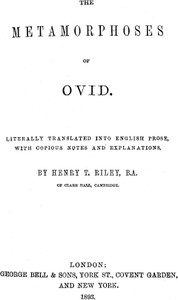
The volume presents Henry T. Riley’s literal English prose rendering of Ovid’s Metamorphoses covering Books VIII through XV, the latter half of the poet’s mythic encyclopedia. The introduction explains that the translation follows the Delphin edition, with occasional emendations noted, and that Riley supplies extensive notes drawn from ancient commentators such as Herodotus, Apollodorus and Pausanias. The e‑text reproduces the translator’s conventions, italics for supplied words, braces for translator’s insertions, and line numbers for each complete fable, so that readers can trace the original Latin structure while navigating the English narrative. The opening passage also details the technical steps needed to display the text correctly, underscoring the scholarly care taken to preserve the work’s integrity.

Riley’s voice is that of a late‑Victorian classicist, aiming for fidelity to the Latin while smoothing the diction for a modern reader. The style is formal yet accessible, interweaving the poetic episodes with explanatory footnotes that illuminate obscure mythological references. Scholars of classical literature, students of Latin poetry, and anyone fascinated by the intricate transformations of Greek and Roman myth will find this translation a rewarding companion to Ovid’s original verses.

Characters in The Metamorphoses of Ovid, Books VIII-XV

  • TheseusYoung Greek hero, muscular build, bronze breastplate, laurel wreath, short curly hair, determined expression
  • MedeaEnchantress with dark flowing robes, sharp eyes, long black hair, holding a staff, pale skin, solemn demeanor
  • OrpheusGentle-faced poet, long wavy hair, lyre in hand, simple tunic, laurel garland, serene expression

The opening · free to read

œ, Œ (oe ligature) κείρω, ἀκονιτὶ

If any of these characters do not display properly, or if the apostrophes and quotation marks in this paragraph appear as garbage, make sure your text reader’s “character set” or “file encoding” is set to Unicode (UTF-8). You may also need to change the default font. As a last resort, use the latin-1 version of the file instead.

In the original text, words and phrases supplied by the translator were printed in italics. In this e-text they are shown in braces {}. Italics in the notes and commentary are shown conventionally with lines. Square brackets [] in the body text are in the original.

Line numbers from the Latin poem--not its prose translation--were printed as headnotes on each page. For this e-text, only the line numbers of each complete “Fable” are given. Line numbers used in footnotes are retained from the original text; these, too, refer to the Latin poem and are independent of line divisions in the translation.

In Transcriber’s Notes, references to Clarke are from the third edition (1752).]

The book keeps going

Keep reading, and see it illustrated

Reading is free forever. Sign up and watch scenes appear while you read.

Illustrated scene from Pride and PrejudiceIllustrated scene from Alice's Adventures in WonderlandIllustrated scene from The Adventures of Sherlock Holmes

Scenes Storieta drew for other classics.

New illustrated classics

A new classic, drawn, in your inbox.

Once or twice a month: the latest books to get full character casts, scene art, and free comic editions. No account needed.