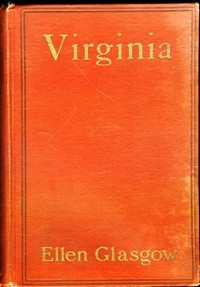
Public-domain ebook
Virginia
by Ellen Anderson Gholson Glasgow
Language: en572 downloads on Project Gutenberg
Subjects
In: Novels·American Literature
Public-domain ebook sourced from Project Gutenberg #26316.
Public-domain ebook
by Ellen Anderson Gholson Glasgow
Language: en572 downloads on Project Gutenberg
Subjects
In: Novels·American Literature
Public-domain ebook sourced from Project Gutenberg #26316.
The opening · free to read
Toward the close of a May afternoon in the year 1884, Miss Priscilla Batte, having learned by heart the lesson in physical geography she would teach her senior class on the morrow, stood feeding her canary on the little square porch of the Dinwiddie Academy for Young Ladies. The day had been hot, and the fitful wind, which had risen in the direction of the river, was just beginning to blow in soft gusts under the old mulberry trees in the street, and to scatter the loosened petals of syringa blossoms in a flowery snow over the grass. For a moment Miss Priscilla turned her flushed face to the scented air, while her eyes rested lovingly on the narrow walk, edged with pointed bricks and bordered by cowslips and wallflowers, which led through the short garden to the three stone steps and the tall iron gate. She was a shapeless yet majestic woman of some fifty years, with a large mottled face in which a steadfast expression of gentle obstinacy appeared to underly the more evanescent ripples of thought or of emotion. Her severe black silk gown, to which she had just changed from her morning dress of alpaca, was softened under her full double chin by a knot of lace and a cameo brooch bearing the helmeted profile of Pallas Athene. On her head she wore a three-cornered cap trimmed with a ruching of organdie, and beneath it her thin gray hair still showed a gleam of faded yellow in the sunlight. She had never been handsome, but her prodigious size had endowed her with an impressiveness which had passed in her youth, and among an indulgent people, for beauty. Only in the last few years had her fleshiness, due to rich food which she could not resist and to lack of exercise for which she had an instinctive aversion, begun seriously to inconvenience her.
Beyond the wire cage, in which the canary spent his involuntarily celibate life, an ancient microphylla rose-bush, with a single imperfect bud blooming ahead of summer amid its glossy foliage, clambered over a green lattice to the gabled pediment of the porch, while the delicate shadows of the leaves rippled like lace-work on the gravel below. In the miniature garden, where the small spring blossoms strayed from the prim beds into the long feathery grasses, there were syringa bushes, a little overblown; crape-myrtles not yet in bud; a holly tree veiled in bright green near the iron fence; a flowering almond shrub in late bloom against the shaded side of the house; and where a west wing put out on the left, a bower of red and white roses was steeped now in the faint sunshine. At the foot of the three steps ran the sunken moss-edged bricks of High Street, and across High Street there floated, like wind-blown flowers, the figures of Susan Treadwell and Virginia Pendleton.
Opening the rusty gate, the two girls tripped with carefully held flounces up the stone steps and between the cowslips and wallflowers that bordered the walk. Their white lawn dresses were made with the close-fitting sleeves and the narrow waists of the period, and their elaborately draped overskirts were looped on the left with graduated bows of light blue ottoman ribbon. They wore no hats, and Virginia, who was the shorter of the two, had fastened a Jacqueminot rose in the thick dark braid which was wound in a wreath about her head. Above her arched black eyebrows, which lent an expression of surprise and animation to her vivid oval face, her hair was parted, after an earlier fashion, under its plaited crown, and allowed to break in a mist of little curls over her temples. Even in repose there was a joyousness in her look which seemed less the effect of an inward gaiety of mind than of some happy outward accident of form and colour. Her eyes, very far apart and set in black lashes, were of a deep soft blue--the blue of wild hyacinths after rain. By her eyes, and by an old-world charm of personality which she exhaled like a perfume, it was easy to discern that she embodied the feminine ideal of the ages. To look at her was to think inevitably of love. For that end, obedient to the powers of Life, the centuries had formed and coloured her, as they had formed and coloured the wild rose with its whorl of delicate petals. The air of a spoiled beauty which rested not ungracefully upon her was sweetened by her expression of natural simplicity and goodness.
For an instant she stood listening in silence to the querulous pipes of the bird and the earnest exhortations of the teacher on the joys of cage life for both bird and lady. Then plucking the solitary early bud from the microphylla rose-bush, she tossed it over the railing of the porch on the large and placid bosom of Miss Priscilla.
"Do leave Dicky alone for a minute!" she called in a winning soprano voice.
At the sound, Miss Priscilla dropped the bit of cake she held, and turned to lean delightedly over the walk, while her face beamed like a beneficent moon through the shining cloud of rose-leaves.
"Why, Jinny, I hadn't any idea that you and Susan were there!"
Her smile included Virginia's companion, a tall, rather heavy girl, with intelligent grey eyes and fair hair cut in a straight fringe across her forehead. She was the daughter of Cyrus Treadwell, the wealthiest and therefore the most prominent citizen of the town, and she was also as intellectual as the early eighties and the twenty-one thousand inhabitants of Dinwiddie permitted a woman to be. Her friendship for Virginia had been one of those swift and absorbing emotions which come to women in their school-days. The stronger of the two, she dominated the other, as she dominated every person or situation in life, not by charm, but by the force of an energetic and capable mind. Though her dress matched Virginia's in every detail, from the soft folds of tulle at the neck to the fancy striped stockings under the bouffant draperies, the different shapes of the wearers gave to the one gown an air of decorous composure and to the other a quaint and appealing grace. Flushed, ardent, expectant, both girls stood now at the beginning of womanhood. Life was theirs; it belonged to them, this veiled, radiant thing that was approaching. Nothing wonderful had come as yet--but to-morrow, the day after, or next year, the miracle would happen, and everything would be different! Experience floated in a luminous mystery before them. The unknown, which had borrowed the sweetness and the colour of their illusions, possessed them like a secret ecstasy and shone, in spite of their shyness, in their startled and joyous look.
"Father asked me to take a message over to General Goode," explained Virginia, with a little laugh as gay as the song of a bird, "but I couldn't go by without thanking you for the cherry bounce. I made mother drink some of it before dinner, and it almost gave her an appetite."
"I knew it was what she needed," answered Miss Priscilla, showing her pleasure by an increasing beam. "It was made right here in the house, and there's nothing better in the world, my poor mother used to say, to keep you from running down in the spring. But why can't you and Susan come in and sit a while?"
"We'll be straight back in a minute," replied Susan before Virginia could answer. "I've got a piece of news I want to tell you before any one else does. Oliver came home last night."
"Oliver?" repeated Miss Priscilla, a little perplexed. "You don't mean the son of your uncle Henry, who went out to Australia? I thought your father had washed his hands of him because he had started play-acting or something?" Curiosity, that devouring passion of the middle-aged, worked in her breast, and her placid face grew almost intense in expression.
"Yes, that's the one," replied Susan. "They went to Australia when Oliver was ten years old, and he's now twenty-two. He lost both his parents about three years ago," she added.
"I know. His mother was my cousin," returned Miss Priscilla. "I lost sight of her after she left Dinwiddie, but somebody was telling me the other day that Henry's investments all turned out badly and they came down to real poverty. Sarah Jane was a pretty girl and I was always very fond of her, but she was one of the improvident sort that couldn't make two ends meet without tying them into a bow-knot."
"Then Oliver must be just like her. After his mother's death he went to Germany to study, and he gave away the little money he had to some student he found starving there in a garret."
"That was generous," commented Miss Priscilla thoughtfully, "but I should hardly call it sensible. I hope some day, Jinny, that your father will tell us in a sermon whether there is biblical sanction for immoderate generosity or not."
"But what does he say?" asked Virginia softly, meaning not the rector, but the immoderate young man.
"Oh, Oliver says that there wasn't enough for both and that the other student is worth more to the world than he is," answered Susan. "Then, of course, when he got so poor that he had to pawn his clothes or starve, he wrote father an almost condescending letter and said that as much as he hated business, he supposed he'd have to come back and go to work. 'Only,' he added, 'for God's sake, don't make it tobacco!' Wasn't that dreadful?"
"It was extremely impertinent," replied Miss Priscilla sternly, "and to Cyrus of all persons! I am surprised that he allowed him to come into the house."
"Oh, father doesn't take any of his talk seriously. He calls it 'starvation foolishness,' and says that Oliver will get over it as soon as he has a nice little bank account. Perhaps he will--he is only twenty-two, you know--but just now his head is full of all kinds of new ideas he picked up somewhere abroad. He's as clever as he can be, there's no doubt of that, and he'd be really good-looking, too, if he didn't have the crooked nose of the Treadwells. Virginia has seen him only once in the street, but she's more than half in love with him already."
"Do come, Susan!" remonstrated Virginia, blushing as red as the rose in her hair. "It's past six o'clock and the General will have gone if we don't hurry." And turning away from the porch, she ran between the flowering syringa bushes down the path to the gate.
Having lost his bit of cake, the bird began to pipe shrilly, while Miss Priscilla drew a straight wicker chair (she never used rockers) beside the cage, and, stretching out her feet in their large cloth shoes with elastic sides, counted the stitches in an afghan she was knitting in narrow blue and orange strips. In front of her, the street trailed between cool, dim houses which were filled with quiet, and from the hall at her back there came a whispering sound as the breeze moved like a ghostly footstep through an alcove window. With that strange power of reflecting the variable moods of humanity which one sometimes finds in inanimate objects, the face of the old house had borrowed from the face of its mistress the look of cheerful fortitude with which her generation had survived the agony of defeat and the humiliation of reconstruction. After nineteen years, the Academy still bore the scars of war on its battered front. Once it had watched the spectre of famine stalk over the grass-grown pavement, and had heard the rattle of musketry and the roar of cannon borne on the southern breeze that now wafted the sounds of the saw and the hammer from an adjacent street. Once it had seen the flight of refugees, the overflow of the wounded from hospitals and churches, the panic of liberated slaves, the steady conquering march of the army of invasion. And though it would never have occurred to Miss Priscilla that either she or her house had borne any relation to history (which she regarded strictly as a branch of study and visualized as a list of dates or as a king wearing his crown), she had, in fact, played a modest yet effective part in the rapidly changing civilization of her age. But events were powerless against the genial heroism in which she was armoured, and it was characteristic of her, as well as of her race, that, while she sat now in the midst of encircling battlefields, with her eyes on the walk over which she had seen the blood of the wounded drip when they were lifted into her door, she should be brooding not over the tremendous tragedies through which she had passed, but over the lesson in physical geography she must teach in the morning. Her lips moved gently, and a listener, had there been one, might have heard her murmur: "The four great alluvial plains of Asia--those of China and of the Amoo Daria in temperate regions; of the Euphrates and Tigris in the warm temperate; of the Indus and Ganges under the Tropic--with the Nile valley in Africa, were the theatres of the most ancient civilizations known to history or tradition----"
The book keeps going
Reading is free forever. Sign up and watch scenes appear while you read.



Scenes Storieta drew for other classics.
New illustrated classics
Once or twice a month: the latest books to get full character casts, scene art, and free comic editions. No account needed.