Public-domain ebook
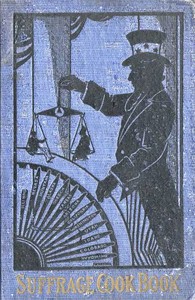
The Suffrage Cook Book
Language: en5,311 downloads on Project Gutenberg
Subjects
In: Cookbooks and Cooking·Suffrage·Cooking & Drinking
Public-domain ebook sourced from Project Gutenberg #26323.
Public-domain ebook
Language: en5,311 downloads on Project Gutenberg
Subjects
In: Cookbooks and Cooking·Suffrage·Cooking & Drinking
Public-domain ebook sourced from Project Gutenberg #26323.
The Suffrage Cook Book presents itself as a practical guide that intertwines culinary instruction with the social reform agenda of early‑twentieth‑century women’s suffrage. Its opening pages argue that modern science has turned cooking into a precise discipline, yet ordinary meals remain unchanged, and it calls on women, described as the natural guardians of children, to master balanced rations and wholesome preparation. The author frames the work as a “dependable guide” aimed at improving health, morality, and civic life, and the extensive front matter lists a wide array of contributors ranging from activists such as Anna Howard Shaw and Jane Addams to politicians and literary figures, underscoring the book’s collective, reformist spirit. The text then moves into a conventional recipe section, beginning with soups, vegetables, meats, breads, and desserts, each laid out in straightforward, instructional format.
Written in a earnest, didactic voice characteristic of progressive‑era pamphlets, the book blends earnest moralizing with detailed, step‑by‑step cooking directions. Its language reflects the formal, slightly rhetorical style of the 1910s, complete with references to “the great cause” and the “spiritual” impact of food. Readers who enjoy historical cookbooks that double as social commentary, particularly those interested in the intersection of domestic science, women's activism, and early American culinary practices, will find this volume both informative and evocative of its time.
The opening · free to read
In these later times professors of the culinary art tell us the cooking has been reduced to a science, and that there is no more guess work about it. They have given high sounding names to the food elements, figured out perfectly balanced rations, and adjusted foods to all conditions of health, or ill health. And yet the world is eating practically the same old things, and in the same old way, the difference being confined mainly to the sauces added to please the taste.
Now that women are coming into their own, and being sincerely interested in the welfare of the race, it is entirely proper that they should prescribe the food, balance the ration, and tell how it should be prepared and served.
Seeing that a large majority of the sickness that plagues the land is due to improper feeding, and can be prevented by teaching the simple art of cooking, of serving and of eating, the wonder is that more attention has not been given to instruction in the simpler phases of the culinary art.
It is far from being certain that famous chefs have contributed greatly to the health and long life of those able to pay the fine salaries they demand. Nor are these sent to minister to the sick, nor to the working people, nor to the poor. It would seem that even since before the time of Lucullus their business has been mainly to invent and concoct dishes that would appeal to perverted tastes and abnormal appetites.
The simple life promises most in this earthly stage of our existence, for as we eat so we live, and as we live so we die, and after death the judgment on our lives. Thus it is that our spiritual lives are more or less directly influenced by our feeding habits.
Eating and drinking are so essential to our living and to our usefulness, and so directly involved with our future state, that these must be classed with our sacred duties. Hence the necessity for so educating the children that they will know how to live, and how to develop into hale, hearty and wholesome men and women, thus insuring the best possible social and political conditions for the people of this country.
"The surest way into the affections of a man is through his stomach, also to his pocket," is an ancient joke, and yet not all a joke, there being several grains of truth in it, enough at least to warrant some thoughtful attention.
Women being the homekeepers, and the natural guardians of the children, it is important that they be made familiar with the culinary art so they may be entirely competent to lead coming generations in the paths of health and happiness.
So say the members of Equal Franchise Associations throughout the length and breadth of our land, and beyond the border as far as true civilization extends.
Hence this book which represents an honest effort to benefit the people, old and young, native and foreign. It is not a speculative venture but a dependable guide to a most desirable social, moral and physical state of being.
Disguise it as we may the fact remains that the feeding of a people is of first importance, seeing the feeding is the great essential to success, either social or commercial. The farmer and stock raiser gives special attention to feeding, usually more to the feeding of his animals than of his children, or of himself. And yet he wonders why his domestic affairs do not thrive and prosper as does his farming and stock raising.
Physical trainers are most particular about what the members of their classes eat and drink. One mess of strawberry short cake and cream will unfit a boy for a field contest for a whole week, while a full meal of dainties may completely upset a man or woman for a day or two.
The cook book of the past was filled mainly with recipes for dainties rather than sane and wholesome dishes; the aim being to please the taste for the moment rather than to feed the body and the brain.
Now that we are entering upon an age of sane living it is important that the home makers should be impressed with the fact that good health precedes all that is worth while in life, and that it starts in the kitchen; that the dining room is a greater social factor than the drawing room.
In the broader view of the social world that is dawning upon us the cook book that tells us how to live right and well will largely supplant Shakespeare, Browning, and the lurid literature of the day.
As it is a serious matter what is put into the human stomach, I feel it incumbent to say that my readers may safely eat everything set down in this book.
Most recipes have been practically tested by me, and those of which I have not eaten coming with such unquestionable authority, there need be no hesitancy in serving them alike to best friend as well as worst enemy--for I believe in the one case it will strengthen friendship, and in the other case it will weaken enmity.
It being a human Cook Book there will likely be some errors, but as correcting errors is the chief duty and occupation of Suffrage Women, I shall accept gratefully whatever criticisms these good women may have to offer.
I thank all for the courtesy shown me and hope our united efforts will prove helpful to the Great Cause.
I ask pardon for any omission of contributors and their recipes.
MRS. L. O. KLEBER.
Mrs. John O. Miller Pittsburgh, Pa. Dr. Anna Howard Shaw New York, N. Y. Lady Constance Lytton London, England Jane Addams Chicago, Ill. Governor Hiram W. Johnson San Francisco, Cal. Mrs. Henry Villard New York, N. Y. Mrs. F. L. Todd Pittsburgh, Pa. Mrs. Kate Waller Barrett Alexandria, Va. Mr. George W. Cable Northampton, Mass. Mrs. Wallis Tener Sewickley, Pa. Miss Eliza Kennedy Pittsburgh, Pa. Governor George H. Hodges Topeka, Kansas Miss Julia Lathrop Washington, D. C. Miss Laura Kleber Pittsburgh, Pa. Mrs. Harriett Taylor Upton Warren, Ohio Mrs. Desha Breckenridge Kentucky Miss Louise G. Taylor Pittsburgh, Pa. Mr. Irvin S. Cobb New York, N. Y. Miss Mary Bakewell Sewickley, Pa. Mrs. Olive Dibert Reese Johnstown, Pa. Miss Lillie Gittings Pittsburgh, Pa. Judge Ben Lindsay Denver, Colo. Mrs. Richard Morley Jennings Pittsburgh, Pa. Mrs. Will Pyle Bellevue, Pa. Mrs. Hornberger Pittsburgh, Pa. Mr. Philip Dibert Oakland, Calif. Miss Elide Schleiter Pittsburgh, Pa. Mrs. David H. Stewart Fair Hope, Ala. Miss Annabelle McConnell Pittsburgh, Pa. Mrs. J. G. Pontefract Sewickley, Pa. Mrs. O. H. P. Belmont New York, N. Y. Governor Edward F. Dunne Springfield, Ill. Mrs. Enoch Rauh Pittsburgh, Pa. Miss Helen Ring Robinson Denver, Colo. Miss Sarah Bennett Pittsburgh, Pa. Miss Leah Alexander Boise City, Idaho. Mrs. A. Hilleman Pittsburgh, Pa. Mrs. Medill McCormick Chicago, Ill. Mrs. Carmen London Glen Ellen, Calif. Jack London Glen Ellen, Calif. Mrs. Edward Hussey Binns Pittsburgh, Pa. Governor Joseph Carey Cheyenne, Wyoming. Mrs. Edmond Esquerre Pittsburgh, Pa. Mrs. Emma Todd Moore West Alexander, Pa. Mrs. Samuel Semple Brookville, Pa. Mrs. John Dewar Bellevue, Pa. Governor Ernest Lister Olympia, Washington. Miss Anna McCord Pittsburgh, Pa. Mrs. Raymond Robins Chicago, Ill. Mrs. C. C. Lee Pittsburgh, Pa. Mrs. Charlotte Perkins Gilman New York, N. Y. Mrs. Robert Gordon Pittsburgh, Pa. Governor George P. Hunt Phoenix, Arizona. Miss Elizabeth Ogden Pittsburgh, Pa. Mrs. Mary Watson Pittsburgh, Pa. Joseph Gittings Pittsburgh, Pa. Eugene D. Monfalconi Pittsburgh, Pa.
The book keeps going
Reading is free forever. Sign up and watch scenes appear while you read.



Scenes Storieta drew for other classics.
New illustrated classics
Once or twice a month: the latest books to get full character casts, scene art, and free comic editions. No account needed.