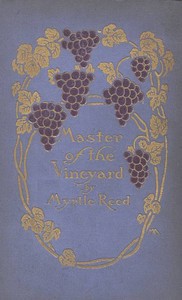
Public-domain ebook
Master of the Vineyard
by Myrtle Reed
Language: en7,116 downloads on Project Gutenberg
Subjects
In: Romance·Novels·American Literature
Public-domain ebook sourced from Project Gutenberg #27661.
Public-domain ebook
by Myrtle Reed
Language: en7,116 downloads on Project Gutenberg
Subjects
In: Romance·Novels·American Literature
Public-domain ebook sourced from Project Gutenberg #27661.
The novel opens with a lyrical panorama of a secluded valley, where Rosemary, a twenty‑five‑year‑old woman, surveys the world from a hilltop that has long represented her escape from “the iron bars of circumstance.” The narrative quickly moves from her solitary contemplation of the river, the aging vineyard, and the red ribbon she ties to a birch, to the arrival of a man who answers her signal after three years of punctual visits. Their dialogue, set against the backdrop of a family‑owned vineyard and a schoolhouse, introduces the central tension of man‑woman relationships, as both characters voice their dislikes, grapes, children, routine, and their yearning for freedom, while the surrounding landscape mirrors their emotional states.
Written in a richly descriptive, almost poetic prose style, the book reflects the late‑19th‑century sensibility of romantic realism, with its elaborate metaphors and frequent asides. Readers who appreciate atmospheric settings, introspective character exchanges, and a contemplative exploration of love and duty will find this work engaging, especially those drawn to stories that blend natural scenery with the inner lives of their protagonists.
The opening · free to read
Only one house was near the river; the others were set farther back. The one upon the shore was the oldest and largest house in the valley, severely simple in line and with a certain air of stateliness. The broad, Colonial porch looked out upon the river and the hills beyond it, while all around, upon the southern slope between the opposite hills and the valley, were the great vineyards of the Marshs', that had descended from father to son during the century that had elapsed since the house was built.
The gnarled and twisted vines scarcely showed now, upon the grey-brown background of the soil, but in a few places, where the snow had not yet melted, the tangled black threads were visible. Like the frame surrounding a tapestry, great pines bordered the vineyard save on the side nearest the valley, for the first of the Marshs, who had planted the vineyard and built the house, had taken care to protect his vines from the north-east storms.
The clanging notes of a bell, mellowed by distance, came faintly from the valley below. Rosemary took out the thin, old watch that had been her mother's and her mother's mother's before her, and set the hands at four upon the pale gold dial. Then she drew up the worn gold chain that hung around her neck, under her gown, and, with the key that dangled from it, wound the watch. In an hour or so, probably, it would stop, but it was pleasant to hear the cheerful little tick while she waited.
The doors of the white schoolhouse in the valley burst open and the tide of exuberant youth rushed forth. Like so many ants, the children swarmed and scattered, their shrill voices sounding afar. Rosemary went to a hollow tree, took out a small wooden box, opened it, and unwound carefully a wide ribbon of flaming scarlet, a yard or more in length. Digging her heels into the soft earth, she went down to the lowest of the group of birches, on the side of the hill that overlooked the valley, and tied the ribbon to a drooping bough. Then she went back to the top of the hill, where a huge log, rolled against two trees, made a comfortable seat for two people.
Five minutes of the allotted twenty had passed since Rosemary had set her watch. At twenty minutes past four, or, at the most, twenty-five, he would come. For three years and more he had never failed to answer the signal, nor, indeed, to look for it when he brushed the chalk from his clothes and locked the door of the schoolhouse behind him.
A kindly wind, in passing, took the ribbon and made merry with it. In and out among the bare boughs of the birches it fluttered like a living thing, and Rosemary laughed aloud, as she had not done for many days. The hill, the scarlet signal, and the man who was coming symbolised, to her, the mysterious world of Romance.
Sometimes the birches were shy dryads, fleeing before the wrath of some unknown god. At other times, they were the Muses, for, as it happened, there were nine in the group and no others upon the hill. The vineyard across the valley was a tapestry, where, from earliest Spring until the grapes were gathered colour and light were caught and imprisoned within the web. At the bend in the river, where the rushes grew thickly, the river-god kept his harp, which answered with shy, musical murmurings to every vagrant wind.
Again, the hill was a tower, and she a captive princess, who had refused to marry except for love, and Love tarried strangely upon the way. Or, sometimes, she was the Elaine of an unknown Launcelot, safely guarding his shield. She placed in the woods all the dear people of the books, held forever between the covers and bound to the printed page, wondering if they, too, did not long for freedom.
The path up the hill wound in and out among the trees, and so it happened that Rosemary heard muffled footsteps before she saw him coming. A wayfaring squirrel, the first of his family to venture out, scampered madly up a tree and looked down upon the girl with questioning, fearful eyes. She rose from the log and looked up, with her hands outstretched in unconscious pleading.
"No?" he queried, flushed and breathless from the climb. "I wonder if there is anyone else for whom you wave red ribbons from your fortress!"
"Take it down, will you please?"
"Wait until I get three full breaths--then I will."
She went back to the log while he awkwardly untied the ribbon, rolled it up, in clumsy masculine fashion, and restored it to the wooden box in the hollow tree. "Aren't you cold?" he asked, as he sat down beside her.
"No--I'm too vividly alive to be cold, ever."
"But what's the use of being alive unless you can live?" he inquired, discontentedly.
She sighed and turned her face away. The colour vanished from her cheeks, the youth from her figure. Pensively, she gazed across the valley to the vineyard, where the black, knotted vines were blurred against the soil in the fast-gathering twilight. His eyes followed hers.
"Of course. Aren't they always bad? What's the use of caging up fifty little imps and making 'em learn the multiplication table when they don't even aspire to the alphabet? Why should I have to teach 'em to read and write when they're determined not to learn? Why do I have to grow grapes when it would be the greatest joy of my life to know that I'd never have to see, touch, taste, or even smell another grape in this world or the next?"
She turned toward him. A late Winter sunset shimmered in the west like some pale, transparent cloth of gold hung from the walls of heaven, but the kindly light lent no beauty to her face. Rosemary's eyes were grey and lustreless, her hair ashen, and almost without colour. Her features were irregular and her skin dull and lifeless. She had not even the indefinable freshness that is the divine right of youth. Her mouth drooped wistfully at the corners, and even the half-discouraged dimple in her chin looked like a dent or a scar.
The bare hands that lay listlessly in her lap were rough and red from much uncongenial toil. He looked at her for a moment, still absorbed in himself, then, as he noted the pathos in every line of her face and figure, the expression of his face subtly changed. His hand closed quickly over hers.
The book keeps going
Reading is free forever. Sign up and watch scenes appear while you read.



Scenes Storieta drew for other classics.
New illustrated classics
Once or twice a month: the latest books to get full character casts, scene art, and free comic editions. No account needed.