Public-domain ebook
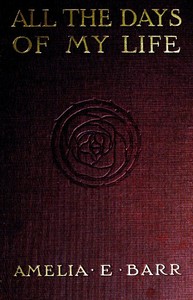
All the Days of My Life: An Autobiography The Red Leaves of a Human Heart
Language: en1,355 downloads on Project Gutenberg
Subjects
In: Biographies
Public-domain ebook sourced from Project Gutenberg #35706.
Public-domain ebook
Language: en1,355 downloads on Project Gutenberg
Subjects
In: Biographies
Public-domain ebook sourced from Project Gutenberg #35706.
All of the work is presented as an autobiography by Amelia E. Barr, a nineteenth‑century American novelist who lived from 1831 to 1919. The opening pages explain that, despite her earlier resolve not to write a memoir, the relentless press coverage of her life forces her to adopt the autobiographical form. She frames the book as a corrective to published errors, a response to public demand, and a vehicle for personal motives that will become clear as she writes. The introductory chapter, titled “The Border Land of Life,” immediately situates the narrative in her birth on March 29, 1831, in Ulverston, Lancashire, and proceeds to trace her family’s lineage, the maritime tragedies of her ancestors, and the religious upbringing that shaped her early years. The text is interwoven with reflections on spiritual possession, familial duty, and the desire to offer solace to other women.
Barr’s voice is earnest and reflective, marked by a Victorian‑era diction that blends moral earnestness with a hint of self‑aware humor. Her style moves fluidly between personal anecdote, genealogical detail, and philosophical musings, creating a portrait that feels both intimate and historically grounded. Readers who appreciate nineteenth‑century women’s writing, especially those interested in the intersections of biography, religious thought, and the social expectations of the era, will find this memoir rewarding. It offers a window into the life of a prolific author while speaking directly to women seeking encouragement and insight from a seasoned, contemplative mind.
The opening · free to read
This is to be a book about myself but, even before I begin it, I am painfully aware of the egotistical atmosphere which the unavoidable use of the personal pronouns creates. I have hitherto declared that I would not write an autobiography, but a consideration of circumstances convinces me that an autobiography is the only form any personal relation can now take. For the press has so widely and so frequently exploited certain events of my life--impossible to omit--that disguise is far out of the question. Fiction could not hide me, nor an assumed name, nor even no name at all.
Why, then, write the book? First, because serious errors have constantly been published, and these I wish to correct; second, there has been a long-continued request for it, and third, there are business considerations not to be neglected. Yet none, nor all of these three reasons, would have been sufficient to induce me to truck my most sacred memories through the market-place for a little money, had I not been conscious of a motive that would amply justify the book. The book itself must reveal that reason, or it will never be known. I am sure, however, that many will find it out, and to these souls I shall speak, and they will keep my memory green, and listen to my words of strength and comfort long after the woman called Amelia Huddleston Barr has disappeared forever.
Again, if I am to write of things so close and intimate as my feelings and experiences, I must claim a large liberty. Many topics usually dilated on, I shall pass by silently, or with slight notice; and, if I write fully and truly, as I intend to do, I must show many changes of opinion on a variety of subjects. This is only the natural growth of the mental and spiritual faculties. For the woman within, if she be of noble strain, is never content with what she has attained; she unceasingly presses forward, in lively hope of some better way, or some more tangible truth. If any woman at eighty years of age was the same woman, spiritually and mentally, she was at twenty, or even fifty, she would be little worthy of our respect.
Also, there are supreme tragedies and calamities in my life that it would be impossible for me to write down. It would be treason against both the living and the dead. But such calamities always came from the hand of man. I never had a sorrow from the hand of God that I could not tell to any good man or woman; for the end of God-sent sorrow is some spiritual gain or happiness. We hurt each other terribly in this world, but it is in ways that only the power which tormented the perfect man of Uz would incite.
I write mainly for the kindly race of women. I am their sister, and in no way exempt from their sorrowful lot. I have drank the cup of their limitations to the dregs, and if my experience can help any sad or doubtful woman to outleap her own shadow, and to stand bravely out in the sunshine to meet her destiny, whatever it may be, I shall have done well; I shall not have written this book in vain. It will be its own excuse, and justify its appeal.
The book keeps going
Reading is free forever. Sign up and watch scenes appear while you read.



Scenes Storieta drew for other classics.
New illustrated classics
Once or twice a month: the latest books to get full character casts, scene art, and free comic editions. No account needed.