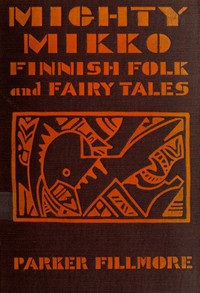
The spirit of nationalism that swept over the small peoples of Europe in the early nineteenth century touched faraway Finland and started the Finns on the quest of the Finnish. There as elsewhere scholars who were also patriots found that the native tongue, lost to the educated and the well-to-do, had been preserved in the songs and stories which were current among the peasants. Elias Lönnrot spent a long and busy life collecting those ancient runos from which he succeeded in building up a national epic, the Kalevala. This is Lönnrot's great contribution to his own country and to the world. Beside the material for the Kalevala Lönnrot made important collections of lyrics, proverbs, and stories.
During his time and since other patriot scholars have made faithful records of the songs and tales which the old Finnish minstrels, the runolaulajat, chanted to the strains of the kantele. The mass of such material now gathered together in the archives of the Society of Finnish Literature at Helsingfors is imposing in bulk and of great importance to the student of comparative folklore.
My own excursions into the Finnish have been made possible through the kindness and endless patience of my friend, Lydia Tulonen (Mrs. Kurt J. Rahlson). With her as a native guide I have been wandering some time through the byways of Finnish folklore. The present volume is the traveler's pack I have brought home with me filled with strange treasures which will, I hope, seem as lovely to others as they seemed to me when first I came upon them.
The stories as I offer them are not translations but my own versions. Literal translations from the Finnish would make small appeal to the general reader. To English ears the Finnish is stiff, bald, and monotonous. One has only to read or attempt to read Kirby's excellent translation of the Kalevala to realize the truth of this statement. So I make no apology for retelling these tales in a manner more likely to prove entertaining to the English reader, whether child or adult.
In some form or other all the tales in this book may be found in the various folklore collections made by Eero Salmelainen, one of the patriotic young scholars who followed in Lönnrot's footsteps. His books were sponsored by the Society of Finnish Literature and used in its campaign to bring back the Finnish language to the Finns at a time when Swedish was the official language of the country.
Full of local color as these stories are, it would be vain to pretend that they are not, for the most part, variants of stories told the world over. All that I can claim for them is that they are dramatic and picturesque, that they are told with a wealth of charming detail which is essentially Finnish, and that they are certainly new to the generality of English readers. The Three Chests, so characteristic in feeling of a country famous for its lakes and marshes, is the variant of a German story which Grimm gives as Fitcher's Bird. Of The Forest Bride I have found variants in the folklore of many lands. There are several very beautiful ones in the Russian; in other books I myself have retold two, one current among the Czechs and one among the Serbians; Grimm has two different versions in The Three Feathers and The Poor Miller's Boy and the Cat; and Madame d'Aulnoy has used the same story in her elaborate tale, The White Cat. There is a well-known Oriental version of Mighty Mikko in which the part of the fox is played by a jackal and I am sure that Mikko's faithful retainer, though neither city-bred nor polished, is after all pretty closely related to that most debonnaire of Frenchmen, Puss in Boots. Perrault probably and Madame d'Aulnoy certainly are in turn indebted to Straparola. And so it goes.
The little cycle of animal stories included under Mikko the Fox will of course instantly invite comparison with the Beast Epic of Reynard the Fox. The two have many episodes in common and both have episodes to be found in Æsop and in those books of animal analogues, widely read in mediæval times, Physiologus and the Disciplina Clericalis of Petrus Alfonsus. The Reynard as we have it is a finished satire on church and state and in its present form has been current in Europe since the twelfth century. It was thought at one time that the animal stories found in Finland were debased versions of the Reynard stories, but scholars are now of opinion that they antedate Reynard and are similar to the earlier simpler stories upon which the Reynard cycle was originally built. This makes the little Finnish tales of great interest to the student. Needless to say I do not present them for this reason but because they seem to me charming merely as fables. The animals here are not the clerics and the judges and the nobles that the Reynard animals are, but plain downright Finnish peasants, sometimes stupid, often dull, frequently amusing, and always very human.
I have taken one liberty with spelling. I have transliterated Syöjätär, the name of the dread Finnish witch, as Suyettar. I have been unwilling to translate by the insufficient word, bath-house or vapor bath, that very characteristic institution of Finnish family life, the sauna, but have retained the Finnish word, sauna, allowing the context in each case to indicate the meaning.
P. F.
The book keeps going
Keep reading, and see it illustrated
Reading is free forever. Sign up and watch scenes appear while you read.
Scenes Storieta drew for other classics.