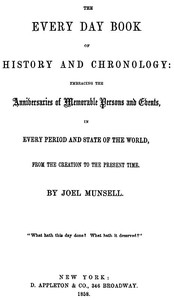
The object of this work, as will be seen, is to bring together the great events of each day of the year, in all ages, as far as their dates can be ascertained, and to arrange them chronologically. It has been necessary to observe brevity in its compilation, in order to reduce it within a proper compass. Hence notices of the most eminent men are often confined to two or three lines, while individuals of less note have occasionally received more attention, on account of the absence of ready reference to them in books.
The dates are in accordance, it is believed, with the best authorities. Great care has been taken to make them so, and nothing has been inserted for which there was not at least some authority. Occasionally authors have been found to disagree in days, months, and even years, and it has been necessary to reconcile, as well as possible, such discrepancies. Much of this confusion arises from the change in the calendar; some authors following the old, others the new style, without informing us which they adhere to. The protestant countries did not all adopt the new style till 1777, about two centuries after the catholic authorities had reformed the calendar. The Russians still use the Julian era, and are now consequently twelve days behind the true time. With these difficulties in the way, no ordinary vigilance ensures an entire freedom from error in a work like this. The dates here, however, are made to conform to the new style as far as practicable. In some cases where different dates have been given, and it has been found impossible to determine the true one, the article has been inserted under different days with cross references. Repetitions have crept in however, which could only be discovered in preparing the index. Errors of this kind are perpetuated by a succession of authors following a wrong date, and are exceedingly difficult to detect, or when suspected, not easily traced to their origin. When dates have been taken from computations of time other than the Christian era, it should be understood that the corresponding day has been made to conform to our own era, and consequently perfect accuracy can not be claimed for them.
It has been said that geography and chronology are the eyes of history; in aiding to promote one of these sciences, the reader will not fail to discover how great and varied is the amount of facts brought together, rendering the work of use to persons of every age and calling. A reference to the index will show more clearly the extent of the work.
January 1
154 B. C. It was fixed that the Roman consuls should always enter upon their office on this day, and the years were named after them. On this occasion they went in solemn procession to the Capitol to sacrifice to Jupiter Capitolinus; after which the senate held a solemn session. Those who had discharged the office of consul enjoyed the pre-eminence of rank over the other senators. They were annually elected by the people till the time of Tiberius, who ordered that they should be chosen by the senate. The last consul after whom the year was named, was Barsilius, in the year 541, in the reign of Justinianus.
38. B. C. The Spanish era, or era of the Cæsars, commenced, being the year following the conquest of Spain by Augustus. It was much used in Africa, Spain and the south of France; but was abolished by one kingdom after another during the fourteenth century, and by Portugal 1555.
404. TELEMACHUS, or St. Almachus, whose story is the foundation of Fenelon's famed work Telemaque, suffered martyrdom at Rome.
1109. The Festival of Fools was instituted at Paris, and continued prosperous for 240 years. This, with the Lords of Misrule, and the Abbots of Unreason, was doubtless designed to ridicule the Druidic saturnalia.
1308. WILLIAM TELL, the Swiss patriot, associated himself on this day with a band of his countrymen against the tyranny of their oppressors.
1349. EDWARD III, king of England, defeated the French before Calais with great slaughter.
1504. Birthday of CASPER CRUCIGER, an extensive and multifarious scholar, and a follower of Luther. He died 1548.
1515. LOUIS XII of France, surnamed the father of the people, died. Notwithstanding the faults of his education, which had been purposely neglected, he became a wise and politic monarch, who had the welfare and improvement of his country in mind. Though extensively engaged in wars, he avoided burdening the people with taxes--was economical, just and magnanimous.
1513. JUAN DIAZ DE SOLIS, coasting the southern continent, discovered the mouth of a river on this day, which in consequence he called Rio Janeiro.
1516. JUAN DIAZ DE SOLIS again entered the Rio de Solis which he had discovered three years previous. In attempting a descent on the country he was slain by the natives, who in sight of the ship cut his body in pieces, and roasted and devoured it. He was reputed the ablest navigator in the world.
1523. Knights of Malta driven from the island of Rhodes by the Turks.
1537. JAMES V of Scotland married Magdalen, daughter of Francis I of France.
1617. HENRY GOLTZIUS, a distinguished Dutch painter and engraver, died. His father was a painter on glass, and gave his son instructions in the art; but it was his own genius and application that raised him to the rank he ultimately held among the best artists of the time.
1618. Charter of the first New Netherland company expired by its own limitation.
1618. Birthday of BARTHOLOMEW ESTEBAN MURILLO, the greatest of all the Spanish painters. He was employed by the churches and convents of Seville a great number of years, which were enriched by the masterly productions of his pencil, and procured for himself an independent fortune. Having been invited to Cadiz, he there executed his grand picture of St. Catharine; but just as he was about to finish it he was dreadfully wounded on the scaffolding, and died at Seville, 1682.
1630. THOMAS HOBSON, the celebrated carrier of Cambridge, England, died. One of the most general proverbial expressions in England originated with him. He let to students and others horses, and his practice was to secure equal portions of rest as well as work for each horse. Hence when applied to for any, none but that which had its due proportion of rest could be let. "This or none" was the answer. Hence the phrase "Hobson's choice; this or none."
1644. MICHOB ADER, calling himself the Wandering Jew, appeared at Paris, where he created an extraordinary sensation among all ranks. He pretended to have lived sixteen hundred years, and that he had traveled through all regions of the world. He was visited by the literati of the city, and no one could accost him in a language that he was ignorant of; he was also familiar with the history of persons and events from the time of Christ, so that he was never confounded by intricate or cross-questions; but replied readily and without embarrassment. The learned looked upon him as a counterfeit, or madman, yet they took their leave of him bewildered and astonished.
1651. CHARLES II crowned king of Scotland at Scone.
1661. A parliament met in Scotland.
1700. The Russians began their new year.
1715. WILLIAM WYCHERLEY died, aged 81, an eminent English dramatic writer and comic poet.
1727. CLAUDE ADRIAN HELVETIUS died; a celebrated Dutch physician, who, having obtained celebrity by introducing the use of ipecacuanha in dysentery, was made inspector general of military hospitals, and died at London.
1729. Great fog in London, persons lost their way in St. James' park, and many fell into the canal.
1730. SAMUEL SEWALL, chief justice of the supreme court of Massachusetts died.
1731. EDWARD CAVE printed the first number of the well known Gentleman's Magazine.
1748. Birthday of GODFREY AUGUSTUS BURGER, a celebrated German poet, and the writer of that whimsical satire, Munchausen's Travels.
1748. JOHN BERNOUILLI, a Swiss mathematician, died. He was born at Basil in Switzerland, and educated for a merchant, but afterwards studied medicine, and finally devoted his attention to mathematics with great success. He was the contemporary of Leibnitz and De L'Hopital, and of Newton. His labors in the science were indefatigable, and his works contain an immense mass of discovery. But the details of his private life exhibit an unusual degree of acerbity and disingenuousness.
1752. The new style commenced this day in England by act of parliament. (See March 25.)
1757. Calcutta surrendered to the British under Admiral Watson, Colonel Clive and Captain Coote.
1761. Great hurricane in the East Indies, destroying a part of the British fleet; of the crews of three of the ships lost but 14 were saved out of 1100.
1776. Norfolk Burnt. Lord Dunmore, the royal governor of Virginia, having abandoned the town and retired on board his ships, became distressed for provisions; and on the arrival of the Liverpool man of war, the inhabitants refusing to supply his majesty's ships, the place was reduced to ashes. The provincials themselves destroyed the houses and plantations near the water, to deprive the ships of every resource of supply.
1781. Revolt of the Pennsylvania line at Morristown, N. J. They had enlisted for three years, and that term having expired they wished to be discharged.
1787. ARTHUR MIDDLETON, a signer of the Declaration of Independence, died. He was a native of South Carolina, born 1743, and educated in England; and at the age of twenty-two made the tour of Europe. On the breaking out of the war he engaged warmly on the side of the colonies. In 1779 he distinguished himself in the defence of Charleston against the British, who afterwards ravaged his plantation and rifled his mansion, by which he suffered an immense loss of property; and in the following year he was taken prisoner. On the termination of the contest he returned to his native seat, and spent the remainder of his life in elegant and philosophical ease--a model of private wealth and public virtue; a firm patriot and an enlightened philanthropist.
1793. A beginning was made upon the Pennsylvania state canal, at Conewago falls; seventeen rocks being blasted--one for each stockholder of the canal company.
1794. The French convention abolished flogging in the army and navy and substituted other punishments more congenial with the spirit of the times.
1794. THOMAS PAINE and ANACHARSIS CLOOTS arrested by order of Robespierre and sent to prison in Paris.
1797. ZEMAUN SHAH made his triumphal entry into Lahore, the capital of the Sikhs, where he formed an army of 100,000 men with a view of marching upon Delhi.