Public-domain ebook
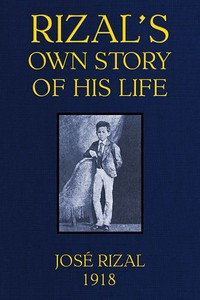
Rizal's own story of his life
by José Rizal
Language: en16,233 downloads on Project Gutenberg
Subjects
In: Biographies·History - Other
Public-domain ebook sourced from Project Gutenberg #48438.
Public-domain ebook
by José Rizal
Language: en16,233 downloads on Project Gutenberg
Subjects
In: Biographies·History - Other
Public-domain ebook sourced from Project Gutenberg #48438.
Rizal’s Own Story of His Life is an autobiographical memoir compiled from the young José Rizal’s own writings, sketches, and musical arrangements. The volume opens with a self‑portrait drawn in Berlin when he was twenty‑five, followed by a series of poems set to familiar tunes, a list of acknowledgments, and a litany of illustrations that trace his family, school, and early artistic endeavors. The first chapters recount his birth in Kalamba, his childhood memories, and his schooling in Biñan, presented in the straightforward, first‑person voice of a teenager who would later become the Philippines’ national hero. The text is interspersed with photographs, drawings, and reproductions of his own artwork, giving readers a tactile sense of the man behind the legend.
The narrative is written in the earnest, descriptive style of a late‑nineteenth‑century diary, reflecting the language and sensibilities of a colonial‑era Filipino intellectual. Its blend of personal anecdote, cultural observation, and modest self‑reflection will appeal to readers interested in historical autobiography, scholars of Southeast Asian history, and anyone drawn to the formative years of a figure whose influence shaped a nation.
The opening · free to read
Miss Josephine Craig advised and assisted in the selections.
Hon. C. E. Yeater read and criticised the original manuscript.
Miss M. W. Sproull revised the translations.
Dean Francisco Benitez acted as pedagogical adviser.
Miss Gertrude McVenn simplified the language for primary school use.
Mr. John C. Howe adapted and arranged the music.
Mr. Frederic H. Stevens planned the make-up and, in spite of wartime difficulties, provided the materials needed.
Mr. Chas. A. Kvist supervised the production.
Mr. C. H. Noronha, who, in 1897, in his Hongkong magazine Odds and Ends, first published Rizal's farewell poem "My Last Thought", was the careful and obliging proofreader.
Assistant Insular Architect Juan Arellano, a colleague of the editor on the Dapitan Rizal national park committee, designed the sampaguita decorations.
Mr. A. Garcia achieved creditable illustrations out of poorly preserved photographs whose historical accuracy has not been impaired by the slightest embellishment.
And the entire establishment of Messrs. E.C. McCullough & Company--printers, pressmen and bookbinders--labored zealously and enthusiastically to do credit to the imprint: "Made in Manila--The Work of Filipinos".
The Memory of Rizal is kept alive in many ways:
1. A province near Manila bears his name.
2. The anniversary of his death is a public holiday.
3. A memorial school has been built by the Insular Government in his native town.
4. His home in exile has been made a national park.
5. The first destroyer of the future Philippine navy is named "Rizal".
6. Rizal's portrait appears on the two-peso bill.
7. Rizal's portrait appears on the two-centavo postage stamp.
The book keeps going
Reading is free forever. Sign up and watch scenes appear while you read.



Scenes Storieta drew for other classics.
New illustrated classics
Once or twice a month: the latest books to get full character casts, scene art, and free comic editions. No account needed.