Public-domain ebook
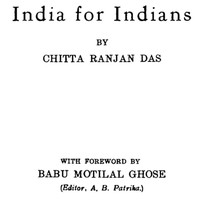
India for Indians Enlarged Edition
Language: en553 downloads on Project Gutenberg
Subjects
In: Essays, Letters & Speeches·History - Other·History - Modern (1750+)
Public-domain ebook sourced from Project Gutenberg #45247.
Public-domain ebook
Language: en553 downloads on Project Gutenberg
Subjects
In: Essays, Letters & Speeches·History - Other·History - Modern (1750+)
Public-domain ebook sourced from Project Gutenberg #45247.
The opening · free to read
Gentlemen,--When this morning Mr. Akran Khan called upon me to request me to preside over this meeting, I felt it was a call of duty to which I must respond. My heart is filled with gladness to find that on this platform and at this meeting Hindus and Mahomedans of Calcutta have met together to fight their common battle. Indeed in the days of the Swadeshi movement in 1905, I knew--and my friend Mr. Bipin Chandra Pal will bear me out--we knew that the day was not far distant when the Hindus and the Mahomedans will fight shoulder to shoulder in the cause of their country. I did not then know that the time was so near. While I must give expression to this feeling I feel at the same time, a sense of deep loss. I refer to the death of my friend Mr. Rasul. How I wish he had been here to-day to fight this battle with us shoulder to shoulder, how I wish his presence had animated us to-day. Gentlemen, on the morning of the day that he died, I felt this loss but I feel it overwhelmingly to-day in this vast assembly. There is no man in Bengal, Hindu or Mahomedan who was more respected by the whole Bengalee race. There is no man in Bengal who fought so much, who exerted himself to such an extent to bring about the union between Hindus and Mussalmans of this country and if I may be permitted to say so, he was almost the pioneer amongst Mahomedans, the first who felt that the interest of the Hindus and the interest of the Mahomedans is the same in spite of religious differences. Gentlemen, we have met to-day to protest against the policy of internment and to ask for the release of the gentlemen who have been interned. Who are the persons who are specially mentioned in your notice? I am sure you will agree with me that these are names which are respected by Mahomedans and Hindus alike. The name of Mahomed Ali is a household word in India. I had the honour of his friendship. We met together often when he was in Calcutta and I can tell you that there is no more sincere and ardent patriot in the whole of this country than Mr. Mahomed Ali. Mr. Shaukat Ali, I do not know personally but I have heard accounts of him from many of my friends which show that this gentleman is an unselfish patriot. This gentleman had been engaged in the work of union between Hindus and Mahomedans all over India and certainly such a man is worthy of esteem and honour. The last name is that of Sham Sunder Chakravarty. I have had personal acquaintance with him. I have been bound with him by ties of friendship and I can assure you, gentlemen, that Sham Sunder Chakravarty is incapable of having done anything which deserved his internment. I have given you the honoured names which are mentioned in this notice. But over and above these few names I can tell you there is hardly a home in East Bengal from which one or more persons have not been interned. Every home in East Bengal is filled with sadness to-day, because these people have been snatched away from their homes and imprisoned without trial or without proof. I protest on your behalf against this policy of internment. I say this policy is un-British, is opposed to all the time honoured traditions upon which the British Empire is based. It is opposed to all rules of common sense and prudence and uprightness and the sooner this policy is abrogated the better for the peace and prosperity of the empire.
Gentlemen, at a time when the British Government in its wisdom has declared its policy that Home Rule in some shape or other must be granted to this country that some sort of responsible Government is necessary for the foundation and preservation of the empire; at a time when His Excellency the Viceroy has advised us to preserve an atmosphere of calmness; I ask, is it wise to detain these men against popular opinion, against the universal desire of the Indian people. And why should they be detained? May we not tell those who are responsible? You detain them under an Act which has been characterised by the highest authorities in England and in this country to be illegal and ultra vires. You have detained these men and other persons on political considerations which are outside the purview of the Defence of India act under which you claim to detain them. Gentlemen, I wish to read to you a passage from the judgment of one of the greatest judges in England--I may say that the Act in England is similar to the Act under which these gentlemen have been snatched away from society and kept imprisoned. This learned Judge, Lord Shaw than whom a nobler judge there is not in the whole of England says--You remember, gentlemen, in England persons of German origin have been sought to be detained in this way and His Lordship says:--"But does the principle, or does it not, embrace a power not over liberty alone but also over life?" His Lordship says that if by the stroke of a pen you can take away the liberty of a man, does it not also follow that by the stroke of a pen you can take away his life also? His Lordship goes on to say:--
"If the public safety and defence warrant the Government under the Act to incarcerate a citizen without trial, do they stop at that, or do they warrant his execution without trial? If there is a power to lock up a person of hostile origin and associations because the Government judges that course to be for public safety and defence, why, on the same principle and in exercise of the same power, may he not be shot out of hand? I put the point to the learned Attorney-General, and obtained from him no further answer than that the graver result seemed to be perfectly logical. I think it is. The cases are by no means hard to figure in which a Government in a time of unrest, and moved by a sense of duty, existed, it may be, by a gust of popular fury"
"might issue a regulation applying, as here, to persons of hostile origin or association, saying, 'Let such danger really be ended and done with; let such suspects be shot.' The defence would be, I humbly think, exactly that principle, and no other, on which the Judgments of the Courts below are founded--namely, that during the war this power to issue regulations is so vast that it covers all acts which, though they subvert the ordinary fundamental and constitutional rights, are in the Government's view directed towards the general aim of public safety or defence."
"Under this the Government becomes a Committee of Public Safety. But its powers as such are far more arbitrary than those as of the most famous Committee of Public Safety known to history."
This is what one of the greatest of English Judges has said. Now, gentlemen, we next come to these particular cases. Mr. Mahomed Ali, as you all know--and if I have said more of him, you will pardon me, because he was a friend of mine,--he was asked to give an undertaking. He gave it but he said: "Subject to the injunctions of my religion." They are all the facts which have appeared in the letter of his mother whom judging from her letter, we all hold in deep veneration? Judging from that letter it seems to me that Mr. Mahomed Ali was not released because he would not give an unconditional undertaking, because he did not say, "What ever the injunctions of my religion may be I give an undertaking, the undertaking which you want." Well, gentlemen, I pause for one moment and I ask you to consider according to what right or what principle does the Government of this country or any government in the world, ask a man to give up his opinion and his religion? Ought he to submit to it? Is it not his duty to say at once, "I do not care what you do but it is my religion, I stand on it and here in this sphere I am a free man, You may hold my body imprisoned but my soul is in the hands of God." Now gentlemen, exactly, that illustration was given by this great judge in his judgment. His Lordship goes on to say:--
No far-fetched illustrations are needed; for, My Lords, there is something which may and does move the actions of men often far more than origin or association, and that is religion. Under its influence men may cherish belief which are very disconcerting to the Government of the day, and hold opinion which the Government may consider dangerous to the safety of the realm. And so, if the principle of this construction of the statute be sound, to what a strange pass have we come! A regulation may issue against Roman Catholics--all, or, say, in the South of Ireland, or against Jews--all, or, say in the East of London,--they may lose their liberty without a trial. During the war that entire chapter of the removal of Catholic and Jewish disabilities which has made the toleration of British famous through the world may be removed not because her Parliament has expressly said so, but by the stroke of the pen of a Secretary of State. Vested with this power of proscription, and permitted to enter the sphere of opinion and belief, they, who alone can judge as to public safety and defence, may reckon a political creed their special care, and if that creed be socialism, pacifism, republicanism, the persons holding such creeds may be regulated out of the way although never deed was done or word uttered by them that could be charged as a crime. The inmost citadel of our liberties would be thus attacked. For, as Sir Erskine May observes, this is "the greatest of all our liberties--liberty of opinion."
Gentlemen, is life worth living if we have not that liberty of opinion? You may differ from me, I may differ from you--you must be allowed to hold your own opinion, I must be allowed to hold mine. Members of the Civil Service may hold one opinion, I may hold another opinion. His Excellency the Viceroy may hold another opinion. His Majesty the King Emperor personally may hold one opinion and I may hold the contrary opinion--but is opinion a crime? Has it ever been a crime in the history of civilization? We hoped that the dark ages have gone but it seems that it still lingers. Now, apart from the opinion of this great judge, I rely,--I venture to think I have got the right to rely--upon the gracious Proclamation of 1858. Let me quote to you, gentlemen, the passage which has been often quoted and which we regard as our Magna Charta. It says this;--
"Firmly relying ourselves on the truth of Christianity and acknowledging with gratitude the solace of religion, we disclaim alike the right and the desire to impose our convictions on any of our subjects. We declare it to be our royal will and pleasure that none be in anywise favoured, none molested or disquieted, by reason of their religious faith or observances, but that all shall alike enjoy the equal and impartial protection of the law; and we do strictly charge and enjoin all those who may be in authority under us that they abstain from all interference with the religious belief or worship of any of our subjects on pain of our highest displeasure."
Gentlemen, I venture to think, that the Government, His Excellency the Viceroy or the Members of Council whoever may be responsible for it, has absolutely no right to demand an undertaking which in any way goes against the dictates of his religion. I hold in my hands the Magna Charta, I hold in my hands the very words used by Queen Victoria Empress of India, viz., "all those we charge and strictly enjoin, who may be in authority" and in this case the Council here is in authority,--"that they abstain from all interference with the religious belief or worship of any of our subjects on pain of our highest displeasure." His Excellency should know and the Council should know that by this act they are going against the Proclamation of 1858, according to which they would incur the displeasure of His Majesty the King. It is not we who are against the King, it is not we who are going against the principles upon which this Empire is based. It is those who Snatch away our liberty without just cause, without trial. Now, gentlemen, all these considerations might have been placed before the Government--I am sure the Government would have listened and done justice--but there is a difficulty in our way.
The book keeps going
Reading is free forever. Sign up and watch scenes appear while you read.



Scenes Storieta drew for other classics.
New illustrated classics
Once or twice a month: the latest books to get full character casts, scene art, and free comic editions. No account needed.