All of us are now striving for "Swaraj" or Home Rule. We wish to be masters of our own destiny. We want sooner or later the representatives of the people of the country to govern it. There are some amongst us who consider that Home Rule, is an immediate necessity. Others believe that Home Rule, at present without the fulfilment of certain preliminary conditions would be attended with disastrous results. But all are agreed that we should work for it. The practical difficulties in the way of its attainment due, partly to the relations between the various communities in India, partly to the opposition of powerful interests and the period that must therefore elapse before we overcome them render the discussion of time, ignoring or brushing aside those difficulties, only of academic interest. Mr. Gandhi's great influence is due to the popular belief in the efficacy of his leadership to attain immediate Home Rule. To me his Non-Co-operation Campaign appears to be an egregious blunder for which we are already paying dearly. A long line of illustrious statesmen, Indian and English have just succeeded in leading us out of the house of bondage. How long we shall have to wander in the deserts we do not know. But it is certain that Mr. Gandhi is not leading his followers in the direction of the promised land. He is not only going in the opposite direction but instead of toughening our fibre by a life of toil and struggle is endeavouring to entirely emasculate us and render us altogether unfit for the glorious destiny that, but for him and others like him, is awaiting us.
This will be clear once the nature of his agitation is realised. For that purpose, it is necessary to understand his mentality and his real views on the problems of life and the various questions now in debate.
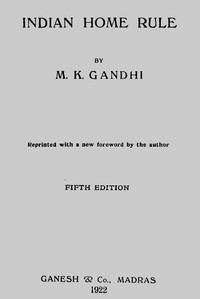
These are given in various books which have been published and in his paper "Young India", edited by him. His "Indian Home Rule", was first published in 1908. In a publication of 1921, he says "I withdraw nothing except one word of it and that in deference to a lady friend." The reason is the indelicacy of the expression....
The book is in the form of a dialogue between a Reader and the "Editor" the latter being Gandhi himself.
Mr. Gandhi wishes to know the necessity of driving away the English,
Reader:--"Because India has become impoverished by their Government. They take away our money from year to year. The most important posts are reserved for themselves. We are kept in a state of slavery. They behave insolently towards us, and disregard our feelings."
Gandhi:--"Supposing we get Self-government similar to what the Canadians and South Africans have, will it be good enough?"
Reader:--"That question also is useless. We may get it when we have the same powers. We shall then hoist our own flag. As is Japan so must India be. We must own our navy, our army, and we must have our own splendour. Then will India's voice ring throughout the world."
Gandhi:--"You have well drawn the picture. In effect it means this: that we want English Rule without the Englishman. You want the tiger's nature but not the tiger; that is to say you would make India English and when it becomes English, it will be called not Hindustan but Englistan. This is not the Swaraj that I want."
Nothing can be clearer. He does not want the dominion status of Canada or South Africa for India. He does not claim the independence of Japan for India as he points out a few lines below, "What you call swaraj is not truly swaraj."
What is then the real "Swaraj" according to Mr. Gandhi? He proceeds to develop his views by illustrations.
He gives his views on the poverty of India. He says Railways, Lawyers and Doctors have impoverished the country, so much so that, if we do not wake up in time, we shall be ruined.
About railways he says as follows:--
"Man is so made by nature as to require him to restrict his movements as far as his hands and feet will take him. If we did not rush about from place to place by means of railways and such other maddening conveniences, much of the confusion that arises, would be obviated. Our difficulties are of our own creation. God set a limit to a man's locomotive ambition in the construction of his body. Man immediately proceeded to discover means of overriding the limit. God gifted man with intellect that he might know his Maker. Man abused it so that he might forget his Maker. I am so constructed that I can only serve my immediate neighbours, but in my conceit, I pretend to have discovered that I must with my body serve every individual in the Universe. In thus attempting the impossible, man comes in contact with different religions and is utterly confounded. According to this reasoning, it must be apparent to you that railways are a most dangerous institution. Man has gone further away from his Maker".
And he advises all his friends to go into the interior of the country that has yet not been polluted by the railways and live there in order to be patriotic.
I shall not insult the intelligence of my reader by attempting a defence of the railways which have knit India together. I will only observe that according to Mr. Gandhi, the construction and use of railways for locomotion not possible for man in his natural condition, is an abuse of God's gift. And why? Because if he comes into contact with different natures, with different religions he might try to serve others than his neighbour whom alone God intended him to serve!!!
As to lawyers, he will have none of them; without lawyers, courts could not have been established or conducted and without them the British could not hold India. He has yet to learn that there were courts both in pre-British India and British India before lawyers. He thinks the Hindu-Mahomedan quarrels have often been due to the intervention of lawyers. He wants all people to settle their own quarrels; "men were less unmanly if they settled their disputes either by fighting or by asking their relatives to decide them. They became more unmanly and cowardly when they resorted to the Courts of Law. It is a sign of savagery to settle disputes by fighting. It is not the less so by asking a third party to decide between you and me. The parties alone know who is right and therefore they ought to settle it". Such is his opinion of lawyers and of Courts.
He is even more harsh on doctors. His opinion is quoted below as any statement of it in my own words might be regarded as travesty:--
"Let us consider; the business of a doctor is to take care of the body, or, properly speaking, not even that. Their business is really to rid the body of diseases that may afflict. How do these diseases arise? Surely by our negligence or indulgence. I overeat, I have indigestion, I go to a doctor, he gives me medicine. I am cured, I overeat again, and I take his pills again. Had I not taken the pills in the first instance, I would have suffered the punishment deserved by me, and I would not have over-eaten again. The doctor intervened and helped me to indulge myself. My body thereby certainly felt more at ease, but my mind became weakened. A continuance of a course of medicine must, therefore, result in loss of a control over the mind.
"I have indulged in vice, I contract a disease, a doctor cures me, the odds are that I shall repeat the vice. Had the doctor not intervened, nature would have done its work, and I would have acquired mastery over myself, would have been freed from vice, and would have become happy.
"Hospitals are institutions for propagating sin. Men take less care of their bodies, and immorality increases".
He says therefore that a doctor should "give up medicine, and understand that rather than mending bodies, he should mend souls", and he must also understand that "if, by not taking drugs, perchance the patient dies, the world will not come to grief and he will have been really useful to him".
There is no use in arguing with him and his dupes on this subject after this. But his views must be borne in mind when we come to deal with the present agitation.
About education, his views are equally remarkable. If, he says, education simply means knowledge of letters it is merely an instrument and an instrument may be well used or abused. He adds:--
"We daily observe that many men abuse it and very few make good use of it".
He will not give any education to a raiyat or poor peasant:--
"The ordinary meaning of education is a knowledge of letters. To teach boys reading, writing and arithmetic is called primary education".
"What do you propose to do by giving him a knowledge of letters? Will you add an inch to his happiness? Do you wish to make him discontented with his cottage or his lot?"
So much for primary education. As to higher education he says he has learnt Geography, Astronomy, Algebra, Geometry etc., but neither has that learning benefited him nor any body about him. As to knowledge of English, it is only useful to enslave people:--
"The foundation that Macaulay laid of education", he says: "has enslaved us. It is worth noting that by receiving English education, we have enslaved the nation. Hypocrisy, tyranny etc. have increased; English-knowing Indians have not hesitated to cheat and strike terror into the people. Now, if we are doing anything for the people at all, we are paying only a portion of the debt due to them".
I shall have to deal with this question of education later in connection with this appeal to the boys to leave the schools and colleges.
After all this, it will not surprise any one to be told that we must have nothing to do with machinery:--
"It was not that we did not know how to invent machinery, but our forefathers knew that, if we set our hearts after such things, we would become slaves and lose our moral fibre. They, therefore, after due deliberation, decided that we should only do what we could with our hands and feet. They saw that our real happiness and health consisted in a proper use of our hands and feet."
He would not therefore have mills for the reason that machinery is the chief symbol of modern civilisation and it has already begun to desolate Europe. In his opinion it were better for us to send money to Manchester and to use flimsy Manchester cloth than to multiply mills in India. I wonder why he does not ask Lancashire to pay him his crore of rupees. Lancashire would no doubt do so in consideration of the monopoly of supplying India with manufactured goods and India would, according to Mr. Gandhi, get Swaraj. India does not want manufactured goods; he asks:--
"What did India do before these articles were introduced? Precisely the same should be done to-day. As long as we cannot make pins without machinery, so long will we do without them. The tinsel splendour of glassware we will have nothing to do with, and we will make wick, as of old, with home grown cotton, and use hand-made earthen saucers for Lamps". He finally adds: "I cannot recall a single good point in connection with machinery."
Mr. Gandhi wrote his book in 1908 after a visit to England when the Liberal and the Labour parties were carrying on their great campaign in favour of the working men and against the capitalists and Lloyd George was about to launch his great land campaign. He seems to have been impressed with the horrors of the condition of the wage earners which was then portrayed in dark colours in order to support that campaign. His mind, emotional and ill balanced, seems to have been entirely upset by the descriptions that he had then read. He is on the fringe of a large question about which he seems to have been singularly ill informed. In England there is not at this time and there was not when he wrote, any question of the destruction of machinery which is a necessary adjunct to the industrial system. The questions under debate are the conditions of labour and the distribution of the wealth created by machinery between capitalists and labour. These questions have been under consideration now for some years; the condition of the labourers is being slowly improved, a minimum wage has been introduced and there is a prospect of a still more equitable distribution of the proceeds between capital and labour. Mr. Gandhi says that he has read Dutt's book on the decline of Indian industries but he does not seem to have learnt the lesson inculcated therein--that it is necessary to improve our industries not only to meet the needs of the people of the country, find employment for our labouring population, but also not to force them to compete with the cultivating classes. In India the same problem as in England awaits us. We have to see that the condition of the labourers in the mills and in the other industries is improved. In asking for the ruin of all our manufacturing industries Mr. Gandhi is only playing into the hands of our opponents. He will find strong support in this respect from Lancashire who will, according to some Indian publicists, only be too willing to take any steps to effect the destruction of our competing industries. If he had directed half the energy of his non-co-operation campaign to improving the conditions of the workmen in all our industries he might possibly have succeeded in getting rid of many of those evils which in his opinion require elimination of all machinery and of all industrial undertakings. The other reason for the deplorable condition of the industrial workmen in England is the congestion and overcrowding, in the industrial centres. This is due to a great extent to the action of the landlords who will not allow any expansion of those industrial centres in order to increase the value of their land and thus to exploit the community. In India we have not got that trouble. There is ample room for extension except in Bombay, in all the industrial centres and even in Bombay the difficulty is not due, so far as I am informed to the action of landlords but to natural conditions arising out of the geography of Bombay. Machinery is essential to the creation of wealth by manufacturing industries. The evils that have been portrayed by Mr. Gandhi can be and are being removed by patient effort. His tirade against machinery and mill industries on account of the evils he has witnessed in the West, is due to his ignorance; a little knowledge in his case has proved a dangerous thing. It is this feeling which has led him to advocate the universal use of spinning wheel in India. This might be useful as a cottage or home industry. It might find work for some who would otherwise be idle. But he is living in a fool's paradise if he considers it a substitute for or will supplant, machinery.