Public-domain ebook
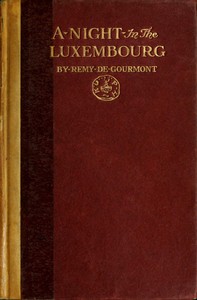
A Night in the Luxembourg
English433 downloads on Project GutenbergDownload EPUB
Public-domain ebook sourced from Project Gutenberg #46766.
Public-domain ebook
English433 downloads on Project GutenbergDownload EPUB
Public-domain ebook sourced from Project Gutenberg #46766.
The opening · free to read
"Comme on voit sur une branche au mois de mai la rose,"
so one sees the philosophy of M. de Gourmont, not quarried stone, but a flower, so light, so delicate, as to make us forget the worlds that have been overthrown in its manufacture.
I remember near the end of The Pilgrim's Progress there is a passage of dancing. Giant Despair has been killed, and Doubting Castle demolished. The pilgrims were "very jocund and merry." "Now Christiana, if need was, could play upon the viol, and her daughter Mercy upon the lute; so, since they were so merry disposed, she played them a lesson, and Ready-to-halt would dance. So he took Despondency's daughter, Much-afraid, by the hand, and to dancing they went in the road. True, he could not dance without one crutch in his hand; but I promise you he footed it well; also the girl was to be commended, for she answered the music handsomely." Just so, in this book, on a journey no less perilous among ideas, there is an atmosphere of genial entertainment, a delight in the things of the senses illumined by a delight in the things of the mind. And in this there is no irreverence. Only those who have ceased to believe have forgotten how to dance in the presence of their God.
Perhaps the technician alone will observe the skill with which M. de Gourmont has handled the most difficult of literary forms. In translating a book one becomes fairly intimate with it, and not the least pleasure of my intimacy with Une Nuit au Luxembourg has been to notice the ease and the grace with which its author turns, always at the right moment, from ideas to images, from romance to thought. "The exercise of thought is a game," he says, "but this game must be free and harmonious." And the outward impression given by this subtly constructed book is that of an intellect playing harmoniously with itself in a state of joyful liberty. M. de Gourmont is a master of his moods, knowing how to serve them; and no less admirable than the loftiest moment of the discussion, is the Callot-like grotesque of the three goddesses, seen not as divinities but as sins, or the Virgilian breakfast under the trees.
It is possible that Une Nuit au Luxembourg may be for a few in our generation what Mademoiselle de Maupin was for a few in the generation of Swinburne, a "golden book of spirit and sense." Ideas are dangerous metal in which to mould romances, because from time to time they tarnish. Voltaire has had his moments of being dull, and Gautier's ideas do not excite us now. M. de Gourmont's may not move us to-morrow. Let us enjoy them to-day, and share the pleasure that the people of the day after to-morrow will certainly not refuse.
ARTHUR RANSOME.
"We have just learned of the sudden death of one of our confrères on the foreign press, M. James Sandy Rose, deceased yesterday, Sunday, in his rooms at 14 Rue de Médicis. Notwithstanding this English name, he was a Frenchman; born at Nantes in 1865, his true name was Louis Delacolombe. He was brought up in the United States, returned to France ten years ago, and from that time till his death was the highly valued correspondent of the Northern Atlantic Herald."
On the following day, the 14th of February, the same journal printed this note among its miscellaneous news:--
"THE MYSTERY OF THE RUE DE MEDICIS
"We announced yesterday the sudden death of M. James Sandy Rose, our confrère on the foreign press. His death seems to have taken place under suspicious circumstances. At present a woman of the Latin Quarter, Blanche B----, is strongly suspected of having been at least an accomplice to it. This woman is known for her habit of dressing in very light colours, even in mid-winter, and it was this that made the concierge notice her. She lives, moreover, behind the house of the crime--assuming that there has been a crime--in the Rue de Vaugirard. This is what is said to have happened:--
"Because M. J. S. Rose, who was of fairly regular habits, had not been seen for some days, his door was broken open, and he was discovered inanimate. He had been dead for a few hours only, a fact which does not agree with the length of time during which he had remained invisible, and still further complicates the question. It is supposed that the woman B----, after passing the night with him, put him to sleep by means of a narcotic (from which the unhappy man did not awake), or strangled him at a moment when he was defenceless; then, her theft accomplished, she would seem to have fled precipitately. An extraordinary circumstance is that in her haste she forgot her dress, and must have gone out enveloped in a big cloak. At least there is no other explanation of the presence of an elegant white robe in the rooms of M. Rose, who lived alone...."
On the next day again, there was a third echo:--
"THE MYSTERY OF THE RUE DE MEDICIS
"It appears that the young woman at first implicated in this affair has been for a fortnight at Menton with M. Pap----, a deputy from the banks of the Danube. They have both written from that place to mutual friends. The inquiry makes no progress; on the contrary..."
Other papers, that I then had the curiosity to examine, had embroidered my friend's death with still madder tales. As the police, with very good reason, made no communications to the press, the journalists pushed unreason to insanity; then, as their imaginations could go no further, they were silent.
In reality, the mixing up of Blanche B---- with the story was due solely to the chatter of a young clerk, a neighbour of M. James Sandy Rose, who had noticed a woman's dress of white material in the room. I recount, at the end of the volume, the facts which disturbed this pubescent imagination. Neither the police, who immediately lost interest in the affair, nor justice, which had never taken any, would have been able to implicate anybody in a "mystery" which, if it is really a mystery, is not one of those that police or magistrates can resolve.
For some days following, Le Temps left the Rue de Médicis alone. At the end of a fortnight, a very talkative young journalist, accompanied by an old gentleman who, like him, took notes in a pocketbook, but said nothing, came and rang at my door. He came with the intention of questioning me. I was willing enough to reply that M. James S. Rose had died of apoplexy, or, at least, suddenly; that I was his friend, and that he had made me his heir; that the rumours of crime were absurd, and the rumours of "mystery" ridiculous.
"What is there," I said, "more normal than death?"
The old gentleman acquiesced, while the young journalist murmured--
"And yet...."
"The only thing of interest," I continued, "in this banal story, sad, perhaps, for me alone, is that M. James Sandy Rose leaves an unpublished work which in his will he has charged me to bring out. I am going to do this...."
I threw a persuasive glance at the young journalist.
"It is one of the most curious books I have ever read, and, though the author was my familiar friend, it is a revelation to me...."
"Really?"
"It is indeed so. The public, without knowing what there is in the book, await it with impatience."
"Ah!"
"When you have read it, when you have merely seen it, you will agree with me."
This innocent advertisement was duly inserted in Le Temps and in Le Nouveau Courrier des Provinces, to which the old gentleman had been asked to contribute. I gained some moments of amusement, nothing more.
Here is the book, of course without commentaries. In accordance with the imperative requirements of the will, I have not corrected its style, but revised it where that was necessary, for Louis Delacolombe, educated in English, had retained some traces of his school-years in his language. I think that it was written as fast as the pen would move, and with a feverish hand, in the space of a few days.
I have summarised in a final note the results of my personal inquiry. There is no need to read it, but I think, however, that it will interest those whose curiosity is aroused by my friend's enigmatical narrative.
_P. S._--The drawing below, which is from the hand of M. Sandy Rose, and which I have inserted at the place that he had indicated, may have a meaning, but, if so, I have been unable to penetrate it. It seems to represent a Greek medal dedicated to the goddess Core. But KOPH means also young girl, and even doll. Besides, are such medals known?
A NIGHT IN THE LUXEMBOURG...
I am certainly drunk, yet my lucidity is very great. Drunk with love, drunk with pride, drunk with divinity, I see clearly things that I do not very well understand, and these things I am about to narrate. My adventure unrolls before my eyes with perfect sharpness of outline; it is a piece of faery in which I am still taking part; I am still in the midst of lights, of gestures, of voices.... She is there. I have only to turn my head to observe her; I have only to rise to go and touch her body with my hands, and with my lips.... She is there. A privileged spectator, I have carried away with me the queen of the spectacle, a proof that the spectacle was one of the days of my actual life. That day was a night, but a night lit by a Spring sun, and, behold, it continues, night or day, I do not know.... The queen is there. But I must write.
The abridged story of my adventure will appear to-morrow morning in the Northern Atlantic Herald, and will soon make the circuit of the American press, to return to us through the English agencies: but that does not satisfy me. I telegraphed, because it was my duty; I write, because it is my pleasure. Besides, experience has taught me that news gains rather in precision than in exactitude in its journeys from cable to cable, and I am anxious for exactitude.
With what happiness I am going to write! I feel in my head, in my fingers, an unheard-of facility....
On the first intelligence of the pious riots that transformed into fortresses our peaceful churches, peaceful after the manner of old haunted castles, the newspaper that I have represented for ten years asked me, with a certain impatience, for details. As I live in the Rue de Médicis, having a long-standing passion for the Luxembourg, its trees, its women, its birds, I went down towards the Place Saint-Sulpice. The square was occupied by children, playing as they returned from school; round it rolled great empty omnibuses; now and again a tramcar widowed of a horse left with difficulty, while another struggled up and turned round without grace. My prolonged stay in Paris has made me an idler like every one else. Nothing astonishes me, and everything amuses me. Besides, I am by nature at once sceptical and inquisitive. That is why, when I lifted my eyes towards the church, my attention was vividly excited by the fact that the windows on the side towards the Rue Palatine seemed lit by the rays of a brilliant sunset. But the sun had not shone that day, and, even if the sky had been clear, no reflection could, at that late hour, light the south side of the church of Saint-Sulpice. I thought of a fire, but no trace of one was to be seen in the sky. Something unusual was certainly going on inside. I hurried towards the door in the Rue Palatine. As I advanced, without losing sight of the windows, I perceived that the light seemed to be coming down the length of the church, as if blazing torches were being carried about in this transept of the nave. At the moment when I went in, the windows by the choir began to shine, while those nearer the front of the church were now obscure.
The book keeps going
Reading is free forever. Sign up and watch scenes appear while you read.



Scenes Storieta drew for other classics.
New illustrated classics
Once or twice a month: the latest books to get full character casts, scene art, and free comic editions. No account needed.