Public-domain ebook
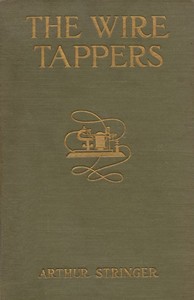
The Wire Tappers
Language: en397 downloads on Project Gutenberg
Subjects
In: Crime, Thrillers and Mystery·Novels·American Literature
Public-domain ebook sourced from Project Gutenberg #50203.
Public-domain ebook
Language: en397 downloads on Project Gutenberg
Subjects
In: Crime, Thrillers and Mystery·Novels·American Literature
Public-domain ebook sourced from Project Gutenberg #50203.
The opening · free to read
The discharged prisoner hung back, blinking out at the strong sunlight with preoccupied and unhappy eyes. When the way at last seemed clear he thrust his hands deep in his pockets, and with an assumption of bravado that seemed incongruous to the stern and thoughtful face, sauntered toward Sixth Avenue.
At the corner, a crowd of idlers watched two workmen on a scaffolding, cleaning the stone of Jefferson Market with a sand-blast. It was not until he had forced his way in on one side of this crowd, and edged circuitously out on the other, that he felt at ease with the world. It was like dipping into a stream: it seemed to wash away something scarlet and flaming. A more resolute touch of self-respect came back to him. The square shoulders took on some old-time line of natural dignity. He was of the world again.
He crossed Sixth Avenue with quicker steps, and then, smitten with the pangs of sudden hunger, pushed his way into an oyster-bar on the next street corner. With his reawakening to actualities came the question as to what the next turn of the grim wheels of destiny would bring to him. For, at heart, he was still sick and shaken and weak. It was his first offense; and he felt the need of some obliterating stimulation. So, even though the heavy odors of that transformed bar-room were as nauseating as the mouldy gaol-smell he had left behind him, he calmly called for coffee and a dozen raw. He ate the oysters as they were opened, between gulps of the hot but rancid coffee. He next directed his attention to a bowl of crackers, moistening them with catchup as he adroitly made away with them.
It was not until then that he noticed the stranger beside him, looking at him pointedly. This stranger was corpulent, and friendly enough of face, but for the blocked squareness of the flaccid jaw and the indefinite pale green glint of the deep-set, predatory eyes that shifted from side to side under the fringe of grayish eyebrow, as though the great neck were too vast a thing to be lightly troubled. He was floridly dressed, the younger man noticed, with a heavy, chased-gold band on one fat finger, and a claw-mounted diamond in the stud on his shirt-front. There was, too, something beefily animal-like in the confident, massive neck that refused readily to move, and in the square upthrust of the great shoulder.
The discharged prisoner returned the other’s half-quizzical gaze of inspection. He did so with a look that was unmistakably belligerent. For, although they stood side by side, they were of two worlds, and the prisoner was no longer a prisoner.
The stranger, unabashed, merely smiled, and leaned amiably against the stool-lined counter.
“What’ll you have, Durkin?” he asked, easily.
The other man still glared at him, in silence. Thereupon the stranger with the diamond stud thrust his hands deep down in his pockets, and rocking on his heels, laughed confidently.
“Climb down, my boy, climb down!”
Durkin buttoned up his coat: the gesture was as significant as the slamming of a door.
“Oh, smoke up, and have something with me!”
“Who are you, anyway?” demanded Durkin, wheeling on him, jealous of his momentary isolation.
“Me?—Oh, I was just keepin’ an eye on you, over yonder!” The stout man jerked a thumb vaguely toward Jefferson Market, then turned to the attendant.
“Slip us a nip o’ that London Dry o’ yours, Terry, with a plate o’ hot beans and sandwiches. Yes, I was kind o’ lookin’ on, over there. You’re up against it, aren’t you?”
“What do you mean by that?” asked the other, hungrily watching a leg of boiled ham, from which the attendant was shaving dolefully thin slices.
“Here, brace up on a swig o’ Terry’s watered bootleg; then we can talk easier. Hold on, though—it won’t cost us any more to get comfortable, I guess!”
He ordered the luncheon over to a little round table in a corner of the room. Durkin could already feel the illicit London Dry singing through his veins; he was asking himself, wolfishly, if he could not snatch that proffered meal before taking to flight.
“Now, this isn’t monkey-work with me, it’s business,” announced the newcomer.
“Indeed?” said Durkin, hesitating, and then taking up a fork.
“Now, first thing, I want to tell you something. That song and dance you threw up to the Old Boy over on the bench, about your bein’ an electric inventor in hard luck, caught my eye, first thing. Look here,—straight off the bat, d’ you want to get a cinch on a good job?”
“I do!” declared Durkin, through a mouthful of beans. “But doing what?”
“Same old thing!” answered the other, offhandedly.
Durkin put down his fork, indignantly.
“What same old thing?” he demanded.
“Operatin’, of course!”
Durkin, in a sudden tremor of alarm, felt that the break would come before even that steaming plate of beans was eaten. So he fought back his affronted dignity, and giving no sign of either surprise or wonder, parried for time.
“I’m tired of operating,” he said, washing a mouthful of his lunch down with a second glass of Terry’s London Dry. “My arm has been giving out.”
“Well, I want a man, and I want him quick. You’re—er—not very well fixed just now, are you?”
“I haven’t a penny!” cried the other, passionately, surrendering to some clutching tide of alcoholic recklessness.
“Well, my hours wouldn’t kill you!” began the older man, fraternally.
“I’m sick of the sight of a key and sounder!”
“You’d rather do the Edison act in a Third Avenue garret, I s’pose—broodin’ round inventin’ electrical gimcrackery nobody wants and nobody’s goin’ to buy!”
“But I tell you somebody will want what I’m going to do—and somebody is going to pay money for it, and a heap of money, too!”
“What’ve you got?” inquired the older man, with the slightest curl of the lip. The younger man seemed nettled by the touch of contempt in the other’s voice.
“I’ve got an amplifier and I’ve got a transmitting camera—you needn’t laugh, for when I get a relay so sensitive that I can sit in a St. Louis office and send a message to London or Paris, or when I can send a drawing of a train wreck somewhere outside of San Francisco right through to New York, or telegraph a photo or a map or a sketch—why, I’ve got something that men are going to pay for, and pay well!”
“I’ve heard of ’em all before—in the dope page o’ the Sunday papers!”
“But I tell you I’ve got this transmitting camera! All I want is time and money to work it out, on the business side. Wait a minute, now, and let me explain. If you’ve operated a key you’ll understand it easily enough. You know what we call the Tesla currents, and you know what selenium is. Well, when I first tackled this thing, my problem was to get some special apparatus for reproducing the shadows and high-lights on, say, a photograph. I had to have a different flow of current for light and dark, to carry the impression from the transmitter to the receiver. Well, I found that selenium did the trick, for a peculiarity of that mighty peculiar metal is that it offers less resistance to a current when in the light than in the dark. My next problem was to control the light in the receiving camera. That’s where the Tesla currents came in, inducing the rays of vacuum pipes under the high tension. Do you follow me?”
“Yes, go on!” said the other man, impatiently. But his tone was lost on the young inventor, who, under the stress of his excitement, was leaning forward across the little table, gesticulating now and then with long and slender and strangely expressive fingers.
“Now, if I was telegraphing a photograph of you to Chicago, it would have to be in the form of a film, wrapped about a glass cylinder in the transmitter. Light would be thrown on it by means of a convex lens. Now, I cover the glass pipe with vulcanized rubber, or, say, with sealing wax, so that no rays get out, except through the one little window where they’ll fall on the film or the paper moving in front of it. Inside my cylinder is a lens containing selenium, where the rays fall after passing through the glass. But, pshaw, what’s all this to you?”
“Go ahead—I’m listenin’!”
The book keeps going
Reading is free forever. Sign up and watch scenes appear while you read.



Scenes Storieta drew for other classics.
New illustrated classics
Once or twice a month: the latest books to get full character casts, scene art, and free comic editions. No account needed.