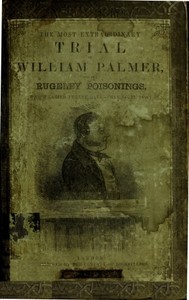
William Palmer is a member of a wealthy family, and is thirty-one years of age. He was educated for the medical profession, was a pupil at St. Bartholemew’s Hospital, London, received the diploma of the Royal College of Surgeons in 1846, and shortly afterwards settled at Rugeley, his native place. He seems, however, to have paid more attention to the “turf,” and what are commonly called sporting pursuits, than to his profession, and to have confined his practice to his own family and friends.
His name appears in the “London and Provincial Medical Directory” of 1851, and again in 1855, as that of one of the persons who had neglected to inform the editor of that work of the nature of their qualifications. He married, in 1847, Anne, the natural daughter of Col. William Brookes and Mary Thornton, his housekeeper. Col. Brookes, who, after quitting the East India service, took up his residence at Stafford, died in 1834, leaving considerable property, and more than one natural child.
To Anne Thornton he bequeathed, by a will dated July 27, 1833, nine houses at Stafford, besides land, and the interest of 20,000 sicca rupees, for herself and her children, and appointed Dr. Edward Knight, a physician of Stafford, and Mr. Dawson, her guardians and trustees. To Mary Thornton, the mother of Anne, the colonel bequeathed certain property, which was to pass to her daughter at the decease of the mother. Mary Thornton departed this life--it is said, while a guest at Mr. Palmer’s house,--in 1848 or 1849.
Now, although the will of Colonel Brookes would seem clear enough to anyone who was ignorant of law, and although, in the present state of the law, as we are informed, it would be sufficient, yet it was discovered by the legal fraternity, some years since, that the language conveying the bequest to Anne Thornton was not sufficiently forcible to convey it to her absolutely, but only to give her a life interest in it, insomuch as, at her decease, it was liable to be claimed by the heir-at-law to Colonel Brookes.
Under these circumstances, there was nothing unnatural or unusual in the idea that Palmer should insure his wife’s life, in order to protect himself from the inevitable loss which must ensue in case of her decease; and since her property consisted of seventeen acres of land, valued at between £300 and £400 per acre, besides nine houses, and the interest of the sicca rupees--probably altogether worth at least £400 per annum, upon which he had borrowed largely from his mother--there could be no doubt of his having such an interest in his wife’s life as would justify insurance.
Accordingly, in January, 1854, he insured her life for £3,000 in the Norwich Union, and in March in the Sun for £5,000; there was also an insurance in the Scottish Equitable for £5,000. Mrs. Palmer died on September 29, 1854, leaving only one surviving child, a boy of seven years; and, as if to justify the husband in effecting an insurance, an action was brought within a month by Colonel Brookes’s heir-at-law, to obtain possession of Mrs. Palmer’s property.
Palmer brought up the life policies on the Sun and Norwich Union on the 16th of October, 1854, and employed Mr. Pratt, the solicitor, to obtain the money from the offices. Mr. Pratt, who seems to have acted with entire bona fides, and the caution usual among lawyers, required to be furnished with evidence of the husband’s pecuniary interest in his wife’s life, took counsel’s opinion on every step, and obtained the £8,000 from the offices on the 6th of February, 1855; strangely enough, the £5,000 from the Scottish Equitable was paid through a banker unknown to Pratt.
Great excitement prevailed in reference to the trial, and large bodies of persons who could have no possible chance of admission crowded the avenues of the court. Day after day notices have appeared in the papers, that only those who had obtained tickets of admission from the Sheriffs would be admitted; and the under-sheriffs very wisely adhered to that determination. In consequence of their very excellent arrangements, the Court was at no time inconveniently crowded. At ten o’clock the judges appointed to try the case entered the Court, and took their seats on the bench. They were Lord Campbell, the Lord Chief Justice of the Queen’s Bench, Mr. Baron Alderson, and Mr. Justice Cresswell.
The long-deferred trial of William Palmer, which, owing to the necessity of passing a special act of Parliament to enable it to take place in this court, has been delayed for a period of several months since the finding of a true bill by the Grand Jury of Staffordshire, commenced to-day at the Old Bailey; and, notwithstanding the interval which has elapsed since this extraordinary case was first brought under the notice of the public, the intense interest and excitement which it then occasioned seem in no degree to have abated. Indeed, if the applications for admission to the court which were made so soon as the trial was appointed, and the eager endeavours of large crowds to gain an entrance to-day, may be regarded as a criterion of the public anxiety upon the progress and issue of the trial, the interest would seem to have augmented rather than diminished.
At a very early hour every entrance to the court was besieged by persons of respectable appearance, who were favoured with cards giving them a right of entrance. Without such cards no admittance could on any pretence be obtained, and even the fortunate holders of them found that they had many difficulties to overcome, and many stern janitors to encounter, before an entrance to the much-coveted precincts could be obtained. On the whole, however, the arrangements of the Under-Sheriffs Stone and Ross were excellent, and, although there may be individual cases of complaint, as there always will be when delicate and important functions have to be performed with firmness, it is but justice to testify to the general completeness and propriety of the regulations which the Sheriffs had laid down.
Among the distinguished persons who were present at the opening of the Court were the Earl of Derby, Earl Grey, the Marquis of Anglesea, Lord Lucan, Lord Denbigh, Prince Edward of Saxe Weimar, Lord W. Lennox, Lord G. G. Lennox, and Lord H. Lennox. The Lord Advocate of Scotland sat by the side of the Attorney-General during the trial.
At five minutes to ten o’clock the learned Judges, Lord Chief Justice Campbell, Mr. Baron Alderson, and Mr. Justice Cresswell, accompanied by the Lord Mayor, and Aldermen Sir G. Carroll, Humphrey, Sir R. W. Carden, Finnis, Sir F. G. Moon, and Sidney, Mr. Sheriff Kennedy, Mr. Sheriff Rose, Mr. Under-Sheriff Stone, and Mr. Under-Sheriff Rose, took their seats on the bench.
The prisoner, William Palmer, was immediately placed in the dock; and to the indictment which charged him with the wilful murder of John Parsons Cook, who died at Rugeley upon the 21st of November last, he pleaded, in a clear, low, but perfectly audible and distinct tone, “Not guilty.” The prisoner is described in the calendar as “William Palmer, 31, surgeon, of superior degree of instruction.” In appearance Palmer is much older, and, although there are no marks of care about his face, there are the set expression and rounded frame which belong to the man of forty or forty-five. His countenance is clear and open, the forehead high, the complexion ruddy, and the general impression which one would form from his appearance would be rather favourable than otherwise, although his features are of a common and somewhat mean cast. There is certainly nothing to indicate to the ordinary observer the presence either of ferocity or cunning, and one would expect to find in him more of the boon companion than the subtle adversary. His manner was remarkably calm and collected throughout the whole of the day. It was altogether devoid of bravado, but was respectful and attentive, and was calculated to create a favourable impression. He frequently conversed with Mr. Smith, his professional adviser, and remained standing until the close of the speech for the prosecution, when at his request his counsel asked that he might be permitted to sit--an application which was at once acceded to by Lord Campbell.
The counsel engaged in the case were:--The Attorney-General, Mr. E. James, Q.C., Mr. Bodkin, Mr. Welsby, and Mr. Huddleston, for the Crown; and Mr. Serjeant Shee, Mr. Grove, Q.C., Mr. Gray, and Mr. Kenealy, for the prisoner.
A most respectable jury having been empanelled, and all the witnesses, with the exception of the medical men, having been ordered out of court,
The Attorney-general
proceeded, amid breathless silence, to open the case on the part of the prosecution. He said: Gentlemen of the jury, the duty you are called upon to discharge is the most solemn which a man can by possibility have to perform--it is to sit in judgment and to decide an issue on which depends the life of a fellow human being who stands charged with the highest crime for which a man can be arraigned before a worldly tribunal. I am sure that I need not ask your most anxious and earnest attention to such a case; but there is one thing I feel it incumbent on me to urge upon you. The peculiar circumstances of this case have given it a profound and painful interest throughout the whole country. There is scarcely a man, perhaps, who has not come to some conclusion on the issue which you are now to decide. All the details have been seized on with eager avidity, and there is, perhaps, no one who is not more or less acquainted with those details. Standing here as a minister of justice; with no interest and no desire save that justice shall be done impartially, I feel it incumbent on me to warn you not to allow any preconceived opinion to operate on your judgment this day. Your duty--your bounden duty--is to try this case according to the evidence which shall be brought before you, and according to that alone. You must discard from your minds anything that you may have read or heard, or any opinion that you may have formed. If the evidence shall satisfy you of the prisoner’s guilt, you will discharge your duty to society, to your consciences, and to the oaths which you have taken, by fearlessly pronouncing your verdict accordingly; but if the evidence fail to produce a reasonable conviction of guilt in your minds, God forbid that the scale of justice should be inclined against the prisoner by anything of prejudice or preconceived opinion. My duty, gentlemen, will be a simple one. It will be to lay before you the facts on which the prosecution is based, and in doing so I must ask for your most patient attention. They are of a somewhat complicated character, and they range over a considerable period of time, so that it will be necessary not merely to look to circumstances which are immediately connected with the accusation, but to go back to matters of an antecedent date. I may safely say, however, that, in my conscience, I believe there is not a fact to which I am about to ask your patient attention which has not an immediate and most important bearing on this case. The prisoner at the bar, William Palmer, was by profession a medical practitioner, and he carried on that profession in the town of Rugeley, in Staffordshire, for several years. In later years, however, he became addicted to turf pursuits, which gradually drew off his attention and weaned him from his profession. Within the last two or three years he made over his business to a person named Thirlby, formerly his assistant, who now carries it on. In the course of his pursuits connected with the turf, Palmer became intimate with the man whose death forms the subject of this inquiry--Mr. John Parsons Cook.