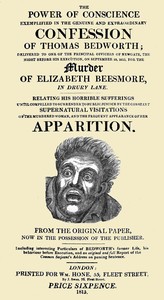
THOMAS BEDWORTH’S CONFESSION.
THOMAS BEDWORTH was born in the year 1764, in the parish of Bloxidge, Staffordshire. His parents were of honest reputation and industrious habits, and could well afford to instil into his mind the principles of a good education; but to this he was obstinately averse, and they not being firm in their purpose, he successfully opposed every attempt that was made to furnish him with that knowledge of good and evil, without which he fell a sacrifice to the consequences of sensual indulgence, and expiated a crime, conceived in jealousy and stimulated by intoxication, on the scaffold of Newgate.
Arriving at the age of fourteen years, he was placed as an apprentice in the town of Walsall, in Staffordshire, near Birmingham, to learn, with a respectable tradesman there, the art of bridle, bit, and stirrup making. In the year 1782, his father having died, and the term of his apprenticeship being expired, he went to Birmingham, where he was employed a considerable time. Being of an unsettled disposition, however, he left that place, and went to London, where he soon afterwards obtained employment in the manufactory of Mr. Rowley, of Prince’s Street, Drury Lane, where he remained until the year 1795.
At this period, and during his residence in London, Thomas Bedworth was united in marriage, to Mary, the daughter of Mr. Bainer, a respectable tradesman in St. Anne’s, Soho, but, again becoming restless in his mind, he left London, and having gone a distance into the country, he, in an unguarded moment, enlisted into the Fifeshire Fencibles, then commanded by Colonel _James __Durham_. With this regiment, he visited most parts of Ireland and Scotland, as well as this country, but finally left the regiment in 1803. In the course of this period his wife continued with him, and they had three children.
After Bedworth’s discharge from the army, he left his wife with his friends, at Walsall, and went to Birmingham, whither, however, she followed him. In a short time, Bedworth went to London, in search of work, and entreated his wife to remain in the country, and there await his success. She consented, and he had not arrived many days in town, when he obtained employment from Mr. Birch, of Rupert Street, Haymarket. Here, however, he had not long been engaged, when, unfortunately for Bedworth, his employer failed, and he immediately formed the resolution of going to sea.
In the year 1804 he entered the Navy, and in the course of his service suffered many hardships, and was in several severe and celebrated engagements with the enemy. But, however the last sanguinary act of his checquered life may have stained his character, he had at least the reputation of being a good seaman, and it was also his pride, at the moment of his narrating these facts, that he had faithfully performed his duty to his country. He continued in the service until the year 1813, and at that period received his discharge, and was made an out-pensioner of Greenwich Hospital.
It was now his melancholy fate to learn, that, instead of joining his long-absent partner, and spending the remnant of his days in domestic peace, a widely different lot awaited him. His wife, the partner of his bed and the parent of his children, had, during his absence, formed an illicit acquaintance with another man, to whom she was actually married, and had three children during her unlawful union.
Bedworth’s horrid reflections, in consequence of this discovery of his wife’s unfaithfulness, distracted his mind; and the very means he adopted as a consolation, became a train of circumstances tending to the commission of the crime, which, with bitter tears, he repented, and atoned for by an ignominious death.
In time, his mind became more calm, and he seriously bethought himself of settling into regular habits, which a seafaring life had deranged, and subsisting upon his pension, and by his industry. He once more, therefore, obtained employment in his own trade, but, to his irretrievable mishap, became acquainted with Elizabeth Beesmore. This unfortunate woman, who was also married, was the sister of his own wife. Her husband, John Beesmore, had grossly neglected her, as well as a child, which remained in her care: he had not only denied her and her infant the necessaries of life, but had also declared his determination of never more residing with her, or even in the neighbourhood where she might be. Her case naturally excited the unhappy Bedworth’s commiseration, and he took advantage to complain of the conjugal infidelity and baseness which his own wife, her sister, had manifested towards himself. The similarity of their situations induced a sympathy in Bedworth’s mind; common acquaintance ripened into a kinder intimacy, and he ultimately became attached to her. Bedworth then proposed that she should place herself and her child under his protection, and that they should consider each other as a wedded couple. With this offer she complied, and, while she solemnly swore to unite her fate with his, and never to hold communication with her husband, but to be faithful to Bedworth, as his wife, he as sacredly pledged himself to be a husband to her.
Thomas Bedworth and Elizabeth Beesmore, thus connected, lived together until the month of April, in the present year, 1815, being a space of about two years and two months. At this period, John Beesmore, the woman’s husband, who had hitherto been employed in the town of Wedgbury, in Staffordshire, came to London. He discovered the retreat of his discarded wife, and contrived to communicate to her and Bedworth, a repetition of his formerly-expressed determination not to cohabit with his wife, and also an assurance that he would not disturb the connection which she had formed with Bedworth. She also, at this critical period, took occasion to renew her vows of attachment and fidelity to Bedworth, whom she justly represented as having saved herself and child from starvation.
In a short time, however, the affairs of John Beesmore, the husband, became unfavourable; he was out of employment, and he applied to his wife to afford him pecuniary assistance from the earnings of Bedworth. This, after some hesitation on her part, she complied with, and Bedworth made the discovery, that his little property was daily wasting upon a man, whose neglected wife and child he had supported, whom she herself had most solemnly renounced, and in whose fortunes or misfortunes, she had sworn never to interest herself.
Here commenced a dreadful spirit of jealous bickering and hate between the unhappy Bedworth and Elizabeth Beesmore. Unable to endure the insults offered to his feelings, by the renewed acquaintance of Beesmore and his wife, Bedworth determined no longer to be the means of her husband’s support. He abandoned the society of the deceased, and took a private lodging. His heart was agonized, his mind distracted, and Elizabeth Beesmore discovered him in his retreat, in this state, and visited him. She herself was in a very distressed condition—she renewed her sentiments of affection towards him, and trusted he would yield her some assistance. A multitude of conflicting thoughts now agitated his mind at this meeting. It is difficult to say whether pity, jealousy, or indignation, was most predominant. At length he took compassion on her. She had some refreshment with him, he gave her some money, and she departed.—Her renewed protestations of regard towards him, he considered as the mere affectation of attachment: his mind became hourly more unhappy, and he at length flew for relief to that source of treacherous consolation, the gin-shop. For many days he remained in an unsettled state of mind, neglecting his work, and occasionally visiting Elizabeth Beesmore, in a state of intoxication.
On the 19th of June, he called on Elizabeth Beesmore, at an early hour in the morning, but not much in liquor.—On this occasion she received him not only with coolness, but contempt. She informed him, tauntingly, that she was about to live again with her lawful husband, and desired that he would not again come to disturb her, or the house in which she was. He answered her coolly, that it was not his intention to disturb her, he only wished to disturb himself, and would immediately leave her, and proceed to the only enjoyment he had left, namely liquor. He then took his leave, and, having drank to excess, retired to his lodgings, and went to bed.
On awaking the next morning, the 20th of June, his mind was on the rack: besides, the powerful effects of the former day’s intoxication, jealousy, and indignation deprived him of reason. In this state of distraction, he walked up and down his room, and at length formed the horrible resolution of murdering Elizabeth Beesmore, the cause of his distress.—With this intention, having furnished himself with a shoemaker’s knife, which he found in the house where he resided, he put it in his pocket, and proceeded to her lodgings, in Short’s Gardens, Drury Lane. On his way thither, he met with a woman who worked at her needle with the deceased, and they went to a public-house, and drank gin together.—After parting with her, he went elsewhere and drank a quantity of beer, so that, by the time he reached Elizabeth Beesmore’s apartments, he was in a state of inebriety.—She, upon his arrival, perceiving his situation, prevailed upon him to go to bed, and, during the time he lay there, she sent for gin several times, of which he drank freely. In the course of the morning, her son came into the room and struck and insulted him several times, while on the bed, which aggravating Bedworth exceedingly, she ordered her son to quit the room. Soon after he had gone, Bedworth rose with an intention of leaving the house, but found that his coat and shoes had been taken away while he was asleep. These he asked for, but she refused to let him have them, and he left the house without them, and went to an adjoining public house and had more gin.—He soon returned to her apartments, and she prevailed upon him to drink some tea, into which also she infused some gin.
At this period, Bedworth’s mind was dreadfully unsettled, and he once more laid down upon the bed, but the irritation of his feelings would not let him rest. In a short time he again rose and peremptorily demanded his shoes and coat. These Elizabeth Beesmore gave him, and strongly advised him to go home without delay, and go to bed, in order to attend work the following morning. He left the room, and she followed him down stairs, where they had some conversation. She returned up stairs, for the purpose of bringing him an apron and a handkerchief, and, upon her again descending the stairs, he told her he wished to speak with her in the kitchen.—She replied, she must first put on his handkerchief, which, having done, they retired to the kitchen. Each remained for a moment in mute anxiety.—The unhappy woman, however, broke the pause, by clasping her right arm round his neck and embracing him, at the same time saying, with much agitation, “_O my dear Bedworth_!” These were her last words, uttered in the last minute of her life. She kissed him during his conflict between jealous passion and strong affection: his injured regard and her perfidy rushed upon his mind; her deceptive embrace maddened him: whilst her kiss was warm upon his cheek, he suddenly drew the knife from his right hand pocket, and, as he supported her head with his left arm, he, by one rapid and determined cut, across her throat, nearly severed her head from her body!—She fell lifeless, to the ground, without a groan!