Public-domain ebook
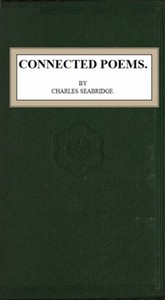
Connected Poems
Language: en195 downloads on Project Gutenberg
Subjects
In: Poetry
Public-domain ebook sourced from Project Gutenberg #51770.
Public-domain ebook
Language: en195 downloads on Project Gutenberg
Subjects
In: Poetry
Public-domain ebook sourced from Project Gutenberg #51770.
The opening · free to read
CHARLES SEABRIDGE.
Oubliant tout à fait la race humaine, je me fis des sociétés de créatures parfaites, aussi celestes par leurs vertus que par leurs beautés, d’amis sûrs, tendres, fidèles, tels que je n’en troüvai jamais ici-bas.--_Confessions de Rousseau, Partie_ II., livre 9.
Qui Deum amat, conari non potest, ut Deus ipsum contra amet.--_B. de Spinoza, Ethica, Pars._ V.
LONDON: TRÜBNER & CO., 60, PATERNOSTER ROW, 1866.
CONNECTED POEMS.
I.
O poor preludings to some happier praise, Thou frail decoy to merit myriad-hued, The violets of whose virtue pave your ways, Breathing beneficence on your sullen mood; Go, test your worth, nor once obtrude the award On who, unanxious, cannot pant for fame; His only verdict, whom these lines applaud, Shall touch my soul with sense of praise or blame, Howe’er it be; this verse has frighted woe, And caught the glimpses of a banished Heaven, Haply surpassing in its quiet glow Life’s fickle transports, nourishment and leaven; If here is aught, its dues shall be allow’d; I rest content, but of my office proud.
II.
Aye fashioned from the mirror of the soul That lends its shadow to this fleeting world, How doth thy beauty in itself control The spirit and the form wherein ’tis whirled; In others earth beneath the inward fire Sinks down, abashed, nor knows to bear the fame, While some more mean exalt the entrancing mire, Smothering the sparkles of celestial flame; Yet either wanting, for, with those of earth, Earth’s purer mixture hallows what it lends, And easier leads the sons of self-same birth To fathom beauty in its heavenlier ends: ’Tis fit Nature should find a lovely hearse, When man by death springs from the Universe.
III.
If there be some true meaning and a sign In all the altars where sad suppliants pray, And if the words they sometime subtly twine, Be not unpregnant of a deeper lay, What depths of mystery might not then be read, What gages of new hope lie undiscerned, In all the purpose that thy beauties wed, And all the thought in glowing shrine inurned, In the unfathomable music, weaving The young glad utterance of unconscious vows, And in the eloquence, quickening and relieving, Like sunset lingering round becalmèd prows; The heaven that wooes, now flashes, from that eye Hath stol’n Jove’s lightning and his joys from high.
IV.
Fain would I speak of all thy hopes disclose, My pen, charm’d with delights, scarce will steal on, Lingering about the rapture which it knows It dallies coyly with an idle song; Too long the prospect which mine eye surveys, How shall I mark each flower or stay to cull? Through light, through shade, Perfection planes the ways With sweet variety, that grows not dull; Each new enchantment seems itself so fair, That the last pride spoils his ancestor’s aims: So justly tempered all, none can impair Concent’ring beauty’s just imperial claims; Each borrows new delight while it conveys, And leads to harmony by various ways.
V.
Who hath not seen the morning breaking gaily, The rivers leaping into dazzling light? Who hath not view’d the eve declining palely, Flouting her rosy stillness with black night? Who then hath mark’d thee not in joy delightful, Careering on thy young soul’s restless flow? Or who hath, sadly, blam’d not sorrow spiteful, Tempering thy beauty with a heavenly glow? The even tenor of thy bosom led past, Nor brook’d those tremors that disturb light breasts; But, like a holy ocean, calm, pure, steadfast, Just heav’d beneath its load which on it rests; Streaked with faint tints of long delicious light, Whose radiance lures but never tires the sight.
VI.
Bound in a little room, my heart exulting, Surveys the treasures of unmeasured space; A thousand pathways in one spot resulting, Disclose the errors of the human race; What all men seek within that centre lies, Whose ripening virtues shun the general view, Lest all should dub them beautiful and wise, And all that nature has of good and true: O well for me that worth all would admire Most should unconscious leave to my employ; So may thy budding beauties breathe their fire, All unattempted by the world’s annoy: So nature crowns her gifts by liberal growth, She owes success and sanctifies her troth.
VII.
But soon the rosebud, in developed beauty, Unfolds its maiden, luring charms to light; Soon love usurps the walks of tired duty, And shows its godlike fulness to the sight; The eaglet soon gladdens his golden plumage, In the intensest orient of the sun; Even the meek violet gently must assume age, And glance through leaves the merit she hath won; The noon it stealeth from the dewy morning, And amorous night catcheth the trembling day, The spring must ripen, and the summer’s warning That autumn shall not linger more than May; Thou too must change, developed till all love thee, And yet a change shall hover just above thee.
VIII.
If thou must change, beauty shall form the groove, And nourish promise in a firmer mould, Which, all unchequered, onward still shall move, Informed with wisdom and in virtue old: Thus shalt thou live, but no, what years can add To the keen edge of thy unbated mind? Or what hath wisdom, more than reason had, When in thy form she mustered all her kind? Within the acorn lies the oak’s whole essence, Man can accomplish but what in man dwells; The iron that supples with its incalescence, Yet wears the nature that its coldness tells; So, yet unfashioned, in thy youth reposes The germ that turns to use young nature’s roses.
IX.
’Tis thou hast taught me what of truth I know, Kind debt, that binds me nearer unto thee, That worth’s best triumph scorns all outward show And works within its quiet mystery; That the same virtues walk in various light, Accomplishing by each their several ends, That as the sun to day, the moon to night, This, its pale lustre, that, its ardour lends; So with each mortal’s differing merits twined, A separate glory crowns peculiar aims, And myriad fates, in one deep urn combined, Stamp, with one issue, more than million claims; Some only tower, above the rest, supreme, That such thy lot, methinks, it well would seem.
X.
Rare lot where reason is with fate combined, Where envy enters not, but only love; Thought, expectation, fancy, intertwined, All could not fashion, that which thou dost prove: Where then is time for jealous jarring thought To ruffle the full transport of our heaven, Or clog the wings of adoration fraught With purity and hope’s exulting leaven? Sunk in the sense of that supremest pleasure, Here let me lose myself to live in thee; A priceless boon, I only know to measure, By what it costs my soul again to flee: From heaven I fall, and this must, sure, be hell, Earth never looked so void, I know full well.
XI.
Spirit of youth and joy and hope and love, All this thy essence is and dwells in thee, This praise but mocks thee, whilst thou soar’st above Such vague assaults, in nature’s witchery! Thou art a pearl, snatched from the angry deep, A star, which envy hurled from comrade suns, An opal, where all rays reflected sleep, The summer lightning, glistering as it runs; All things that loveable and lovely are, Such thou appearest, in thy joyous hour; Oft frolicsome as leaves, that dance from far, When the wind dallies with some pensive flower; All these thou art yet all of these express Nought of the magic of thy loveliness.
XII.
Lovely in joy but grander yet when rage O’erflows the dams that reason interposed, The barriers past, themselves must, loath, engage And swell the tumult they’d have fain opposed; There, once enlisted, shows the scene so fair, Such modulation of impetuous wrath, That what was scorn’d, now claims their tenderest care, And arm’d in conscious worth they sally forth. Aye, ever did thy just soul scorn the wrong, ’Twas only virtue lured thee thus astray; How oft to goodness did’st thou wile the strong, By young enticement’s headstrong, winning way, Till all of theirs was thine, and thou could’st pour At love’s high altar gifts of virgin ore.
XIII.
Young spirit, thou hast taught me what is joy, And fathomed nature with a larger line; How sweet to learn when nature’s powers deploy, And o’er thy frame their dalliance combine: Ye passions soothed to one unanimous end, Thou concord breath’d through avenues of sound, Witchery, ever winning, from its power to blend Fancy’s light hints with intuition’s ground: Fulness of power lives not with those who roam, Dandling the toy of a fantastic grief, Iconoclast of woe, it builds its home In joy’s ebullience at its own relief; Youth founds the pile where age contented dwells, And drowns his dearth with draughts from childhood’s wells.
XIV.
A young Apollo flush’d with love and beauty, The world shall wonder owning thy command; Now, the boy Eros, scorning rugged duty, And mocking forms poor custom’s sole demand: His archness blended with his sprightly grace, His glance of love and fitfulness and sport, His human godhead and heaven-moulded face; These all are mingled in thy witching port: And, more than these, the eloquence of thy look, The energy whose fire informs thy frame; Well might man read thee as the favourite book, Wherein maternal nature graves her name. In thy humanity perfection lives, And kills th’ ideals which rash fiction gives.
XV.
Youth is the torch that lights up beauty’s forms, The sail that wafts us where our hopes repose, Now steals it towards the heart which now it storms, And gradual towards its own ideal grows; It sifts the sands, and clasps the golden grains; It weaves a rainbow through the mists of life; Sluggard desire that faints, even as it strains, And wears fulfilment, as a tedious wife, Feels but the touch of youth, and rapturous soars To other heights, imagining brighter views; Youth is a woodland slope, whose mossy pores Are bursting with the life of violet hues; Melodious changes of a harp’s reply To its sweet theme of mutability.
XVI.
Art thou not goddess of this world, O Change? Expound the riddle, otherwise who may, Yet can I never from thy altar range, Nature, artificer in a various way! Enough for me if I may still adore Each touch that throbs from thy maternal breast; If I may linger by the lonely shore, And find a universe of Elysian rest. If that with hands reverent and pure and holy I drag some relics from the unworthy shade, Thou wilt assist, and fashion visions wholly After the pattern which thyself hast made! How more than mortal poor mankind should be, If taught to crown the yearnings found in thee.
XVII.
There is a virtue loftier than the rules By which belief squares what it would digest, There is a process which the subtler schools Believe too simple for their high bequest; A goddess hovers o’er this giddy earth, Her snowy breasts are budding to the air, Her sad smile ’s conquered peace yet shrinks from mirth, Reclines she, and her arms invite, her hair, Sole garment of her loveliness, conformed To the semblance of a golden lap, the shrine And cradle of all promise; here are formed All creeds of holiness, beauty, divine Truth, and immortal strivings unfulfilled, And through the whole rich charity’s distilled.
The book keeps going
Reading is free forever. Sign up and watch scenes appear while you read.



Scenes Storieta drew for other classics.
New illustrated classics
Once or twice a month: the latest books to get full character casts, scene art, and free comic editions. No account needed.