Storieta
English
Sign up

About this book

The work is a nineteenth‑century polemic that assembles a “catena” of quotations from classical, medieval and modern thinkers to argue against the consumption of animal flesh. It opens with a formal bibliographic notice, then presents a series of epigraphs, from Ray, Rousseau and a German proverb, followed by a dense preface in which Howard Williams situates the debate within the moral progress of civilization. He contrasts the abhorrence once felt toward cannibalism with the contemporary indifference to animal slaughter, and outlines the breadth of his source material, ranging from Hesiod and Pythagoras to Newton and Shelley. The table of contents lists over forty chapters, each devoted to a different authority, promising a systematic survey of the ethical, scientific and humanitarian arguments that have historically opposed meat‑eating.

Williams writes in a formal, essayistic style characteristic of Victorian scholarship, employing elaborate sentences, extensive historical allusion and a moralizing tone. The language is peppered with Latin phrases, archaic spelling and occasional foreign quotations, reflecting the academic conventions of the 1880s. Readers who relish exhaustive intellectual histories, enjoy tracing the genealogy of ideas, or have a particular interest in the early vegetarian movement will find this volume rewarding, while those seeking a concise modern guide to diet ethics may prefer a more streamlined approach.

The opening · free to read

This e-text is based on ‘The Ethics of Diet,’ from 1883. Inconsistent and uncommon spelling and hyphenation have been retained; punctuation and typographical errors have been corrected. Quotations, particularly in languages other than English, have not been changed. Some footnote anchors are missing in the original text. They have been restored in the position where they make sense on the page in question.

The succession of chapter titles in the table of contents has been rearranged for chapters XLIII.–XLVII. to match the order of chapters printed in the text. Neither the author Louis Lémery, referred to in the index, nor any of his works could be located in the text; the reference has been retained, though.

Passages in italics have been surrounded by underscores; small capitals have been converted to UPPERCASE LETTERS.

######################################################################

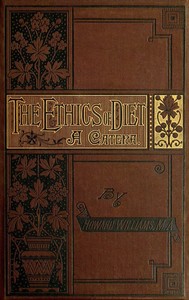
THE ETHICS OF DIET.

A Catena OF AUTHORITIES DEPRECATORY OF THE PRACTICE OF FLESH-EATING.

BY HOWARD WILLIAMS, M.A.

“Man by Nature was never made to be a carnivorous animal, nor is he armed at all for prey and rapine.” --_Ray._

“Hommes, soyez humains! c’est votre premier devoir. Quelle sagesse y-a-t-il pour vous hors de l’humanité?” --_Rousseau._

“Der Mensch ist was er isst.” --_German Proverb._

LONDON: F. PITMAN, 20, PATERNOSTER ROW; JOHN HEYWOOL, 11, PATERNOSTER BUILDINGS, MANCHESTER: JOHN HEYWOOD, DEANSGATE AND RIDGEFIELD.

1883.

The book keeps going

Keep reading, and see it illustrated

Reading is free forever. Sign up and watch scenes appear while you read.

Illustrated scene from The Adventures of Sherlock HolmesIllustrated scene from FrankensteinIllustrated scene from The Great Gatsby

Scenes Storieta drew for other classics.

New illustrated classics

A new classic, drawn, in your inbox.

Once or twice a month: the latest books to get full character casts, scene art, and free comic editions. No account needed.