Public-domain ebook
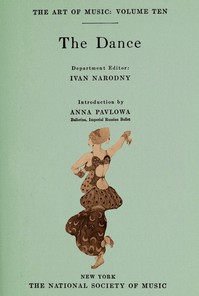
The Dance
Language: en940 downloads on Project Gutenberg
Subjects
In: History - Other·Art·Music
Public-domain ebook sourced from Project Gutenberg #59104.
Public-domain ebook
Language: en940 downloads on Project Gutenberg
Subjects
In: History - Other·Art·Music
Public-domain ebook sourced from Project Gutenberg #59104.
The opening · free to read
Lack of art sense among the Hindoos; dancing and the Brahmin religion; the Apsarazases, Bayaderes and Devadazis; Hindoo music and the dance; dancing in modern India; Fakir dances; philosophic symbolism of the Indian dance.
IV. DANCES OF THE CHINESE, THE JAPANESE AND THE AMERICAN INDIANS 30
Influence of the Chinese moral teachings; general characteristics of Chinese dancing; court and social dances of ancient China; Yu-Vang’s ‘historical ballet’; modern Chinese dancing; dancing Mandarins; modern imitations; the Lantern Festival--Japan: the legend of Amaterasu; emotional variety of the Japanese dance; pantomime and mimicry; general characteristics and classification of Japanese dances--The American Indians: The Dream dance; the Ghost dance; the Snake dance.
Biblical allusions; sacred dances; the Salome episode and its modern influence--The Arabs; Moorish florescence in the Middle Ages; characteristics of the Moorish dances; the dance in daily life; the harem, the Dance of Greeting; pictorial quality of the Arab dances.
Homeric testimony; importance of the dance in Greek life; Xenophon’s description; Greek religion and the dance; Terpsichore--Dancing of youths, educational value; Greek dance music; Hyporchema and Saltation; Gymnopœdia; the Pyrrhic dance; the Dipoda and the Babasis; the Emmeleia; The Cordax; the Hormos--Greek theatres; comparison of periods; the Eleusinian mysteries; the Dionysian mysteries; the Heteræ; technique.
Æsthetic subservience to Greece; Pylades and Bathyllus; the Bellicrepa saltatio; the Ludiones; the Roman pantomime; the Lupercalia and Floralia; Bacchantic orgies; the Augustinian age; importations from Cadiz; famous dancers.
The mediæval eclipse; ecclesiastical dancing in Spain; the strolling ballets of Spain and Italy; suppression of dancing by the church; dances of the mediæval nobility; Renaissance court ballets; the English masques; famous masques of the seventeenth century.
Louis XIV and the ballet; the Pavane and the Courante; reforms under Louis XV; Noverre and the ballet d’action; Auguste Vestris and others; famous ballets of the period--the Revolution and the Consulate; the French technique, the foundation of ‘choreographic grammar’; the ‘five positions’; the ballet steps--Famous danseuses; Sallé, Camargo; Madeleine Guimard; Allard.
The rise of nationalism--The Spanish folk-dances: the Fandango; the Jota; the Bolero; the Seguidilla; other Spanish folk-dances; general characteristics; costumes--England: the Morris dance; the Country dance; the Sword dance; the Horn dance--Scotland: Scotch Reel, Hornpipe, etc.--Ireland: the Jig; British social dances--France: Rondo, Bourrée and Farandole--Italy: the Tarantella, etc.--Hungary: the Czardas, Szolo and related dances; the Esthonians--Germany: the Fackeltanz, etc.--Finland; Scandinavia and Holland--The Lithuanians, Poles and Southern Slavs; the Roumanians and Armenians--The Russians: ballad dances; the Kasatchy and Kamarienskaya; conclusion.
XI. THE CELEBRATED SOCIAL DANCES OF THE PAST 144
The Pavane and the Courante; the Allemande and the Sarabande; the Minuet and the Gavotte; the Rigaudon and other dances--The Waltz.
XII. THE CLASSIC BALLET OF THE NINETEENTH CENTURY 151
Aims and tendencies of the nineteenth century--Maria Taglioni--Fanny Elssler--Carlotta Grisi and Fanny Cerito; decadence of the classic ballet.
The Danish ballet and Boumoville’s reform; Lucile Grahn, Augusta Nielsen, etc.--Mrs. Elna Jörgen-Jensen; Adeline Genée; the mission of the Danish ballet.
Nationalism of the Russian ballet; pedagogic principles of the Russian school; French and Russian schools compared-- Begutcheff and Ostrowsky; history of the Russian ballet--Didelot and the Imperial ballet school; Petipa and his reforms--Tschaikowsky’s ‘Snow-Maiden’ and other ballets; Pavlowa and other famous ballerinas; Mordkin; Volinin, Kyasht, Lopokova.
Nineteenth-century decadence; sensationalism--Loie Fuller and the Serpentine Dance--Louise Weber, Lottie Collins and others.
XVI. THE NATURALISTIC SCHOOL OF DANCING 195
The ‘return to nature’; Isadora Duncan--Duncan’s influence: Maud Allan; Duncan’s German followers--Modern music and the dance; the Russian naturalists; Glière’s ‘Chrisis’-- Pictorial nationalism: Ruth St. Denis--Modern Spanish dancers; ramifications of the naturalistic idea.
The old ballet arguments pro and _con_--The new movement: Diaghileff and Fokine; the advent of Diaghileff’s company; the ballets of Diaghileff’s company; ‘Spectre of the Rose,’ ‘Cleopatra,’ Le Pavilion d’Armide, ‘Scheherezade’-- Nijinsky and Karsavina--Stravinsky’s ballets: ‘Petrouchka,’ ‘The Fire-Bird,’ etc.; other ballets and arrangements.
XVIII. THE EURHYTHMICS OF JACQUES-DALCROZE 234
Jacques-Dalcroze and his creed; essentials of the ‘Eurhythmic’ system--Body-rhythm; the plastic expression of musical ideas; merits and shortcomings of the Dalcroze system--Speculation on the value of Eurhythmics to the dance.
The defects of the new Russian and other modern schools; the new ideals; Prince Volkhonsky’s theories--Lada and choreographic symbolism--The question of appropriate music.
EPILOGUE: FUTURE ASPECTS OF THE DANCE 261
The book keeps going
Reading is free forever. Sign up and watch scenes appear while you read.



Scenes Storieta drew for other classics.
New illustrated classics
Once or twice a month: the latest books to get full character casts, scene art, and free comic editions. No account needed.