Public-domain ebook
A Day with Ludwig Beethoven
by May Byron
Language: en228 downloads on Project Gutenberg
Subjects
In: Biographies·Music
Public-domain ebook sourced from Project Gutenberg #59672.
Public-domain ebook
by May Byron
Language: en228 downloads on Project Gutenberg
Subjects
In: Biographies·Music
Public-domain ebook sourced from Project Gutenberg #59672.
The opening · free to read
At daybreak, on a summer morning, in the year 1815, a short, thick-set, sturdily-built man entered his sitting-room, and at once set to work to compose music. Not that he disturbed the slumbers of the other inhabitants by untimely noises upon the pianoforte: a course which, at three in the morning, might be resented by even the most enthusiastic admirer of his genius. No: he sat down at his table, with plenty of music paper, and addressed himself to his usual avocation of writing assiduously till noon or thereabouts.
The untidy, uncomfortable condition of his room did not distress Ludwig van Beethoven in the least. True, it was scattered all over with books and music; here the remains of last night's food, there an empty wine bottle; on the piano, the hasty sketch of some immortal work; on the floor, uncorrected proofs, business letters, orchestral scores, and MSS. in a chaotic pile.
But he thoroughly enjoyed casting a glance, from time to time, at the sunny scene without; at the vista towards the Belvedere Garden, the Danube, and the distant Carpathians,--the view for the sake of which he had taken up his lodgings at this house in the Sailer-stätte, Vienna. For if there was one thing which still could afford a unique and cloudless pleasure to this sensitive, unhappy man, it was Nature in all her varied forms of light and loveliness. Nature, that "never did betray the heart that loved her," still held out open arms of help and solace for the healing of his afflicted soul.
Beethoven, in his various migrations from lodging to lodging--and they were very numerous, and inspired by the most trivial causes--always endeavoured to select an airy, sunshiny spot, where he could at least feel the country air blowing to him, and so keep in touch with his beloved green fields. If the supply of sunshine proved insufficient, that was quite a valid reason for another removal. But his restless, sensitive mind was apt to magnify molehills into mountains, and the most trifling inconvenience into a serious obstacle to work. Work was his starting point, his course, his goal; work was his whole raison-d'-être, the very meaning and object of his existence.
It has been observed that if we would represent to ourselves a day in the life of Beethoven, one of the Master's own wonderful compositions would serve as the best counterpart. Wagner instances the great Quartet in C sharp minor as a notable instance of this allegoric music,--designating the rather long introductory Adagio, "than which, probably, nothing more melancholy has ever been expressed in tones, as the awaking of a day
'Which through its tardy course No single longing shall fulfil--not one!'
And yet the Adagio is in itself a prayer, a period of conference with God, in faith, in eternal goodness." And it was in a state of mind which one may term unconsciously devotional, that the great composer now ascended into regions where few could follow him,--where, his senses deaf and blind to earthly sights and sounds, he could hold intercourse with a pure and celestial art. For Music contains, within its inexhaustible treasuries, not only all that we conceive of best, all those highest and most ennobling emotions which thrill us as at a touch of the Divine finger, but it also possesses all the characteristic beauties of other arts. The composer shares Form and Colour with the painter--a much more elastic variety of Form--and an incomparably wider use of Colour, in the magnificent paintbox of the orchestra. The composer's art, moreover, is not stationary at one fixed point--one moment, so to speak, seized and immortalised upon canvas: but has the fluidity and onward movement of actual life, passing with bewildering rapidity of transition from one phase of thought to another, even as life does. And the composer, while he shares with the great prose writer and the poet the power of expressing things marvellously well,--of uttering in beautifully poised and balanced rhythm the whole gamut of human emotion,--yet has a greater power than theirs. For he can put into a single phrase, with an exquisite intimacy of intuition, a meaning which could hardly be denoted in a hundred words: he can condense into a couple of bars the essence of a whole chapter.
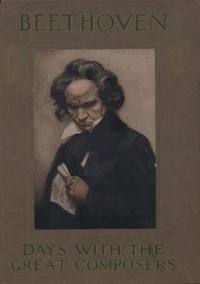
The outward appearance was far from beautiful, which belied the really lofty heart of the great composer as he sat indefatigably at work. His thick, dark, upstanding hair, already turning grey, crowned a pitted, swarthy face; his looks were rugged, gloomy, forbidding; his chin bore evidence of the most superficial shaving; his hands were covered with thick black hair; his small, deeply set, fiery eyes alone redeemed him from ugliness. For the rest, he had cotton wool in his ears, and his rough, shabby, hairy clothes gave him a Crusoesque look, almost comic in its incongruity with his occupation.
The housekeeper brought in his breakfast: he paid no attention to her. He had punctiliously counted out sixty coffee-beans overnight, and handed them to her in readiness for the morning; but now, after he had dipped his pen in the coffee-cup instead of the ink some three or four times, he pushed away the discoloured mixture, and absently nibbled his crusty roll. He was composing a Polonaise, to be dedicated to the Empress of Russia, for which he was to receive fifty ducats. This seemed an absurdly small remuneration, but although Beethoven was "really forced" (to quote Richard Wagner) "to support himself from the proceeds of his musical labours," yet, as life had no allurements for him in the ordinary sense, he had less necessity laid on him to make much money; and "the more confident he became in the employment of his inner wealth, so much the more confidently did he make his demands outward; and he actually required from his benefactors, that they should no longer pay him for his compositions, but so provide for him that he might work altogether for himself, unconcerned as to the rest of the world. And it really happened--a thing unprecedented in the lives of musicians--that a few benevolent men of rank pledged themselves to keep Beethoven independent in the sense demanded."
So it was not with any misgivings that he set aside the score of the Polonaise, still unfinished, and turned to something which he justly regarded as holding promise of his best vocal work; that which is still, perhaps, the greatest love-song in the world--the unequalled Adélaide. Its words, though above the average of the German lyrist of that period, served merely as a peg upon which to hang the music.
"Lonely strays thy friend in April's garden, Lovely fairy lights around are gleaming Through the tremulous boughs of rosy blossom, Adélaide!
In the stream, and on the snowy mountain, In the dying day all gold-beclouded, In the starry fields, thy likeness lingers, Adélaide!
Evening breezes through the leaves are lisping, Silver May-bells in the grasses chiming, Waves are rustling, nightingales are fluting-- Adélaide!
Soon, O wonder! on my grave a floweret, From the ashes of my heart upspringing, Shall reveal, on every purple petal-- Adélaide!" (Matthisson.)
Beethoven had qualified himself for vocal writing to a degree which is rarely attempted by the instrumental composer. Although his father and grandfather had been vocalists, his own early studies had been in other branches of music; he knew little of the capabilities of the voice. So he took singing lessons from the Italian composer Salieri; and notwithstanding that his own voice was shrill and harsh, increasingly so as his deafness grew upon him, he was thus enabled to pour forth liquid and melodious phrases, such as those of Adélaide, which seem so absolutely adapted to the requirements of a singer that they could, so to speak, sing themselves.
"_Adélaide_," he said, "came entirely from my heart;" and therefore its pure ardour goes straight to the heart of the hearer. But he was not contented with his work, upon which he had already spent much time and thought. A frown gathered heavily upon his overhanging brows, as, humming the air and playing an imaginary accompaniment on the desk, he went over it again and again in the endeavour to "gild refined gold."
"The more one achieves in art," he grumbled, "the less contented is one with former works." And this, indeed, was characteristic of Ludwig van Beethoven: never to be satisfied with what he had accomplished, but to go on continually, as it were, from strength to strength. That "divine discontent which is at the root of all improvement," perpetually impelled him towards higher things, and made him at once haughtily conscious of his own powers, and yet the most modest and laborious of men.
In Adélaide, however, lay hidden more than the fluent outcome of his creative instinct. It remains the lovesong for all time--the last word of a noble and ennobling passion. Here--to pursue the simile of the C sharp minor quartet--a dream-image of the Allegro awakened in charming reminiscence and played sweetly and sorrowfully with itself. For this rough, rugged, eccentric, bad-tempered musician was capable of reaching the austerest heights of love--those heights where renunciation sits eternally enthroned.
Love and Beethoven seem a singularly anomalous pair: yet from his youth onward love was the very mainspring of his unsullied life. It began, rooted in filial affection for his mother, of whom he wrote those touching words, "She was such a good, loving mother to me, and my best friend. Oh, no one could be more fortunate than I, when I was able to speak that sweet name 'Mother', and it was heard--and to whom shall I ever say it now?"--And it continued as a vague but fervent longing for some sweet unknown--some "not impossible She."
"Love, and love alone, is capable of bringing lasting happiness .... O God, let me find her--_her_--who will strengthen me in virtue and lawfully be mine."
So he sighed: but his hopes remained unfulfilled. "His intense longing for a home and for female companionship was never satisfied," and the extraordinary number of attachments by which his career was punctuated, and which were generally for women of superior rank to his own, were every one of them destined to be transitory and destitute of result. Magdalena Willmann, Giulietta Guicciardi, Bettine Brentano, Thérèse von Brunswick, Amalie Sebald, and many another charming phantom, passed, fugitively brilliant, across his horizon: and the domestic happiness for which Beethoven never ceased to crave, was never within measurable distance of his grasp.
But now he resolutely put away Adélaide and its attendant wistful thoughts, and addressed himself to more severely intellectual work: the great B flat Sonata (Op. 106) which, like all his latter work, is orchestral in feeling and treatment.
--------------------------------------------------------------------
"The Scherzo of the 'Moonlight' Sonata, wherein a troop of glimmering fairy forms come dancing through the midnight forest."
--------------------------------------------------------------------
The book keeps going
Reading is free forever. Sign up and watch scenes appear while you read.



Scenes Storieta drew for other classics.
New illustrated classics
Once or twice a month: the latest books to get full character casts, scene art, and free comic editions. No account needed.