Public-domain ebook
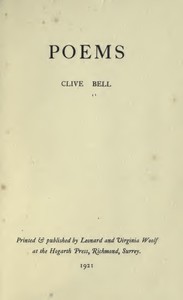
Poems
by Clive Bell
Language: en269 downloads on Project Gutenberg
Subjects
Public-domain ebook sourced from Project Gutenberg #60237.
Public-domain ebook
by Clive Bell
Language: en269 downloads on Project Gutenberg
Subjects
Public-domain ebook sourced from Project Gutenberg #60237.
The opening · free to read
Here in a garden under vines Translucent in the mid-day sun, Washing, green shutters, and the lines Of the Salute, which is fun And pure baroque to men of taste, I'm waiting--while the pot-boy chaste Or chastish since Ignatius Chowne And J. A. Symonds to this town Have taught Italian history--waiting, I say, while he is regulating A "_conto_" of 12.50-Change For 50 lire; it is strange In "_tutto il viale bello_" In which the shops are small but thrifty There's not a single honest fellow To furnish 37.50.
I'm waiting still, and still I ponder, As I have pondered all the morning, Out on the blue Giudecca yonder, Under the arches, listless, yawning Full-mouthed against precocious summer That's sprung this quick surprise upon us, And found us out, the sly new-comer, Tweed-coated, winter-hosed, astonished-- I ponder, knowing all the time The answer, ponder for the pleasure Of fitting fancy into rhyme And matching music with the weather, What lacks when sea and sky conspire With form as thin but more romantic Than that which some of us admire At Covent Garden,--Transatlantic Cousins still call it monumental, But we know better--sentimental People divine a riddle basking Under its marble,--never mind them, Be sure they'll come, their tales behind them, Safe home to Chelsea. Still I'm asking: "What's lacking yet?" The Spring's awake, Each palace curtsies to her neighbour, Each gondolier's a handsome rake, Each mouth-organ a dulcet tabor; What can I want when Venice plays And Time's a song, and Fate's a dancer, And Life drifts gaily down her ways, What's lacking, Madame? Can you answer?
Books are the quiet monitors of mind, They prompt its motions, shape its ways, they find A road through mazes to the higher ground, Whence to explore the sky-bound marches. Round About us lie the open downs. Our days Still ask a guide and goad. Wherefore always We meditate wise thoughts and passionate lays; Wherefore I send a book.
Books are the mind's last symbol. They express Its visions and its subtleties--a dress Material for the immaterial things That soar to immortality on wings Of words, and live, by magic of the pen, Where dead minds live, upon the lips of men And deep in hearts that stir. Wherefore do I, Drawing a little near, prophetically, Send you a book.
Books are the heart's memorial. They shall measure, In after days, our undiscovered treasure,-- Thrilling self-knowledge, half-divined untold Yearnings, and tongueless agonies, shall unfold Or half unfold to half-illumined eyes. The cypress shadows creeping gnomonwise Still stretch their purple fingers down the hill That hangs above Fiesole; and still Your English fireside glows. Do you most dear-- Sometimes just guessed at, sometimes very near-- Yet always dear and fairest friend, do you Recall the sunlight and the firelight too? Recall the pregnant hours, the gay delights, The pain, the tears maybe, the ravished heights, The golden moments my cold lines commend, The days, in memory or which I send A book?
Dec. 1909.
It was the thrush's song I heard To-day, in March. And you who came At life through books, whom poets stirred To love of beauty, who the name Of art revered and fancy knew From earliest days,--why, how should you Guess at my feelings when among The elms I heard the thrush's song?
For you the country means a mood, Recalls a poem, lays a scene; For you its beauties are more good Sometimes than paintings: it has been Music to calm or move you, still A background to your thought and will.
Nothing for me the country means: It is. The thrush's earliest song In the precocious sunshine cleans My soul of culture. Comes along The acrid smell of daffodil, Hard from the soil still wet and chill.
These do not mean. I am content To look or listen, passion spent, Far beyond art and thought, and free From Vanity and Jealousy, As free as flower, or bird, or tree, Not to mean anything, but be.
1901.
The sun crept into the peaceful earth And troubled her dream of fair content; He tempted the timorous blossoms to birth, The poor pink fools that laughing went Naked to meet him, their leaves without, And the meddlesome bees droned round and about.
The sober grey that shrouded the head Of the pensive sea he ravished away; He twitched it from her, and gave instead The libertine breezes who ruffle her day; Who tease and tousle and toss anew Her mourning garment of exquisite blue.
He cozened the mud-flies out on the heath, Ephemeral butterflies opened their wings; The credulous birds from their mates beneath Caught up the catch that Eternity sings-- Sings to the Echoes in Fools' Paradise-- "Shall not our folly befool the wise?"
April 1903.
When all the world was very good (So says the nursery rhyme) The fairy Fays and Mays who stood As godmothers, from time to time, Would give their virtuous picaninnies A golden goblet filled with guineas. That was the golden age: and nurse Declared that ours grew worse and worse ("Don't bite the spoon, Miss Leslie!") Yet I believe that fairies still Can fill a cup, and over-fill,-- At any rate in Chelsea. Telling good news is reckoned kind (Except when Germans tell it,) To wrap it in a pleasant rind Of song was thought angelic By the good shepherds, and by me A piece of sweet diablerie.
One cavil: though it ill becomes One who has in his time Bedragged the depths and skimmed the scums To catch a dubious rhyme, To scold a poetess who fell And, though she knew she shouldn't, Wrote down a name that rhymed with "well" Instead of one that wouldn't, Yet, frankly, tuneful, erring sister, Can one be musical to "Mister"? A monosyllable, I confess, Is what the Muse prefers: She cut a queen's name down to Bess And yours is worse than hers: Meanwhile it takes a better poet Than I to deal with Mrs. Jowitt.
I like to let my fancy rove O'er all the charms of Mister Shoave. But oh! how very much above Such obvious charms are those of Shuv.
Oh Shuv most intimate! Oh Shoave More pompous-fine! Yet interwove, How complex-sweet and meet for love The compound name of Gerald Shuv.
Oh Gerald dear! Oh Shuv! Oh Shoave! My late-found bliss, my treasure-trove; My poor heart yearns to counter-prove Those double facets that me move So strangely; therefore, deign t'approve This syncretism--Gerald Shoove.
1912.
If I could catch all the stars in a net And make them tell me their Christian names, Or snare the dream of a violet, Or persuade the squirrels to teach me their games, Or quite surprise, on a warm June night, The lilac bushes that laugh for delight And tremble for fear lest we should hear them,-- If I could tiptoe breathlessly near them And overhear them And master so Secrets that only the lilacs know: If I could feel what a young bird feels When first it flutters across the road, Or learn at last from the creaking wheels Of a wagon that story they tell their load-- The hillside legend that never grows old: If I could be told All the subtle, impalpable, exquisite things That we just surmise when the country sings, That week before they begin the hay: If I could contrive to sing, or to say, Or to be, what the poets have never invented, Should I be contented? Was I to-day?
1915.
After so many days... The moon lies right across the sea, The tide's up to the brink, A door keeps flapping in the wind, I cannot sleep a wink, Although I'm sleepy as can be. But lie in bed and think Of you and all your proud, gay ways.
1915.
They say you are the latest, loveliest jest Of some transmigratory ghost, The last embodiment, and best, Of some small being--tell me, are you most Yourself when most A squirrel or jerboa? Or rather, Since you are tender, humorous, and wise, Is yours the spirit of some steadier goer, A grave, precautious donkey, whose wide eyes See, far away, the thin ambiguous towers, Nor miss the pebbly road nor truant flowers-- See farther, And less painfully, than ours? Or, as I think, Have you, like some Too curious spirit peering from the East, O'erleant the ramparts or your little town In Fairyland; and from the brink Of The Impossible tumbled down To where we now uneasily surmise Your vagrant figure, trailing Sirenwise-- Strayed reveller, from some fairy banquet come To sow sedition at our sober feast?
1915.
And back again, under the rain, As wild as wind-tossed plovers, Wet and chill and enchanted still-- I fear they must be lovers.
1915.
In some few years, when you and I-- Perhaps in some few months--shall lie, Where lie at last everyone must, Little will it approve our dust That one shall write above our tombs: "They gave their days to glums and glooms."
Much rather had I someone said: "They loved to wantonness, these dead." "They kissed too much," I'd have one say, "Until they kissed their souls away. Still they were young, and, lip to lip, They found a way to make Time skip; And they were bold enough to find A way to brave him, mind to mind; And sometimes, by their deadly art, They caught and crushed him, heart to heart."
This elegy methinks becomes Us better than our glooms and glums.
1915.
No: I was not made for love; I was made for easier things, Ecstasies on paper wings, Agonies that end in laughter --Smoke or kisses coming after-- Not for love.
I was made for airy thinking, Nimble sallies, champagne-drinking, Badinage and argument, Reading's infinite content, Ill-considered merriment, Friendship, anything but love.
Made for singing little songs, Made for righting little wrongs, Made to taste whate'er there be Of loveliness and gaiety On this variegated earth; Made for sentiment and mirth And light romance, perhaps just worth A smile from Art, a nod from Truth, I, apt for a fantastic youth Of follies, an old age of thought, And never thinking to be caught As now I am, said "Never mind Love, for Love, you know, is blind." I was made with eyes to see, And taste to choose fastidiously, And ears to hear, enough of brain To make most matters fairly plain, Enough of health for work or play, Of wealth enough to pick my way, Sense to enjoy, and arts to bring Soft nothings off a softer thing, A turn of wit, a taste for ease, And what had love to do with these?
I was made to revel in The viola and violin, The broad bassoon and clarinette, From every art devised to get Its complement of melody: Believe me, I was meant to be One who smiled back at smiling faces, A loiterer in life's pleasant places, A well of receptivity.
I was contrived by God to pull The noses of the very dull; Tweak up as 'twere a cotton gown The law most solemnly laid down; Expressly charged to mock the great And weather-cockwise still girate. To choose a rose and praise a frill, And sometimes cause a tiny thrill, To be a lover in my fashion-- But O! I was not made for passion.
Therefore, dear Lady, if you please Deal very gingerly with these. Here is our garden: O, take care Our passion spoil not our parterre. Be gracious, Madame, lest your frown Should bake the lawns and burn them brown, Be very kind, or jealous showers May quite dash down our scented flowers, And O! be chary of reproof, Remember I'm not made for love.
Is it true? Are Ariel's whims Embodied in your artful limbs? And Puck, they say, betrayed you all his lore: Did he? Are you-- As now to me at any rate you seem, Twisting a Longhi into fun and air,-- Are you, perhaps, that unpropounded theme Of playfulness Mozart forgot to score, As lyrical and debonair and new And fair? The rhythm snaps. Surely I caught you there? You are, at least I'm almost sure you were, Some truant from the lesser Piero's store, A living Procne by a livelier shore, Where lustier satyrs ply remorselessly More pagan antics by a bluer sea, A sea as frankly unmysterious As Theocritus.
The book keeps going
Reading is free forever. Sign up and watch scenes appear while you read.



Scenes Storieta drew for other classics.
New illustrated classics
Once or twice a month: the latest books to get full character casts, scene art, and free comic editions. No account needed.