Storieta
Sign up

About this book

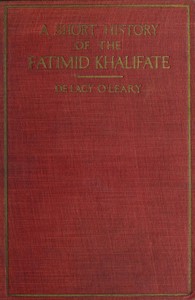
The work is a concise scholarly overview of the Fatimid caliphate, focusing on the line of Fatimid khalifs who ruled Egypt during the First and Second Crusades. It opens by warning that Western Crusade narratives often misrepresent the Eastern powers they encountered, and then promises a corrective drawn from Arabic and Persian sources. The author, De Lacy O’Leary, frames the essay as a supplement to Western histories, tracing the rise of the Ismaʿili sect, its rivalry with the Abbasid caliphate, and the succession of Fatimid rulers from al‑Qaʾim to al‑Fāʿiz, before linking these developments to broader trends in medieval Islam. The detailed table of contents and the extensive introductory discussion of Shiʿite origins signal a systematic, source‑based treatment rather than a novel argument.

Written in the measured, academic prose of early‑20th‑century historiography, the book balances narrative description with extensive footnotes and a bibliography. Its tone is that of a learned guide, aimed at students of medieval Western history, scholars of Islamic studies, and any reader who wishes to see the Crusades from the perspective of the Muslim states they confronted. Those who appreciate careful synthesis of primary sources and a clear, if somewhat formal, exposition of complex religious and political dynamics will find it a valuable reference.

Who appears in A Short History of the Fatimid Khalifate

  • al‑QaʾimMiddle‑aged Arab male, dark beard, curled hair, jeweled turban, embroidered silk robe, seated on throne
  • al‑FāʿizOlder Arab ruler, trimmed beard, ornate headdress, patterned mantle, holding a ceremonial sword, palace backdrop

The opening · free to read

The following pages present a brief outline of the history of the Fatimid Khalifs who were ruling in Egypt at the time of the First and Second Crusades. Too often the student of European history gleans his knowledge of the oriental powers with which the West was brought into contact by the Crusades from western Christian writers, who do not fairly or truly describe those powers, and do not set forth clearly the strong and weak points which are so important in interpreting the actual forces with which the Crusaders were brought into contact. These pages are drawn from the Arabic and Persian historians so as to present a picture which, though inaccurate in some points, nevertheless shows the other side not perceived by the historians who wrote the narrative of the Crusades from a western standpoint. Directly, therefore, they supplement the western history, but are still more important in their indirect bearing as an effort has been made to show the rise and development of the Fatimid Khalifate and sect as a rival to the orthodox Abbasid Khalifate of Baghdad, which is most essential to the right understanding of the world into which the Crusaders penetrated, whilst at the same time it shows a curious and important phase of Muslim tendencies which are not without a bearing on the later history of Islam. The present essay does not claim to be an original study in a field hitherto unexplored, but simply aims at bringing together in an accessible form material which will be of service to the student of mediaeval western history and to those who are interested in the development of Islam, and to do so with such comments as will enable it to be co-ordinated with contemporary European history.

The book keeps going

Keep reading, and see it illustrated

Reading is free forever. Sign up and watch scenes appear while you read.

Illustrated scene from FrankensteinIllustrated scene from The Great GatsbyIllustrated scene from Pride and Prejudice

Scenes Storieta drew for other classics.

New illustrated classics

A new classic, drawn, in your inbox.

Once or twice a month: the latest books to get full character casts, scene art, and free comic editions. No account needed.