Public-domain ebook
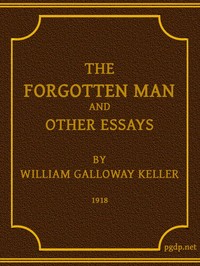
The Forgotten Man, and Other Essays
Language: en1,399 downloads on Project Gutenberg
Subjects
In: Essays, Letters & Speeches·Politics·Economics
Public-domain ebook sourced from Project Gutenberg #65693.
Public-domain ebook
Language: en1,399 downloads on Project Gutenberg
Subjects
In: Essays, Letters & Speeches·Politics·Economics
Public-domain ebook sourced from Project Gutenberg #65693.
The volume is a posthumous gathering of William Graham Sumner’s economic and social essays, assembled after the editor discovered unpublished manuscripts and responded to earlier critics who demanded a fuller bibliography and an index. The introductory note explains that the series grew from an original single‑volume plan, “War and Other Essays,” into three further collections, and that this final book now brings together the “Forgotten Man” lecture for the first time, alongside a range of shorter pieces on free trade, protectionism, monetary policy, and other topics that Sumner addressed between the 1880s and the early 1900s. The editor’s preface details the pragmatic, “plain‑language” approach Sumner took in his popular agitation, and the contents list shows a broad sweep from tariff reform to the “Science of Sociology,” reflecting his lifelong commitment to exposing what he saw as economic quackery and social injustice.
Sumner writes with a forceful, polemical voice that blends scholarly argument with the vigor of a public lecturer. His prose is direct, often laced with satire, and rooted in the late‑19th‑century American debate over free trade, gold‑standardism, and the role of government in the economy. Readers who enjoy vigorous economic commentary, the history of American liberal thought, or the intellectual origins of the “forgotten man” metaphor will find his essays rewarding, while those preferring more detached academic analysis may find his impassioned style a demanding but enlightening companion.
The opening · free to read
With the present collection the publication of Sumner’s Essays comes to an end. The original project of publishers and editor contemplated but a single volume--“War and Other Essays”--and they accordingly equipped that volume with a bibliography which was as complete as they then could make it. But when, later on, other materials came to be known about, and especially after the discovery of a number of unpublished manuscripts, the encouraging reception accorded to the first venture led us to publish a second, and then a third collection: “Earth Hunger and Other Essays” and “The Challenge of Facts and Other Essays.” It was during the preparation of the latter of these, now some five years ago, that the late Professor Callender deplored to the editor the omission of certain of Sumner’s essays in political economy--in particular those dealing with free trade and sound money. And the reviewers of preceding collections had reminded us, rightly enough, that there should be a fuller bibliography and also an index covering all the essays.
In this last volume we have striven to meet these several suggestions and criticisms. And it is now the purpose of the publishers to form of these singly issued volumes a set of four, numbered in the order of their issue. Since the series could not have been planned as such at the outset, this purpose is in the nature of an after-thought; and there is therefore no general organization or systematic classification by volumes. In so far as classification is possible, under the circumstances, it is made by way of the index. This and the bibliography are the work of Dr. M. R. Davie; and are but a part of the service he has performed in the interest of an intellectual master whom he could know only through the printed word and the medium of another man.
Sumner’s dominant interest in political economy, as revealed in his teaching and writing, issued in a doughty advocacy of “free trade and hard money,” and involved the relentless exposure of protectionism and of schemes of currency-debasement. As conveying his estimate of protectionism, it is only fitting that his little book on “The -Ism which teaches that Waste makes Wealth” should be recalled from an obscurity that it does not deserve; it is typical of the author’s most vigorous period and witnesses to the acerbity of a former issue that may recur. In default of a single, comprehensive companion-piece in the field of finance, and one making as interesting reading, it has been necessary to confine selection to several rather brief articles, most of them dating from the campaign of 1896. In the choice of all economic essays I have been guided by the advice of my colleague, Professor F. R. Fairchild, a fellow-student under Sumner and a fellow-admirer of his character and career. Professor S. L. Mims also has been generous in his aid. I do not need to thank either of these men, for what they did was a labor of gratitude and love.
The title essay will be found at the end of the volume. It is the once-famous lecture on “The Forgotten Man,” and is here printed for the first time. When “War and Other Essays” was being prepared, we had no knowledge of the existence of this manuscript lecture; and, in order to bring into what we supposed was to be a one-volume collection this character-creation of Sumner’s, one often alluded to in modern writings, we reprinted two chapters from “What Social Classes Owe to Each Other.” It has been found impracticable in later reprintings of Vol. I to replace those chapters with the more complete essay; and we have therefore decided to reproduce the latter, despite the certain degree of repetition involved, rather than leave it out of the series. In view of the fact that Sumner has been more widely known, perhaps, as the creator and advocate of the “Forgotten Man,” than as the author of any other of his works, we entitle this volume “The Forgotten Man and Other Essays.”
Several essays not of an economic order have been included because they have come to my knowledge within the last few years and have seemed to me to call for preservation. It is almost impossible to fix the dates of such manuscript essays, for I have not been able in all cases to secure information from persons who might be able to identify times and occasions. And there remain a good number of articles and manuscripts, published or unpublished, which can receive no more than mention, with a word of characterization, in the bibliography.
Some mention ought to be made here of a large body of hand-written manuscript left by Sumner and representing the work of several years--1899 to 1905 or thereabouts--upon a systematic treatise on “The Science of Society.” Printed as it was left, partially and unevenly completed and with many small and some wide hiatuses, this manuscript would make several substantial volumes. It is a monument of industry, involving, as it did, the collection over many years of thousands of notes and memoranda, and the extraction from the same, by a sort of tour de force, of generalizations intended to be set forth, with the support of copious evidence, in the form of a survey of the evolution and life of human society. These manuscripts, as left, represent no more than a preliminary survey of a wide field, together with more elaborately worked out chartings of sections of that field. The author planned to re-write the whole in the light of “Folkways.” The continuation, modification, and completion of this enterprise, in something approaching the form contemplated by its author, must needs be, if at all possible, a long task.
As one surveys, through these volumes of essays, the various phases of scholarly and literary activity of their author, and then recalls the teaching, both extensive and intensive, done by him with such unremitting devotion to what he regarded as his first duty--and when one thinks, yet again, of his labors in connection with college and university administration, with the Connecticut State Board of Education, and in other lines--it is hard to understand where one man got the time, with all his ability and energy, to accomplish all this. In the presence of evidence of such incessant and unswerving industry, scarcely interrupted by the ill-health that overtook Sumner at about the age of fifty, an ordinary person feels a sense of oppression and of bewilderment, and is almost willing to subscribe to the old, hopeless tradition that “there were giants in those days.”
In the preparation of this set of books the editor has been constantly sustained and encouraged by the interest and sympathy of the woman who stood by the author’s side through life, and to whom anything that had to do with the preservation of his memory was thereby just, perfect, and altogether praiseworthy. The completion of this editorial task would be the more satisfying if she were still among us to receive the final offering.
A. G. KELLER.
WEST BOOTHBAY HARBOR, ME., September 1, 1918.
The book keeps going
Reading is free forever. Sign up and watch scenes appear while you read.



Scenes Storieta drew for other classics.
New illustrated classics
Once or twice a month: the latest books to get full character casts, scene art, and free comic editions. No account needed.