Public-domain ebook
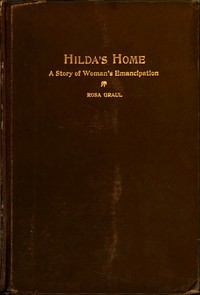
Hilda's Home: A Story of Woman's Emancipation
by Rosa Graul
English453 downloads on Project GutenbergDownload EPUB
Public-domain ebook sourced from Project Gutenberg #67621.
Public-domain ebook
by Rosa Graul
English453 downloads on Project GutenbergDownload EPUB
Public-domain ebook sourced from Project Gutenberg #67621.
The opening · free to read
In the order of nature the ideal precedes the actual. In back-woods phrase, “The wind-work must precede the ground-work.” “The ascent of life is the ascent of ideals.” Ascent means action, change, involving effort, struggle, aspiration. Aspiration implies or pre-supposes DISCONTENT.
The author of the story, “Hilda’s Home,” preaches the gospel of discontent—dissatisfaction with the old, desire for the new. With Ella Wheeler she says,
Be not content; contentment means inaction— The growing soul aches on its upward quest. Satiety is kin to satisfaction— All great achievements spring from life’s unrest.
The tiny root, deep in the dark mould hiding, Would never bless the earth with leaf and flower, Were not an inborn restlessness abiding In seed and germ to stir them with its power.
The author of “Hilda’s Home” preaches the gospel of Freedom—equal freedom, the gospel of Liberty coupled with responsibility. With Spencer she would say, “Every one has the right to do as he pleases so long as he does not invade the equal right of others.” With Macaulay, Rosa Graul would say “The cure for the evils of Liberty is more liberty.” Hence she has no fears that under Freedom the Home and the Family would cease to exist, or that woman will be less loving and lovable, or that man will be less manly and honorable. On the contrary she maintains that only in the soil and atmosphere of freedom is it possible for true womanhood and manhood to live and flourish.
While devoting considerable space to the subject of industrial reconstruction, the central aim of “Hilda’s Home” is the emancipation of womanhood and motherhood from the domination of man in the sex relation. “Self-ownership of woman” may be called the all-pervading thought of the book now offered to the impartial and truth-loving reader. With Havelock Ellis in his “Psychology of Sex,” Rosa Graul would say:
“I regard sex as the central problem of life. And now that the problem of religion has practically been settled, and that the problem of labor has at least been placed on a practical foundation, the question of sex—with the social questions that rest on it—stands before the coming generation as the chief problem for solution. Sex lies at the root of life, and we can never learn to reverence life until we know how to understand sex—So, at least, it seems to me.”
A word of warning: Let no reader expect perfection in the following pages, either in ideal or in its manner of presentation. The editor and publisher offer this work to the reading public not for its literary merits, not for the excellence of its plan nor for the originality of its conception. The writer of “Hilda’s Home” is a poor, hard-working, unlettered woman; one whose advantages in the way of preparation for literary work have been almost nil. The great, the distinguishing merit of Rosa Graul, as an author, is the simplicity, the naturalness with which she tells of the varied experiences that educate and prepare the various characters of her story for living in a co-operative home. For the life history of these children of her brain she is indebted, so she informs us, to the cold hard facts of her own experience and personal observation. “Experience teaches a dear school but fools will learn in no other,” saith the proverb. The trouble with us all is that we are so slow to learn, even in the bitter school of experience. In no department of life is this comment so universally applicable as in the sexual or conjugal relations of women and men. Hence the necessity of plainness of speech and honesty of thought, on this subject, no matter how iconoclastic or revolutionary the thought may be.
Prominent among the criticisms made upon the economic ideal herein presented is the absence of all reference to the “Labor Exchange,” and the apparent acquiescence by the co-operators in the old monopolistic financial system. In answer to this objection it may be said that our story was written some years ago, and before the publication of books on Labor Exchange and other modern economic reforms, and though an appendix was prepared to supply this lack, the addition would have increased the size of the book beyond its prescribed limits.
By others it is objected that an ideal home could and should be built without the aid of the millionaire’s ill-gotten dollars. To this it may be replied that the earth with all it holds, including the accumulations called “capital,” belong to the living present, and not to the dead past, and that if the legal heirs of past accumulations, the Owen Hunters of today, can be induced to build model homes for the use of those who may be ready to utilize them, there would seem to be no rational objection to such attempts at rectification of past wrongs.
To close this brief preface, which must serve also as introduction and appendix, let it be remembered that “Hilda’s Home” is offered not as a final solution of all the problems of human life, but rather as a suggester of thought upon some of the most important and most perplexing of these problems. In all great reforms the public conscience must first be aroused to see the necessity of such change. If this unpretentious volume can be made the vehicle or means of helping to educate and stimulate the public conscience to the point of putting into practice the reforms advocated therein, the chief object of the author, as well as of editor and publisher, will have been realized.
HILDA’S HOME.
“Imelda, surely you know if you love me, if you are able to grant my heart’s desire?” Saying which, he caught her hand in his and drew her out of the shadows into the bright light of the full moon.
“Look at me, Imelda, and tell me what you mean! Can it be that I have been deceived in you? I believed you loved me. I thought I had often read the proof of a tender emotion in your eyes; and now you tell me you do not know.”
Deep feeling quivered in every cadence of his voice. He was terribly excited, terribly in earnest; so much was easy to see.
The smile that for a moment played about her lips was a sad one. Softly and clearly the words fell from them.
“You have not misunderstood me. I do love you, O, so much, but—” The sentence remained unfinished. With a low, happy cry he gathered her in his arms. His silken mustache swept her cheek, his lips closed firmly over hers. For a moment all else was forgotten; their souls blended in that kiss—a draught fraught with divinest love. It was bliss, ecstacy, such as only those are able to enjoy who are possessed of a pure mind. For a few moments the girl gave herself up to the enjoyment of blissful consciousness. Then with a determined effort she freed herself from his embrace, laid her soft hand upon his shoulder and, standing with her head slightly thrown back, said: “But—I do not know if I can marry you.”
Surprise showed plainly in his every feature. “You love me, and do not know if you can marry me! Imelda, you are an enigma. I cannot understand you. What can you possibly mean?”
A sigh escaped the parted lips. “I mean, my Norman,”—laying a hand on either of his cheeks—“I mean that I would fain keep my lover! I am afraid of a husband. Husbands are not lovers.”
The surprised look upon his face intensified until it became perfectly blank. “Husbands are not lovers? Child, who put such notions into your head? As husband and wife, when we are such, then will be the time of the perfect blending of our love—you mine and I thine. Imelda, now that I know the sweet boon of your love is mine, I want to realize it in its fullness. You must grant me the consummation of it.”
Again she was folded in his arms, pillowed upon his breast, while his cheek rested against hers. She felt the increase of his passion in the kisses he pressed upon her lips. His breath mingled with hers. She felt and heard the mighty throbs of his heart, while his love for her seemed almost to overpower him. She felt her blood in a feverish glow as it pulsed through her veins; it was heaven, but—a shudder suddenly shook her frame, she whispered, hurriedly, intensely: “No! No! No! I can not, can not marry you. I am afraid!”
With a mighty effort conquering the tumult of his emotions, but still holding her closely pressed, he could only articulate, “But why? Why should you be afraid when I love you, oh, so dearly? I want you for my own, my precious one—my very own, where never the breath of another man can touch you; where you will be mine forever more.”
“And when the time comes that this feverish love-fire of yours shall have burned itself out, when you begin to tire of me,—always me—what then will I do with my intense love nature? a nature to which love is life and without which I cannot live. What then, Norman, will become of me?” She lay back in his arms and again holding his face between her hands she asked the question with a fierce intensity that left her voice a mere husky whisper,—“Norman, Norman, what then will become of me?”
Norman Carlton was more than surprised; he was fast becoming puzzled. There was every evidence that the girl he was holding in his arms bore him a deep-rooted love, but that she should, at the outset,—at the very moment of the meeting and blending of these two intense natures, that at such a time there should arise in her heart a fear of the future,—fear that a time might come when his love for her might not be the same, did not at all accord with the knowledge he, until now, possessed of the feminine nature.
Woman, as he had found her, was only too willing to believe all the love rhapsodies of man. If he but offered her marriage he was always held by the gentler sex to be the soul of honor. And really, thought he, what greater honor could man confer upon woman than marriage? To make her his wife, to give her his name! Yet here was a woman who with the intensity of a perfectly healthy and normal endowment, bore him a love which only such an one could give, and yet—and yet withheld the trust that he, until now, had found inseparable from the love of woman.
She seemed to be possessed of a doubt that his love would be a lasting one, in the face of the fact of his having just made her an offer of marriage,—using the argument, against all his passionate wooing, that love would not last. He had heard, but had read little, of the doctrines that were at this time being agitated in society, of marriage being a failure; that there was no true happiness in domestic life, etc., etc. Could it be possible that this girl, who had wound herself with the most tender coils about his heart, had imbibed such heresies? He hoped not! The love he bore her was a pure love, and a pure love only he must have in return, and could a love that he had heard termed “free love,”—such as he understood the term, be a pure one? She loved, and yet refused marriage. She clung to the lover and repelled the idea of a husband. What could it mean! It was beyond Norman Carlton’s conception of pure womanhood.
He was indeed the soul of honor. He held all womankind in high esteem. He revered his mother, and held his sister as one to look up to. His highest conception of happiness was the mutual love of the sexes, the consummation of which meant marriage. His idea of home, and of home life was something exalted, while his ideal of a wife was a thing to be held apart from all the world. She should be his to care for, to make smooth the rough paths of her life, to protect and guard her. She should be the mother of his children. He felt, he knew his love would be as lasting as the hills. Why then should she fear? With conflicting emotions he gently clasped her hands while he sought to read what was hidden within the depths of those brown wells of light.
The book keeps going
Reading is free forever. Sign up and watch scenes appear while you read.



Scenes Storieta drew for other classics.
New illustrated classics
Once or twice a month: the latest books to get full character casts, scene art, and free comic editions. No account needed.