Public-domain ebook
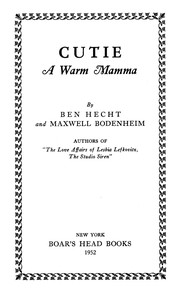
Cutie: A Warm Mamma
by Hecht, Ben; Bodenheim, Maxwell
Language: en485 downloads on Project Gutenberg
Subjects
In: Humour·Novels·American Literature
Public-domain ebook sourced from Project Gutenberg #67680.
Public-domain ebook
by Hecht, Ben; Bodenheim, Maxwell
Language: en485 downloads on Project Gutenberg
Subjects
In: Humour·Novels·American Literature
Public-domain ebook sourced from Project Gutenberg #67680.
The opening · free to read
“Cutie”, on which we collaborated and which appeared in the Times, is a satire on ultra-prudish hypocritical censors and assailers of sexual candor and incisiveness in literary and pictorial work--both official and amateur apostles of so-called cleanliness and righteousness, whose whitewash brushes directed against truthful exposures bear not the slightest resemblance to soap-laden wash-cloths which remove actual dirt from skin. After all, a fig leaf is ludicrously transparent and directs attention to the object which it is supposed to hide. Again, when you examine the much-debated quality of obscenity, it is--outside of vicious, abject crudeness--impossible to establish obscenity, beyond narrow individual preference opposed by relatively tolerant slants. The worn, one-or-two syllable words describing sexual organs and practices can be tagged as obscene, though “gruesomely stale and unnecessary” would be a more exact appellation. But otherwise obscenity is a moot question, and when censors attempt to jab their branding-irons on art of any kind, they are not cow-boys branding steers, but suppressive men fashioning would-be ugly effigies of elusive and sensitively outspoken works of art, and placing mean interpretations on the false figures. For example, in the plot to remove my own novel, Replenishing Jessica, in the late twenties, the censor assigned filth and dirty lasciviousness to whimsically inoffensive lines such as: “Jessica reclined on the couch with Purrell, intimately but not perilously.”... “He tarried before the abode of her morals, but he made only a slight impression on the locks guarding the doorways.”... “As his fingers increased their bold explorations they suddenly ran into an ice floe and hastily withdrew.”
When playful, or sprightly, or oblique moues in words are pounced on by censors and labeled horribly lewd, then these censors must secretly be so afraid of the effect of sexual descriptions on their own glandular secretions that even the most moderate chuckle or eye-wink in print makes them shiver childishly.
“Cutie” is a barbed satire on this infinitesimal venom spurted at sexual verities. Herman Pupick, a prude with one glass eye and splintered pieces of glass in what passed for his heart, is forced to stagger in hilarious pursuits of Cutie herself, who represents an intelligent, involved, nicely belligerent pagan and hoyden, with a face so exquisitely symmetrical, so magically, enticingly, softly, elasticly gleaming, that a paralyzed octogenarian would have jumped out of his wheel-chair in a miracle restoring him to youth. In the uproarious contretemps between Cutie and Pupick, she is seduced to an adultery of which his sourly blotched, equally self-holy wife is unaware. To Pupick, every tiny dalliance and eye-wink represents a dire sin, magnified by a blithe lack of repentance on the part of the minute transgressors.
This book appeared in the Early Twenties. At present the best way to indicate the piercing impudence of a Cutie toward the perennial Fraud of Pupick would be as follows: “Look, Pupick, a person isn’t taking up for adultery just because he admits that it exists and describes the motivations and reasons which make it happen in some cases. That is an accusation as silly as calling some one a lush-hound because he sat in a party of drunks and sympathized with some of the things which they said and did, even though he was sipping ... er, ginger ale. You’re sour cream, Pupick, and your mug would make a rotten cantaloupe apologize to the grocer trying to palm it off on a customer for nine cents and a bus transfer. And as far as sexual details are concerned, rusty nuts and screws always have a yen against nuts and screws oily, polished and in perfect working order. You see, Pupick, a wolf who’s lost most of his claws and teeth ties on a pair of papier mache wings and claps a cardboard halo on his head and slowly and contentedly dies of starvation, but you, Pupick--you’re worse than the wolf. You insist that everybody should have all his teeth pulled out, because you’re a sanctimonious, buttery, pimply long-face. So take your frustrations to the nearest gin-mill (like you did when I pushed you into one on the North Side of Chicago) and pretend that you can chew just as well with your store bicuspids and molars as you did when you were still able to chew rawhide on a bet. Only wipe that cheesy smile off your puss when you try to pull the same camembert line in the next liquid-poison emporium.”
So long, folks, and be sure to read our strip tease of a censor-faker starting on the next page.
Cutie was a shapely Mamma of twenty-one summers. Her bobbed hair looked like a bunch of yellow grapes. She offered an eyeful which would make a brass monkey run a temperature of 209 degrees.
When Cutie hit the boulevard on a breezy afternoon she left a row of asterisks in her wake.
After one look at our little Enemy of Sorrows, men were never the same. Forever after they kissed their wives and sweethearts with faraway eyes. No gent under 104 years of age was fit to pass the Board of Censorship for eight weeks after Cutie smiled on him.
Cutie gave St. Peter writer’s cramps before she was eighteen. After she was eighteen St. Peter crossed her name out of the Judgement Book. Not taking any chances, he also threw away her telephone number.
Nevertheless our little butterfly of passion was as evil to look at as a spring morning.
Where Cutie was born and how nobody knew. All that anybody knew about our little Blue Ribbon roadster was that she had the moth complex. Every night Cutie burned her wings off and every morning she grew them on again.
To be very brief, Cutie was the kind of a girl men forget, forty-nine years after their widows have collected the Insurance.
On her twenty-first birthday, this warm mamma met an over ripe quince who had been named Herman Pupick by his unfortunate parents. A word about Herman. Our hero was one of triplets. His father, Rudolph Pupick, a traveling salesman, rushed home from Milwaukee when he got the tidings.
After looking over the year’s crop, Mr. Pupick, Sr., said: “We’ll keep this one and drown the other two.” The one he kept was Herman. This was a mean break.
Our hero showed his disposition at an early age. He was a wet smack from the take off. When he was five months old he refused to nurse at his mother’s breast. He considered it immoral and obscene.
Before little Herman was nine years old, everybody knew he was the lily’s whiskers. He grew up to be one of those fireproof crepe hangers, who take orders only from God, and he married an autumn leaf named Emmaline, suffering from virginity.
When he was thirty-five years old the only flesh pots Herman had ever seen were those his wife tended on the kitchen stove. He had been married ten years and every night before sliding into the hay he and the dementia praecox case who shared his headaches would kneel beside their thorny couch and request God to keep them pure. And He did.
Herman himself was so pure that he cancelled his subscription to the Presbyterian Weekly during the War owing to a headline which appeared in that racy organ on March 3, 1917. The headline read, “Naval Maneuvers Described by Eye Witness.” Our right hand of God considered this headline too suggestive for an organ intended for the home.
This pious dingelberry had only one eye. The other one was made of glass. It cost seven dollars and a half and was painted green.
The way our hero lost his gig was like this. On the seventh anniversary of his wedding Herman brought home a quart of plain white ice cream.
“Tonight,” said Herman, “is the seventh anniversary of our joint fight against the Devil. It is, therefore, fitting that we should make merry.”
So they ate the ice cream, although Mrs. Pupick complained it gave her a headache. After this part of the bridal night had been relieved, Herman challenged his consort to a game of Tiddlywinks.
In the heat of this game, Mrs. Pupick snapped one of the tiddlywinks with unusual vigor, for marriage had not taken the fire out of her, and it flew into Herman’s lamp and put it out.
“God,” said our one-eyed Pilgrim, as he shelled out the seven and a half smackers for a new gig, “has smote me for my sins.” This was fair enough.
A few more words are necessary about Herman Pupick before launching into this great drama of sin and passion, to illustrate our hero’s ignorance of the world and its alleged humans. Herman thought that a brassiere was something to melt lead in; that bloomers was a slang term which meant a series of mistakes; that torso was the name of a notorious Spanish bullfighter and that passion was what happened when a carpenter hit his thumb with a hammer.
What, you ask, did this big ham do for a living? Stand back, kind reader, control yourself. Herman Pupick was a reformer. He was employed by the United States of America for $29 a week to plug up all the pitfalls of the great city.
Yes, it was Herman’s duty whenever he saw something wicked to jump on it with both feet and crush it into the ground, and although our razzberry pedlar had only one eye he saw plenty that was low and vile.
In fact, to Herman the whole world was just one big House of Shame and everybody excepting himself and his wife and an adenoid sufferer named Rev. Gurglelurgel were all inmates.
Nearly everything Herman saw he figured out incited other people to sin. And this made him mad. Once when God smote our undertaker’s plume with a severe attack of constipation he wrote a burning letter to the Voice of the People in the Tribune denouncing the immorality and obscenity of public toilets.
It was the same way with Madam Pupick. When Madam got all dressed up and ready to go to prayer meeting and tell God what she thought of herself, she looked as if she had forgotten to remove the Boncilla mud pack.
We will now leave this sweet minded team and leap into the maelstrom of tragedy and passion which fate was even then weaving on its maelstrom-loom.
Herman Pupick first met Cutie on the corner of State and Madison streets. Our little home wrecker had slipped and fallen and a large crowd of first nighters had gathered to watch Officer Murphy, the traffic dictator, extract a splinter out of Cutie’s knee.
At this point Herman’s one good eye bulged out of his head like a ripe mushroom. One peek at Cutie’s injured fox trotter filled him with a nameless rage.
“How dare you!” he cried, addressing Officer Murphy. “How dare you take advantage of this maiden’s mishap and expose her person to the lewd eyes of this crowd? Unhand her!”
Officer Murphy dropped the hem of Cutie’s dress and a great sigh went up from the cock-eyed multitude.
“Come with me,” Herman spoke, a ring of authority in his voice, and seizing Cutie’s arm he escorted her to the new Methodist Book Store in the Temple Building, for our hero was a great reader.
“Now,” said Herman, mopping his brow, “you are safe. Be not afraid.”
“Say, bozo,” Cutie said, handing him an O. O., which would have discouraged Former Attorney General Daugherty, “what kind of a racket is this? I am just an honest little kiddie trying to get along.”
The book keeps going
Reading is free forever. Sign up and watch scenes appear while you read.



Scenes Storieta drew for other classics.
New illustrated classics
Once or twice a month: the latest books to get full character casts, scene art, and free comic editions. No account needed.