The opening · free to read
Some years ago a literary investigator came into my office and inquired whether he could find a copy of Richard Tickell’s Anticipation in our library. He was thinking of sending to the British Museum for a photostatic copy, in case we could not supply his need. We were able to reply that we had sixteen editions of this book—ten of them printed in the year 1778 alone. Now publishers do not re-issue a book unless someone is reading it. The number of reprints induced me to read the book, and I found it one of the best of eighteenth-century satires on the ponderous serio-comic addresses delivered in what is still pleased to call itself the M-th-r of P-rl—m-nts. Though Mr. Butterfield has restrained himself in the matter of drawing parallels between the bumbling follies of that legislative conclave, then and now, yet the writer of a foreword may be permitted to do so.
In the summer of 1941, I received in the mail a pamphlet, in an envelope which bore a Chinese postage stamp and the postmark of Shanghai. The pamphlet was one of the familiar blue-covered fascicles which we all recognize as the format of the Parliamentary Debates. This particular fascicle purported to contain the debate for August 15, 1941, and was typographically exact, even to the reproduction of the arms of H-s Br-t-nn-c M-j-sty on the cover. An examination revealed it to be the twentieth-century parallel of Tickell’s _Anticipation_—a satiric report of the debates in the H—s- of C-mm-ns as of 1941. It was obvious German propaganda, but so well done typographically that I found some of my learned colleagues had read a part of it before it dawned on them that the whole thing was analogous to Tickell’s Anticipation. But let no American be complacent about the failure of the H—s- of C-mm-ns to progress during the intervening one hundred and sixty-three years. Let him dip into our own C-ngr-ss—n-l R-c-rd.
Mr. Butterfield and the publisher could have chosen no more appropriate time than the present at which to issue the twentieth-century edition of this book. It ought to be read by all students of American history—elementary and advanced.
Editor’s Foreword
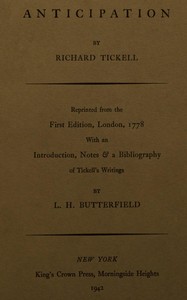
This is the first reprint since 1822 of a politico-literary satire that delighted a generation of readers during and after the American War of Independence. It has seemed to the editor, and to others who encouraged the project, that the neglect of Anticipation has been due less to its want of interest than to the want of a properly edited reprint. The mere presence in it of so many names with deleted letters has discouraged later readers.[1] The present volume provides an account of the author and of the setting and reception of Anticipation, an accurate text, explanatory notes, and a bibliography of Tickell’s writings.
Anticipation was written and printed hastily; and the spelling (especially of proper names), the punctuation, and sometimes even the grammar are erratic. But since it has proved impossible to distinguish the carelessness of the printer from that of the author, I have followed the first issue literally except when corrections were available in the following later ones: “The Third Edition, Corrected,” which appeared within a week of first publication; “The Tenth Edition, Corrected,” 1780, which was the last published during Tickell’s life; and “A New Edition, Corrected,” 1794, a re-issue occasioned, probably, by Tickell’s death and set from new type. Two or three flagrant errors (e.g., the name “Bonille” for “Bouillé” at p. 59) and a few typographical absurdities (such as quotation marks without mates) recur in all the London issues. These I have corrected without warrant from any text.
It should be stated that in the Introduction I have usually not cited sources for dates and other biographical details when the sources are correctly given in W. Fraser Rae’s article on Tickell in The Dictionary of National Biography. Unless otherwise indicated, the place of publication of all works cited is London.
A great many friends have contributed to the making of this book, and almost as many librarians in the United States and England have aided my researches for it. Some special debts I wish to record here. Randolph G. Adams, Director of the William L. Clements Library at Ann Arbor, Julian P. Boyd, Librarian of Princeton University, and Professor George Sherburn of Harvard have read my manuscript and given me helpful advice. W. S. Lewis, Esq., of Farmington, Connecticut, kindly allowed me to quote from notes written by Horace Walpole in a copy of Anticipation now in Mr. Lewis’ collection of Walpoliana; Richard Eustace Tickell, Esq., of London, sent me useful material from the Tickell family papers; Mrs. Flora V. Livingston and Mr. William Van Lennep, curators, respectively, of the Widener Collection and the Theatre Collection in the Harvard College Library, allowed me to quote from manuscript letters in their charge; the New York Public Library gave me permission to reproduce the title-page that precedes the text. For aid in preparing the Bibliography of Tickell’s Writings I am most indebted to Mr. John D. Gordan of the New York Public Library, who read and ably criticized it; to Miss Anne S. Pratt of the Yale University Library, and Mr. Frederick R. Goff of the Library of Congress, who answered numerous bibliographical inquiries; to the Union Catalog in the Library of Congress and its staff; and to the admirable Bibliotheca Americana, begun by Joseph Sabin, continued by Wilberforce Eames, and then completed by R. W. G. Vail, New York, 1868-1937. The services of Herbert B. Anstaett, Librarian of Franklin and Marshall College, have been so various, constant, and indispensable that they deserve my most sincere thanks. No thanks, however, can be adequate for the devoted work and interest bestowed on the preparation of this book, from beginning to end, by my wife.
Lancaster, Pennsylvania March 1941
[1] In the present text deleted letters are supplied within square brackets. Originally the use of blanks and asterisks in names of persons was a means of avoiding libel actions. One should never print a man’s name out at length, said Swift in The Importance of the Guardian Considered, 1713; “but, as I do, that of Mr. St—le: so that, although everybody alive knows whom I mean, the plaintiff can have no redress in any court of justice.” This was such an easy way to add piquancy to defamation that it became conventional in satire. In 1778 the reviewer of an anti-ministerial poem called The Conquerors observed that the work seemed “designed for the perusal of astronomers; there are more stars in it than the galaxy contains” (The Critical Review, XLV, 150).
The book keeps going
Keep reading, and see it illustrated
Reading is free forever. Sign up and watch scenes appear while you read.
Scenes Storieta drew for other classics.