Public-domain ebook
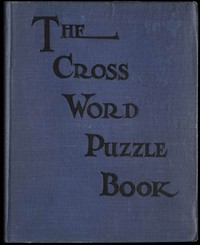
The cross word puzzle book
Language: en1,414 downloads on Project Gutenberg
Subjects
In: Sports/Hobbies
Public-domain ebook sourced from Project Gutenberg #68267.
Public-domain ebook
Language: en1,414 downloads on Project Gutenberg
Subjects
In: Sports/Hobbies
Public-domain ebook sourced from Project Gutenberg #68267.
The Cross Word Puzzle Book opens with a vivid, tongue‑in‑cheek vignette of a husband‑wife domestic scene that quickly gives way to a confession from a crossword‑editing veteran. The narrator recounts how, after years of merely selecting attractive grids, a relentless colleague named F.P.A. spurred him to try solving the puzzles himself, exposing the “acute agony” of faulty clues and prompting a pledge to perfect the craft. From that moment the editor describes his new method of testing each puzzle on the page proof, an approach that ultimately yields the “perfection (more or less)” of the Sunday crosswords that appeared in the World Magazine’s Ingenuities Page. The book proceeds to explain how to solve the grids, offering sample puzzles, a description of the modern single‑number system, and a lively discussion of the linguistic delights and challenges inherent in crossword construction.
Written in a conversational, early‑20th‑century voice, the text blends humor, literary allusion, and a didactic tone that reflects its newspaper‑era origins. Readers who relish wordplay, enjoy the mental gymnastics of clue‑cracking, or have a nostalgic affection for the golden age of printed puzzles will find it engaging. Its blend of practical instruction and witty commentary makes it especially appealing to amateur solvers seeking both guidance and a glimpse into the historical mindset of crossword editors.
The opening · free to read
For many years we’ve lived as man and wife, As happy now as on the day we wed. “We’re more like sweethearts,” I have always said. No cloud has dimmed the sunshine of our life, Though now and then I’ll seize a rolling pin And playfully I’ll clout her on the dome Just to preserve domestic discipline And demonstrate who’s master in our home. At times she’ll hurl with well-directed aim A platter or an iron at my bean. These slight attentions keep romances green And keep alive the hymeneal flame.
On Sunday, when the evening lamp is lit And peace and calm contentment fill our house, With pipe and well-loved book at ease I sit, And at my side, in earnest thought, my spouse, Then fade the cares and troubles of the day; With Conrad and Lord Jim I sail the sea, When suddenly I hear my wife’s voice say, “What word for ‘female child’ begins with G?” “The word is ‘Girl’,” I growl. Again I try To catch the shattered magic of my tale. I find my place. Again with Jim I sail Upon the tropic sea. My wife says “My, What pronoun in three letters starts with Y?”
Calmly I rise and search about the place To find a weapon of sufficient weight. Aha! Upon our wall an ancient mace, Studded with knobs of steel. The very thing. I seize it, and with easy, graceful swing Wallop my darling wife upon the pate, The sconce or bean, or dome, or what you will. Silent she tumbles headlong in the grate. I take my book and leisurely resume My tale, and peace and quiet fill the room.
From F.P.A.’s Conning Tower in The New York World
When I was first made unwilling Cross Word Puzzle Editor some two years ago, the procedure in deciding what puzzle would be run was limited to picking out a good-looking one from among the bunch and sending it upstairs to be set. I saw no reason to change this splendid system. At that time, I had never taken the trouble to do a puzzle and the letters of anathema and condemnation that came in by the dozens had small effect on my conscience. They were evidently from cranks and couldn’t be avoided.
I must admit that the dawning of conscience began with the arrival of F.P.A., who came to work in the next room. When he discovered that I was responsible for the cross words, he formed the atrocious habit of stalking in every Monday morning bright and early (about eleven o’clock) to point out to me in sarcastic tones just what was wrong with yesterday’s. Well, to make a long story short, in order to avoid the moronish feeling that usually followed such a lecture, I decided to reform and find out what a really decent puzzle was like.
I began by trying to do one the next Sunday, and thus experienced the throes of acute agony that come to all solvers of puzzles on discovering definitions left out, numbers wrong, hideously warped definitions, words not to be found inside of any known dictionary, foreign words—very foreign—and words that had no right to be dragged out of their native obscurity. Then and there, with my left hand reposing on a dictionary and my right raised in air, I took an oath to edit the cross words to the essence of perfection. From then on, I instituted the procedure of doing the puzzles myself on the page proof—sort of trying it on the dog—applying the principle,
“If it be not fair to me, What care I how fair it be!”
Since that momentous day, F.P.A.’s visits have grown less frequent—in fact, he has to make up excuses to come in and converse on other matters—and the cross words even came in for an occasional bouquet in Sam Pepys’s diary. So now you all know whom to thank for the perfection (more or less) of the cross word puzzle found each Sunday on the World Magazine’s Ingenuities Page.
Solving a cross word puzzle offers numerous enjoyments of which the uninitiated are ignorant. There is the pure esthetic stimulation of looking at the pattern with its neat black and white squares, like a floor in a cathedral or a hotel bathroom; there is the challenge of the definitions, titillating the combative ganglion that lurks in all of us; there is the tantalizing elusiveness of the one little word that will satisfactorily fill a space and give clues to others that we know not of; and there is the thrill of triumph as the right word is found, fitted, and its attendant branches and roots spring into being. No better illustration could be used than a recent brilliant construction of Mr. Gelett Burgess, published in the Sunday World Magazine.
Consider the solver as he faces his problem. The numbers in the squares, he knows, refer to the definitions; in the system of numbering used in this book, the first letters only are indicated by numbers. Thus 1 horizontal means a word that will fill the space following the figure up to the next black square.
Horizontal +-----+-----+-----+-----+-----+-----+ | 1 | 2 | 3 | | 4 |#####| 1 Lowest form of life | | | | | |#####| 12 Product of coal or pine +-----+-----+-----+-----+-----+-----+ 18 Opponent | 12 | | |#####| | | | | |#####| | Vertical +-----+-----+-----+-----+-----+-----+ | 18 | | | 20 | |#####| 1 Gustated | | | | | |#####| 2 Divine nourishment +-----+-----+-----+-----+-----+-----+ 3 Before |#####| |#####| |#####| 4 Indefinite number |#####| |#####| |#####| +-----+-----+-----+-----+-----+-----+ | 30 | | 32 | | 33 |#####| | | | | | |#####| +-----+-----+-----+-----+-----+-----+ |#####| |#####| +-----+
The solver, then, looks the puzzle over. Aha! a friend. 12 horizontal, three letters long—“product of coal or pine.” Triumphantly the solver writes TAR in the spaces and proceeds with this clue. 2 Vertical is defined as “Divine Nourishment.” It links with TAR at the second letter. A moment of thought and MANNA appears as the only possible solution. He turns to 1 vertical, the second letter of which is the first of 12 horizontal—T. The definition is “gustated,” and the word is of three letters. Why hesitate? ATE goes into the space. “A cinch!” reflects the solver, and joyously writes ENEMY in 18 horizontal, defined as “Opponent.” 3 vertical is defined as “Before,” and with -RE staring him in the face he would be dull indeed who did not write ERE. And now 1 horizontal stands revealed. “Lowest form of life,” eh? AMEBA goes down. 4 vertical is “Indefinite number.” Well, A-Y cannot be anything but ANY—and there is the corner complete, with three clues to the words in other sections.
+-----+-----+-----+-----+-----+-----+ | 1 | 2 | 3 | | 4 |#####| | A | M | E | B | A |#####| +-----+-----+-----+-----+-----+-----+ | 12 | | |#####| | | T | A | R |#####| N | +-----+-----+-----+-----+-----+-----+ | 18 | | | 20 | |#####| | E | E | E | M | Y |#####| +-----+-----+-----+-----+-----+-----+ |#####| |#####| |#####| |#####| N |#####| |#####| +-----+-----+-----+-----+-----+-----+ | 30 | | 32 | | 33 |#####| | | A | | | |#####| +-----+-----+-----+-----+-----+-----+ |#####| |#####| +-----+
So far the sailing has been fairly easy. But trouble waits just around the corner. There are other definitions which are not so simple as “product of coal or pine.” In the far reaches of the puzzle to which the above corner belongs may be found such definitions as “Vexation (Provincial British),” “Humorous figure of speech,” “One-sided headaches” and “Droning dung-beetles.” Is the solver prepared to state that he can fill the spaces represented by those words without the assistance of the linked horizontals or verticals?
It is here that one of the greatest charms of the crossword puzzle lies: the discovery of new words by the process of building them, though entirely ignorant of their actual spelling. Consider another portion of Mr. Burgess’ puzzle. The construction of the provincial form of “Vexation” and “Humorous figure of speech” fortunately come in juxtaposition; they illustrate at once the vocabulary-building feature of the cross word puzzle and a constructional weakness which may lead to non-solution.
The definitions surrounding this precious pair are as follows: Horizontal, “Series of games,” “Self,” “Means of sustenance,” and “Surface of fibres”; Vertical, “Drinking vessel” and “Body of cavalry.” When these words are solved one finds:
+-----+ |#####| |#####| +-----+-----+-----+ |#####| |#####| |#####| |#####| +-----+-----+-----+-----+-----+ |#####| | | |#####| |#####| S | E | T |#####| +-----+-----+-----+-----+-----+-----+-----+ |#####| | | | | |#####| |#####| | T | U | R | |#####| +-----+-----+-----+-----+-----+-----+-----+ | |#####| | | |#####| | | |#####| E | G | O |#####| | +-----+-----+-----+-----+-----+-----+-----+-----+-----+ |#####| | | | | | | |#####| |#####| A | L | I | M | O | N | Y |#####| +-----+-----+-----+-----+-----+-----+-----+-----+-----+ |#####| | | |#####| |#####| N | A | P |#####| +-----+-----+-----+-----+-----+
Now the unfortunate part of it is that the section is completed; there are no more clues, and if one does not know what the humorous figure of speech is and what the British provincialism is, there is no way of discovering them aside from the use of deduction. A little thinking will show that the first letter of the provincialism is more likely to be “S” than any other letter, and a short search in the dictionary will give “Sturm” as the answer; while as for -EUGMA, a brief running through the alphabet will so limit the possibilities that a very short search will reveal ZEUGMA as correct.
It is extremely difficult, in the construction of cross word puzzles, to avoid the use of such “unkeyed” letters, and effort has been used to ensure the presence of common words where more than one letter is unkeyed; but the exigencies of construction will not always allow this. Nor should it always be done; allowance must be made for erudition on the part of the solver. When such a construction appears as S-ALE-E, defined as “Unequal sided and angled” and with all clues exhausted, it is with a warm sensation of culture that one triumphantly fills the blanks with “C” and “N.” And the same thrill is present when “One-sided headaches,” standing clueless with M-GRI-S, is properly filled in to become MEGRIMS.
Thus is the solution achieved; in part by the science of deduction, in part by mother-wit, in part by erudition; appeals to as many as possible of the lobes of the brain. There is no nobler satisfaction than the fitting in of the last word that makes the pattern complete; one rises to lyric heights in the contemplation of the evolution of such a word as one enthusiastic constructor included in his design, the definition of which was “Parallel pairs of simulacra in echinoideans.” The cross-constructions showed BIVIA as the necessary filler and the vocabularies of the solvers were enriched by an addition of high esthetic value and utter incomprehensibility, to be used as occasion demands.
The cross word solver becomes a collector, a connoisseur of words. They lose, to him, their mundane purpose of a suitable medium for the exchange of thoughts, and take on an esoteric significance, akin to the appeal of slip-ware to the collector of pottery or the three-cornered Mauritius to the philatelist. He and Hamlet are one. “Words, words, words”—except that he has the advantage of the melancholy one. Hamlet’s words ran in decorous file, one after the other; the solver’s twine and intertwine, each leading to others, resulting in a harmonious whole unapproached by any except the masterpieces of classic literature.
The book keeps going
Reading is free forever. Sign up and watch scenes appear while you read.



Scenes Storieta drew for other classics.
New illustrated classics
Once or twice a month: the latest books to get full character casts, scene art, and free comic editions. No account needed.
![Cover of Minute Mysteries [Detectograms]](/covers/50603.jpg)