Public-domain ebook
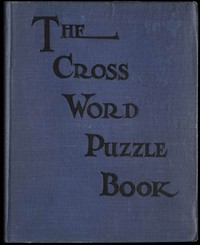
The cross word puzzle book: Second series
Language: en1,317 downloads on Project Gutenberg
Subjects
In: Sports/Hobbies
Public-domain ebook sourced from Project Gutenberg #68681.
Public-domain ebook
Language: en1,317 downloads on Project Gutenberg
Subjects
In: Sports/Hobbies
Public-domain ebook sourced from Project Gutenberg #68681.
The Cross Word Puzzle Book: Second Series is a continuation of the wildly popular 1924 launch that turned crossword solving into a national craze. The opening pages recount how the first volume vaulted to the top of the bestseller list, sparked the formation of the Cross Word Puzzle Association of America, and introduced a set of rules that still govern the game. This sequel, compiled by the New York World’s crossword editors, promises the same “technical perfection” with puzzles arranged from easy to “intricate formations, calculated to baffle Houdini himself.” It includes the familiar pencil, eraser, and answer‑postcard accessories, and each puzzle is judged on interlock, definition accuracy, and the minimisation of unkeyed letters, ensuring a clean, satisfying solving experience.
Written in the brisk, promotional style of the early 1920s, the book blends enthusiastic reportage with practical instruction. Its voice is that of an eager advocate, William A. Stern, the second world champion, who explains techniques, warns against common pitfalls, and celebrates the mental discipline gained from solving. Readers who relish wordplay, enjoy a touch of detective flair, and appreciate a period‑authentic presentation of puzzles will find this volume both a nostalgic artifact and a lively challenge.
The opening · free to read
The first Cross Word Puzzle Book was published on April 10th, 1924. In New York it sprang into immediate popularity, becoming there a best seller within a fortnight. A small but ardent group of cross word puzzle devotees gave the fad a running start. Among these pioneers may be mentioned F. P. A., Montague Glass, Neysa McMein, Emily Price Post, Baird Leonard, Ruth Hale, Gelett Burgess, Robert C. Benchley, Hendrik Willem Van Loon, Kathleen and Charles G. Norris, Mary Roberts Rinehart, and Carolyn Wells.
Cross word puzzling became the thing to do, the raging topic of conversation, supplanting Coué, Mah Jong, and Bananas (first a slogan—now a fact!). With this impetus, the pastime’s popularity radiated to other cities, and within a month the Cross Word Puzzle Book was ranked No. 4 on the national list of non-fiction best sellers. Three weeks later it advanced to third place, and the following month jumped into the lead, where it appears to remain indefinitely.
First a fad, then a best seller, the Cross Word Puzzle Book became an American institution, immortalized in cartoons by Briggs, prose-epics by Bob Benchley, and ballads by F. P. A.
Ordinary books are meant to be read. Here is a book in which one writes—more than that, a book in which one has the supreme satisfaction of unravelling a real mystery, tracking down clue after clue. This, no doubt, is the secret of the irresistible fascination of Cross Word Puzzling. Every one enjoys being an amateur Sherlock Holmes—and the tantalizing black-and-white word patterns provide an ideal battle-ground for one’s detective instincts.
This deep-rooted appeal explains the extraordinary popularity of the book. When we announced in one of our early advertisements that “people do not want this book—they crave it!” we had actual proof to support this statement—frenzied fans storming the publishers’ office to get extra copies in order “to keep peace in the house.”
Six weeks after the publication of the first Cross Word Puzzle Book—May 18th, to be precise—the Cross Word Puzzle Association of America was formed at a convention at the Hotel Ambassador, New York. At this congress the rules and regulations of Cross Word Puzzling were formulated. A contest for the cross word puzzle championship of the world was held, and William A. Stern II won first honors, solving a standard eleven-square formation in 10 minutes, 10 and two-fifths seconds. Mr. Stern has written a preface for this book, explaining the delights of cross word puzzling, for both novice and veteran.
Thus, in the words of Neal O’Hara, America began to gasp for words. The Cross Word Puzzle became the Great Escape from Boredom—the most powerful enemy of ennui....
Not only entertainment and thrills, but sound instruction reward the true Cross Word Puzzler. Here is the most delightful and the most effective way of building up one’s vocabulary and enriching one’s general fund of information. Dictionaries and synonym books joined the best seller list, right behind The Cross Word Puzzle Book itself, for every one, to obtain the maximum benefit and fun, must have a dictionary or a word book handy.
The pencil and eraser provided with The Cross Word Puzzle Book proved to be a most popular feature. Post cards for applying for the correct answers to the puzzles also pleased the followers of the pastime. This equipment, therefore, is retained in the Second Series. The suggestion has been made that future editions of the book be equipped with shock-absorbers and four-wheel brakes.
Thousands of puzzle enthusiasts have indicated their eagerness for this second series of cross words. This book, like the first volume, is edited and compiled by the Cross Word Puzzle Editors of the New York World, the undisputed leaders of the gentle art. Every effort has been made to safeguard the technical perfection of the puzzles. This time they are arranged in the order of their difficulty, beginning with fairly easy ones, and ranging to the most intricate formations, calculated to baffle Houdini himself. Beauty of design, accuracy of definition, complete interlock, and the minimum number of unkeyed letters—these elements have all been considered in selecting the puzzles. We are confident that they will prove as absorbing, as entertaining,—yes, as exciting,—as the first fifty.
The Publishers.
Two years ago I saw a friend of mine earnestly studying a checkered diagram in the magazine section of a Sunday newspaper. Curiosity impelled me to ask him whether he had taken up cross-stitching, because the pattern he so zealously pored over resembled closely that of an old-fashioned sampler. When he explained that he was attempting to solve a puzzle I laughed, because in my ignorance I believed that puzzles were childish time-wasters. I snorted my disdain at this sort of balderdash and, angered, he challenged me to try my hand at it.
I confidently predicted that I would easily solve the foolish enigma and after he had explained the manner of solution I set to work. A few minutes later I started asking questions. What was one supposed to do? My friend explained a second time and I was all at sea. Finally I understood what to do, but was shaky on how to do it. I finished that puzzle the next day. I gave little thought to food and rest; in the end I triumphed.
Since that time I have solved many cross word puzzles but on none have I consumed as much time as on that first heart-breaker. I used to blame my slowness on the fact that the method was never properly explained, but I now believe that my friend who gave me my first cross word baptism was an adequate instructor. The chief difficulty which the uninitiate meets lies in the struggle to concentrate on the explanation. In their simplest terms here are the rules and technique of cross word puzzling:
The primary object of the game is to fill up the blank spaces in a cross word design with letters which spell out words. The solver guesses the words from their definitions. By looking at a pattern we can tell how many letters are in a word to be guessed. Suppose, for example, you were asked for a six letter word meaning unsteady. You would go through all the synonyms for unsteady that you could recall. You would discard unstable, shaky, tipsy, tottering and rocky because none of these words has the proper number of letters. You would accept groggy or fickle. Now apply this system to the solution of a puzzle.
The definitions of the words are shown in two divisions: one division is captioned Horizontal, the other Vertical. Before each definition is a number which indicates that the word defined has its first letter in the square of the same number on the pattern. For example, in the puzzle on the jacket of this book (which is Number 1 in the book itself), we see under Horizontal, “1. stout.” This means that the word is read horizontally and starts in the space numbered “1” on the pattern. The answer is “plump.”
A word always runs from its first letter to a black square or to the end of the diagram. Having the word “plump” written in, we now have hints of a certain letter in each of four other words, because each of the letters in this word, except the letter “L,” is used to form a word which is read downwards. Under the heading Vertical may be found the definitions of the words which read downwards. So we see that the letters in plump are used in the words prove, up, map, and plant. The letter “L” is called in cross word parlance an unkeyed letter because it does not give the solver a key to another word. Well constructed puzzles have few unkeyed letters. You will notice also that all the words in the puzzle are joined together or interlocked so that after guessing the first word the solver may decode the entire puzzle without once being minus a hint of some sort.
I do not mean to infer that these puzzles must be so constructed that the solver has a simple task. An object of crosswording is to puzzle, but fairness to a hard working puzzler dictates certain laws for the designer to follow. The first of these laws is the all-over interlock. The second is that in obsolete, rare, and unfamiliar words no letter should be unkeyed.
And now a few words as to technique. Of course I prefer my own method to any other, but I do not claim for it greater merit than the systems I will tell you about. When I get a puzzle to solve, my first move is to read all the definitions. Among these I am sure to find some familiar and overworked words which I can set into place and be off to a flying start. Certain simple three letter words such as bog, fen, pen, boa, emu, and roc, and other words in which vowels pre-dominate such as opera and arena are used in hundreds of puzzles. I get these out of the way in short order. My next move is to start working on that part of the puzzle where I have filled in the largest number of words, because it is there that I have the greatest number of hints. If I strike a snag I immediately take up my work in some other place. And so I work my way around to completion.
Some people obtain excellent results by another method. They first do all the horizontal words which quickly come to mind. And then all the vertical. Thus they get an excellent start from which to work. Some solvers use the system of building up from the first word which they can guess.
First—Beware of putting in certain words whose definitions do not accurately define. Parts of the verb “to be,” personal pronouns, exclamations, notes of the scale, prefixes, suffixes and prepositions should not be filled in unless an interlocking word gives you a hint as to what they are. They are so numerous that without a hint it is futile to attempt to guess them.
Second—Beware of homonyms. A homonym is two words which have the same sound, but have different meanings. The best illustration of a homonym appeared in F. P. A.’s column, the Conning Tower, a few years ago. According to my feeble memory the sentence ran, “If I should say that you are prone to carp, I would not mean that you are lying face downward to a deep sea fish.” How often does the solver struggle over such a definition as “light,” believing all the while that he must find a word meaning an illuminant, when the correct word is “airy”!
Third—Beware of sloppy printing and careless erasing. When you write in a word, letter neatly. Do not make a P look like an R. And when you find it necessary to erase be sure to obliterate every letter. Dangling characters which rubber crumbs have failed to pick up have cost so many wasted hours that experts in efficiency have taken up the matter in executive session.
Whatever method you employ or whatever mistakes you make, you will reap pleasure and profit for your time. You will increase your vocabulary, give yourself mental discipline, and, above all, you’ll have fun.
I want to thank the Plaza Publishing Company, whose real name is Simon and Schuster, for its work in getting out these Cross Word Puzzle Books. Most of the puzzles are of the first rank and the variety of design is amazing. In fact I feel so kindly toward the publishers that I do not upbraid them for the time they made me lose by a few errata in the first edition, which they promptly corrected in the later editions. I can heartily congratulate any owner of this Cross Word Puzzle Book and all the Cross Word Puzzle Books to follow on the days of real pleasure that lie before him.
The book keeps going
Reading is free forever. Sign up and watch scenes appear while you read.



Scenes Storieta drew for other classics.
New illustrated classics
Once or twice a month: the latest books to get full character casts, scene art, and free comic editions. No account needed.
![Cover of Minute Mysteries [Detectograms]](/covers/50603.jpg)