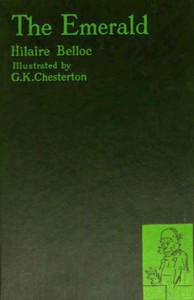
Public-domain ebook
The emerald of Catherine the Great
Language: en488 downloads on Project Gutenberg
Subjects
In: Historical Novels·Crime, Thrillers and Mystery·Novels
Public-domain ebook sourced from Project Gutenberg #68727.
Public-domain ebook
Language: en488 downloads on Project Gutenberg
Subjects
In: Historical Novels·Crime, Thrillers and Mystery·Novels
Public-domain ebook sourced from Project Gutenberg #68727.
The opening · free to read
William Bones was a stalwart man, some thirty-five years of age, the master of a Brig which sailed from the port of Boston in Lincolnshire and was half his own property. He was a native of that town, his father having been therein a pork butcher in a fair way of business, his mother the daughter of a small farmer in the Wring Land. He traded with the Baltic when George the Third was King--indeed, when George the Third was still young and long before George the Third first went mad.
Among other ports, he had found profit more than once in visiting that of the River Neva, and was acquainted with the Russian trade. The great city of St. Petersburg, still new but already splendid, became familiar to him; and he himself, in his humble visits to the local factors, became a familiar figure to the Secret Police of that capital. Even his most domestic and private actions during his dealings in this port were registered; and, it must be added, his strong English frame and handsome English face admired, but also duly noted and their description passed on to the proper authorities.
On his third voyage to Russia he was honoured by the invitation of a merchant somewhat wealthier than the common of his acquaintance and at that table met some official of the Court, of what exact situation his ignorance of Russian and of French forbade him to inquire. Before returning to his native Lincolnshire, his happy spouse and his young family, he enjoyed the singular privilege of a further unexpected invitation from this same Court official whom he had thus chanced to meet, and so found himself at supper in one of the smaller and more discreet rooms of the Palace, upon its mezzanine floor, in a choice company of both sexes.
It is characteristic of the Empress herself--a great woman!--that a large humanity and a laudable curiosity combined rendered her indifferent to the conventions of rank. No sooner had she heard of the British merchant captain's cheerful and manly habit than she desired a more exact description, upon her receiving which he was permitted an entrance to the Presence.
He enjoyed, partly by means of an elderly female who interpreted for him until he had improved his few words of German--the Empress's mother tongue and most familiar idiom--no little conversation with the august sovereign, who, when he arrived at this stage, deigned to keep him by her alone for some while. The interview was repeated upon more than one occasion and her Imperial Majesty was so good, upon his reluctant leave-taking some two or three weeks after his first arrival, as to press him with an invitation to return.
Next season, the moment the Baltic ice was melted, he did so, disposing of a mixed cargo; and, while leisurely awaiting his return charge, was almost daily conveyed to the Palace from his humble lodging. For four successive seasons running this strange adventure persisted.
Meanwhile his Boston neighbours could not but remark that his home in the British haven of which he was a native and mariner, showed a considerable advance in prosperity. His wife was better dressed, his growing family could boast an increasing and superior acquaintance among children of a rank with whom they would not earlier have mixed. It was even whispered that Bill Bones had made formidable investments in the City of London, which he certainly had visited more than half a dozen times during his last winter stay in England; and though his friends very charitably agreed that the profits of the Baltic trade might be large, and that Bill Bones might have had exceptional opportunities, they none the less talked among themselves upon the various possible sources of a fortune which that trade could hardly account for.
With the fifth season there came an end to what had certainly been a remarkable series. Whatever advantages communion with a throne might have had for William Bones, the future would no doubt show; but the fifth season was the end. There had been farewells, and yet no loss of the high regard in which, for some extraordinary reason, he had been held by the Semiramis of the North. He had acquired a certain assurance of bearing which marked his new fortunes, and indeed, in this final scene of his presence upon the quays of St. Petersburg, he seemed by his gait to be some one of consequence. And no wonder, for he had left the Palace for the last time bearing secreted in the bosom of his ample coat a jewel worthy to be a memorial of the greatest passages in any life.
It was an emerald, exceptionally large--the largest, he had been assured, in the world--square in shape, of the purest water and set in a delicate little gold mounting after a fashion which recalled the ornaments of the French Court.
It speaks well for Captain Bones that on his return to Boston he handed this jewel to his wife, who thenceforward had it fixed with a pin, to serve the office of a brooch, and wore it upon great occasions; notably at a dance given by the mayor of the town, to which she brought her eldest daughter, though barely of an age for such ceremonials.
The next year William Bones let his house in Boston and abruptly transported himself and his family to the metropolis. His neighbours were interested to discover that before abandoning them he had purchased not a little property in the town and had even appointed a substantial agent to deal with his rentals. He was clearly an advancing man and their respect for him grew profound when they learnt what figure he now cut in a world above their own. In London he was found entertaining largely and standing upon an equal footing with merchants of repute, though not perhaps as yet of the first fortune. Meanwhile he had preferred the name of Bone, in the singular, to that of his earlier life, conceiving it to be more consonant with his present position and his residence in Cornhill and his interests in the banking world.
His only son George, when of an age for such occupations, which was some five years after the family had come up to London, was taken in as a partner by Mr. Worsle the India merchant, partly, no doubt, as a testimony of friendship to his father, but partly also because William Bone, who would now indifferently sign himself Bone or Bohun--the original form of the name--had put at the young fellow's disposal a very considerable capital.
William Bohun himself died somewhat prematurely in the eighth year after his transmigration, and his wife, who, though much desiring to cut a proper figure in her new world, had never properly succeeded in doing so, followed him within three months to the grave. Her younger daughters had received an excellent education; her eldest, born in her father's earlier days, had perhaps less refinement of accent and deportment--but on the other hand, her solid worth and quite exceptional dowry had procured her alliance with the heir to Sir Philip Goole, a landed gentleman in the West of England possessed of a fine town house in Cavendish Square, but indifferent to politics.
George de Bohun--he had at first rejected but later began to use the prefix "de" which a friend in the Heralds' College had suggested to him--prospered, I am glad to say, exceedingly, as the son of such a worthy father should, and acquired the playful nickname of "The Nabob," which spread from the city to the more exalted circles into which he was welcomed, west of Temple Bar. It is a sufficient indication of the respect in which he was held when I say that he was elected to Brooks's Club, and there, by his generous behaviour at the card table, failed not to become a favourite with the most exalted of his contemporaries in Whig circles.
It may or may not interest the reader to know that upon his father's death it was discovered that the Emerald of Catherine the Great had been made an heirloom and was devised by an explanatory letter--since the law could not enforce such a succession--for the eldest son, or, failing sons, the eldest daughter of the reigning de Bohun on arriving at his twenty-first, or her eighteenth birthday, his or her parents or trustees being its successive custodians until that date. Failing such a personage, the jewel was to be passed to any cadet branch, the eldest in succession. If the great line of de Bohun should fail--which Heaven forfend!--the sacred object was to be buried with the last of that illustrious lineage.
The legal complications to which such a disposition would give rise need not concern us, for in fact they never arose. George de Bohun had but one son, Richard, born in the same year that saw the death of General Bonaparte, the famous Corsican adventurer. To this son in his old age he conveyed the jewel with the instructions concerning it, but he had previously got rid of its unfashionable Louis XVI mounting and had it set again, now as a pendant, after the fashion prevalent in the first years of Queen Victoria.
Mr. George de Bohun had acquired--perhaps from his father--an unusual reverence for the gem which he believed, with a mystical devotion curious in a business man, to be in some way the tutelary genius of his House. He would frequently tell young Richard, his heir, during the boyhood of that philanthropist, the story of how Catherine the Great herself had given it to his own father, the grandfather of the lad, when that powerful genius was engaged upon a secret diplomatic mission to the Russian Court. Hence had the emerald come to be known by the title of "The Emerald of Catherine the Great" in the private circle of the de Bohuns--pronounced "Deboons." That it should be preserved in the family, certainly never sold and--please God!--never lost, was a religion with George, which grew more fanatical as he approached the tomb. He came, perhaps from an idea inherited from his father, to regard it as a necessary condition of their prosperity, and he imbued his son Richard with I know not what vague fears of disaster should its possession be abandoned or should the stone itself be mislaid.
This second in the great line, George de Bohun--pronounced Deboon--the son of its founder, though born as long ago as 1780, lived to see the inauguration of the Hyde Park Exhibition by Queen Victoria in 1851, and, having refused a peerage, closed his eyes in the fine country house known as Paulings.
This mansion was--and is--situated in Herts, at no more than twenty-five miles from Westminster. The successful Russian merchant purchased it upon advantageous terms from the bankrupt and disreputable Parrall family, whose last and seventeenth representative not only proved incapable of preserving the patrimony of his ancestors, but had joined the Romish Church and perished miserably at Boulogne.
Richard de Bohun was of course the "Dirty Dick" of mid-Victorian politics, and an intimate friend of Lord Palmerston. There is little to record of him except that after doing good and lucrative work in two administrations he also refused a peerage; in which he was wise, for though the family fortunes had not diminished, the general increase of wealth around him made his position less conspicuous than that of his father had been in the City of London. Indeed, the family was now no longer connected with trade.
The book keeps going
Reading is free forever. Sign up and watch scenes appear while you read.



Scenes Storieta drew for other classics.
New illustrated classics
Once or twice a month: the latest books to get full character casts, scene art, and free comic editions. No account needed.