Public-domain ebook
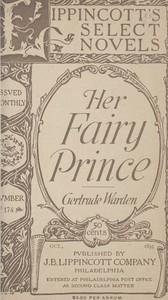
Her fairy prince
Language: en447 downloads on Project Gutenberg
Subjects
Public-domain ebook sourced from Project Gutenberg #70582.
Public-domain ebook
Language: en447 downloads on Project Gutenberg
Subjects
Public-domain ebook sourced from Project Gutenberg #70582.
The opening · free to read
"Hallo, Armstrong! Thought you were in Australia!"
"Hallo, Garth! Thought you were in gaol!"
Such were the greetings interchanged in Boulogne market-place on a hot August forenoon by two Englishmen who had not met for five years.
The first speaker, Mr., or Captain Garth, as he styled himself, was a man of medium height, inclined to stoutness and of florid complexion, with bloodshot blue eyes, plentiful prematurely-white hair, a heavy cavalry moustache, and a jovial swaggering manner. His clothes were carefully brushed and darned, his boots beautifully polished, and his chimney-pot hat, set rakishly on one side on his white curls, was suspiciously shiny in its surface. The Captain's red face, overhanging eyebrows, and ferocious moustache were wont to frighten children, of whom he was specially fond; but his features were well-cut and his manners plausible, and most women considered him a very good-looking man for his six-and-fifty years.
Of his companion's claims to personal beauty there could be no doubt, in spite of the air of drink, dissipation, and neglect which hung about him. Wallace Armstrong at six-and-twenty was intended by nature to be a splendid specimen of muscular manhood--tall, broad-shouldered, vigorous, and sinewy, looming enormous over the small French soldiers who slouched in twos and threes across the market-place, and followed where he walked by the admiring glances of the stalwart bare-footed fish-girls trooping up and down to and from the quay.
But already Wallace Armstrong had done his best to injure the heritage of vigour and manly beauty which had devolved upon him at birth. Under his eyes, of a brilliant bluish-gray colour shaded by thick black lashes, late hours and hard drinking had imprinted lines and shadows ill-suited to early manhood; his whole expression was sullen and defiant, as though he distrusted and despised his fellow men and was at little trouble to disguise his feelings towards them. His manner of greeting his old acquaintance was not only insolent as to words, but still more so in the tone he used the while he roughly shook Garth's detaining hand off his coat-sleeve.
"It's of no use to claim acquaintanceship with me now!" Armstrong remarked, harshly. "I'm broke, stone-broke--and, what's more, if I had any money, I know better now than to play cards with you for it!"
Captain Garth's red face grew a shade redder; but he was not sensitive as to snubs, and his tone was altogether friendly when he spoke again.
"We're all broke occasionally," he observed, soothingly; "even I do not absolutely wallow in gold at the present minute. Still, I've a little place up here in the High Town where I can put up a friend in difficulties until things blow over."
"Oh, I'm not wanted by the police, if that's what you mean!" the other interrupted, scornfully. "My early indiscretions have been whitewashed by a visit to Australia, which means that, having got into bad company in England, I was sent across the sea to get into worse company in Australia."
"Have you been back long?" Garth inquired, accommodating with difficulty his footsteps to the long strides of his companion.
"Long enough to spend in Paris the money which was to take me back to England! Look!" And he turned his empty pockets inside out for Garth's edification.
The elder man looked thoughtful, and walked on by his side for some seconds in silence.
"But your uncle?" he suggested at last. "Surely Alexander Wallace's credit should help his nephew in raising the 'needful'?"
"A lot of use when for four years the old skinflint has gone about denouncing me as a ne'er-do-weel, and proclaiming the fact that I shall never get another ha'penny from him. I've written to him from here--it was the only thing to be done; but it won't be any good. The picture I drew in my letter of my sick and starving young wife was enough to melt the heart of a stone! But it won't move Uncle Alec."
"Your wife?" Garth repeated, in surprise.
"Yes. The young, lovely, and pious orphan daughter of a clergyman, who fell in love with me on board ship and decided to take in hand my reformation. There never was such a perfect woman--if, indeed, she's alive still; but as, when I wrote, she'd had nothing to eat for three days--and I can swear she's had nothing since--she may very likely be dead by this time!"
Captain Garth was neither a good nor a scrupulous man, but he had the remnants of a heart about him, and his companion's words shocked and startled him.
"Are you mad or drunk, Armstrong?" he cried. "Do you really mean to tell me your wife is here in Boulogne starving?"
Armstrong turned and looked at him. Then he thrust his hands into his empty pockets and burst out laughing.
"Why, you old idiot," he exclaimed, "she's only my wife on paper! What in the world should I want to burden myself with a wife for? Uncle Alec has always been soft-hearted about women, probably because he's had very little to do with them and doesn't know what fools and plagues they are; so the idea came into my head to pitch this starving-wife story, and see whether that would move him. But I don't hope much from it."
"It would be rather awkward, though, if he took you at your word and asked you to produce her!"
"Nothing less likely. He has frequently stated in the letters of good advice he sent me at Melbourne that he never wished to set eyes on me again; and Heaven knows I am not hungering for a sight of the sanctimonious old bag of bones! My precious cousin is now the darling of his eye, the industrious apprentice and good boy, and all that sort of thing! He has been taken into the bank, and, no doubt, will get the old screw's money when he dies--if he ever will die, which I am beginning to doubt! He never would if I were his heir, for certain. Curse my luck!"
Clearly Armstrong was in a communicative mood as he strode along, every now and then savagely kicking the stones on the pathway. His last franc had been spent on a dose of fiery cognac, which, taken after long fasting, had mounted to his brain and brought on a talkative mood. All the time they conversed the two men were mounting the dusty white road which led to the High Town, Armstrong insensibly and Garth by design.
Captain Garth, as has been said before, was not wholly ill-natured. Five years before he had had some hand in the ruining of Wallace Armstrong, then a high-spirited lad of one-and-twenty, and known to be the favourite nephew of a wealthy Scotch banker. At that time Garth was the secret proprietor of a gambling club, and it was to meet the liabilities contracted there that young Armstrong forged his uncle's name, and was subsequently banished from his native country and his uncle's favour. The gambling club in question had been raided and dispersed long ago; but Garth had evaded the law and taken up his residence abroad. He was now really sorry to note the shabbiness and recklessness of his former dupe, and was casting about in his mind as to whether he could not assist him with possible profit to himself.
"Come up to my diggings!" he said, cheerily. "My little girl will cook us a cutlet and mix a French salad as well as any waiter in Paris!"
"Your little girl? I didn't know you had any family!"
"Mrs. Garth died in England three years ago," returned the Captain. "She was a very good woman, according to her lights; but--h'm--a little narrow, you know! Country rector's sister, kept house for him in a Sussex village, fell in love with a handsome blue-eyed young racing-man she saw in church. I like church--it's an institution that ought to be kept up. And eighteen years ago, Armstrong,--though I say it that shouldn't--there wasn't a better-looking fellow at Goodwood than Randolph Garth. I have always been weak--I own it--where a pretty woman is concerned; and the late Mrs. Garth was certainly pretty, though she was eight-and-twenty when I first met her, and had never had an offer. That sly old brother of hers drove would-be suitors away--wanted to keep her little pittance--just a beggarly life-interest in three hundred a year in the family, d'ye see? But she fell in love, as pretty women will, quarrelled with her family, ran away to London, and met and married me by appointment in an old church in the City. As to the little misunderstandings which followed, no doubt each of us was a little to blame; but Mrs. Garth was a lady, and never made scenes. Our methods of life didn't suit; so ten years ago we parted quite amicably, and my wife settled down with our little girl Laline in a cottage in the Lake district, where I visited them occasionally. Three years ago Mrs. Garth died very suddenly, and her income died with her. So my little girl had to come over and rough it in Boulogne with her father."
Such was the story of his marriage, detailed airily by Captain Garth--a story true in the main, but with many touches omitted which would have lent meaning and pathos to the whole. The story of a good and tender woman's mistake, of her gradual disillusion and growing hopelessness, and of the self-sacrifice by which, at last, she forfeited annually one-third of her little income to her worthless husband, in order that she might keep and educate her child far from the gambling, drinking, and unscrupulous set to which the man she had once so loved belonged.
Possibly, had Wallace Armstrong paid much attention to Garth's story, he might have read between the lines some of these truths; but he was at present too much occupied with his own affairs to trouble himself with the autobiography of a man whom he despised and mistrusted.
The Rue Planché, where Captain Garth's lodgings were situated, was a mean street in the High Town, composed of tumble-down ill-built little houses, painted in various tints of cream-and-mustard colour, one storey high, and furnished with green shutters and little back gardens liberally adorned with clothes to dry.
One worn step only divided No. 7, Rue Planché, from the street. The front door was open as the two men approached, showing a very narrow, brick-paved passage, and the linen-hung garden beyond, in which la mère Bénoîte, the Captain's landlady, was engaged in hanging up clothes. The Captain's rooms comprised a little salon on the right, and a little salle-à-manger on the left of the entrance, and up-stairs two tiny bedrooms; but before now Mr. Garth had put up a friend on the sofa of one of the ground-floor rooms, and he was prepared to offer a similar privilege to the nephew of Alexander Wallace.
The salon was the Captain's special den. Although the window was open, the scent of spirits and stale tobacco hung on the air, a few sporting prints adorned the walls, and the Captain's desk was littered by cuttings from sporting papers. A card-table stood in the middle of the room, and an empty bottle of cognac, half a dozen glasses, and a dirty well-thumbed pack of cards clearly showed the manner in which the Captain had spent the preceding evening. Nothing in this room was removed except by Garth's special permission; but when he caught sight of the sardonic expression on his visitor's face, he shut the door somewhat hastily, and inwardly regretted that he had not ordered the place to be put straight before leaving home that morning.
The book keeps going
Reading is free forever. Sign up and watch scenes appear while you read.



Scenes Storieta drew for other classics.
New illustrated classics
Once or twice a month: the latest books to get full character casts, scene art, and free comic editions. No account needed.