Public-domain ebook
The hoe cake of Appomattox
by Ellis Spear
Language: en312 downloads on Project Gutenberg
Subjects
In: Biographies·History - American·History - Warfare
Public-domain ebook sourced from Project Gutenberg #70880.
Public-domain ebook
by Ellis Spear
Language: en312 downloads on Project Gutenberg
Subjects
In: Biographies·History - American·History - Warfare
Public-domain ebook sourced from Project Gutenberg #70880.
The opening · free to read
ELLIS SPEAR, Companion Brevet Brigadier-General, U. S. Volunteers.
READ AT THE STATED MEETING OF MAY 7, 1913.
PUBLICATION DIRECTED BY THE LITERARY COMMITTEE UNDER AUTHORITY OF ORDER OF THE COMMANDERY.
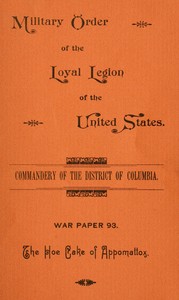
The Hoe Cake of Appomattox.
In considering the unity of that great brotherhood of men who composed the armies of the United States in the war for sustaining the government, and perpetuating the form of it made by the founders, we have been giving attention to every phase of the many common conditions which formed our common experience and bound us so firmly together, excepting those of a social and physical character. The great and firm basis of this lifelong comradeship is, of course, the common devotion and the common sacrifice in the service of the country on the existence of which, latent in peace but manifest in war, the very existence of every government is founded. This common devotion to the service of humanity is in the political and social world what the attraction of cohesion and the attraction of gravitation are in the physical world. We shared alike in that sacrifice and devotion and were fortunate in that we were born and reached an age when that struggle came on which allowed us to have a share in that great action, an epoch in history. We do not envy those born since, although we shall die sooner.
But I think you may properly also consider subordinate conditions of a physical character as not unworthy of mention and not without effect in the comradeship which binds us together. We wore common uniform, and in those four years the fashions did not change. Each fellow looked like every other fellow. The resemblance went even so far as that quality of personal appearance which depends upon the use of soap and water, not always abundant in those years. We lived for the greater part in the same home, the spacious, well ventilated, scantily furnished and unroofed out-of-doors. We all had the same kind of bringing up and education in which “Right face,” “Left face,” and “As you were” were familiar precepts not to be disobeyed without reproof or punishment. We were all boys when we went into this school, some of such a tender age that we should now hesitate to place them in command of a suffragette platoon. We were all boys in the same class and at the same school. We slept in the same bed, the lap of mother earth, and dined at the same table, also usually the lap of mother earth. There was a stern and commendable impartiality also in the distribution of the fare. Luxuries were unknown, excepting when, through scarcity, necessities became a luxury, but we shared alike in abundance and want. We could say with slight paraphrase, like the three brothers in the song:
We three brothers be In one good cause; Tom puffs, Bill snuffs, And I chaws.
Of all these common conditions, that of the diet has impressed me most. It was called rations, I conjecture, from its irrational and unfit nature and painful uniformity.
Who invented the army ration of 1861 to 1865 is, fortunately for his reputation, unknown. He was probably some distinguished commissary, and his works lived after him for many years. He should have a monument appropriately placed amongst the unknown dead built of some quality of stone most nearly approximating hardtack in quality and shape, and surmounted by a marble block carved in imitation of a hunk of rusty salt pork.
In the formative period of enlistment, when we raised companies and enlisted men no greener than ourselves, I used to wonder at that requirement of the army regulations which related to the teeth of the recruit. It was explained that a good set of teeth were necessary for a recruit on account of the necessity of biting the end of the paper cartridge, but for this it appeared that only front teeth were required, though the regulations included the whole set, and grinders could not be brought into play in the operation of biting the cartridges. But when we passed out of the region of the recruiting barracks, and the early stage of soft bread, and when that wonderful creation of the culinary art known as the army cracker appeared, this mystery of the requirement of the teeth was fully cleared up. It then appeared that the men were selected not for courage or endurance, which could not be examined into, but for good grinders, and the wonder now is that men enough to put down the rebellion could have been found with teeth equal to the task of putting down the army hardtack.
Did any comrade ever study this article in a geological way? It was a solid, there was no doubt about that. It was not a stratified rock. It was homogeneous and amorphous, excepting when wormy. It did not resemble anything in the vegetable, animal or mineral kingdom, excepting brick. It was inflexible, inelastic, infrangible, and indigestible, suited neither to the stomach nor bowels, and was adapted, except in shape, better as armor.
Indeed, instances have been reported, though perhaps not in the official records, where the haversack of a soldier stopped the bullet of the enemy, and these perhaps are the only cases where it was found that the hardtack saved life. It is well known that the army mule would not eat it, and it is another proof of the high intelligence of that noble animal, without whose constant aid the rebellion never would have been put down.
I am aware that in making this statement, in which I seem to attribute the suppression of the rebellion to the army mule, I am infringing the claims subsequently made by certain officers who have been talking ever since the war, notably that famous quartermaster whose stories led his infant son to inquire earnestly, “Pa, did anybody help you put down the rebellion?”
We all helped, in fact, but with the volunteers the first duty was to chew, or at least to reduce the ration to chewable condition. Soaking in water was tried, but that was too slow. The ration of one day needed the soaking of the day before. Do any of the companions remember seeing it spluttering in the grease of the frying pan?
But the same genius which invented the hardtack must also have invented that other main element of the ration, rusty salt pork, an infernal compound of animal fat, with sodium chloride, in which the chloride predominated, a combination of the cheapest of minerals with the basest of animals, and rusted by time and heat of the climate.
I speak of coffee respectfully. It was not “Java and Mocha Mixed.” Do you remember how the men carried it on the march? The detachable lining of the haversack furnished the bag. The ground coffee and the brown sugar, well mixed, made a solid ball held in the bottom under a retaining knot tied in the bag itself. A well-battered tin can served as the pot, and in it the mixture was boiled until the last percentage of caffeine was extracted, and the liquid and solid parts were in equal and uniform mixture. Then came that miracle of simultaneous cooling and settling and diluting by a little cool water poured on the top. What a fountain of life we drank from that flowing bowl, soothing to tired muscles and sore feet.
It is true that our diet had not always the same monotony. At Wapping Heights, in what the men called the “Molasses Gap,” in July of 1863, we had marched away from these regular rations, and our diet was more varied and scanty. The purveyor for my mess who had charge of my led horse and the incidental purveying captured a lean old duck. A few fragments of beet leaves from a trampled garden, and a half handful of cracker dust from his inverted haversack, water, the fragments of duck, and no salt, the whole imperfectly boiled, was offered for our dinner.
It was several years before my stomach would accept duck again.
Later in the day we had a handful of blueberries. The next day, returning out of the gap, the brigade nearly went to pieces in an old blackberry field. Later in the day a lean, wayworn steer was sacrificed, speedily dissected, and passed around while still warm to be broiled in the smoke. As Dr. Johnson said of the beef in the Hebrides, it was “ill-kept, ill-killed, ill-dressed, ill-cooked, and ill-served.” Too tough for chewing, it could be cut small and swallowed. In the night, on picket, there was a shower, by advantage of which some of my men stole a hive of honey. I ate, in the rage of hunger, I think a couple of pounds, comb, grubs and all, and then an oppressive doubt struck me that perhaps beeswax was not digestible. But I slept well, though wet, after a day in which the fare, scanty but diversified, was blueberries, blackberries, tough beef, and honey, served in succession.
But I am rambling. The war ended at Appomattox, in a climax, both in a military and dietetic sense.
The climax of the diet consisted in the fact that, having run away from our wagons and the pork and hardtack, for two days we had nothing, which fact prepared me for an anticlimax.
Some relief came later at Appomattox after the surrender, and while we were waiting for some final details some of us were invited to dine with a family living there. To show that we had no hard feeling we accepted the invitation, and consolidated our rations. We furnished salt pork and coffee, and the family a chicken miraculously spared for the occasion. There were also hot biscuits. There was not enough of the consolidated provisions to go around in full helpings, but the buckles of our belts were in the last hole, and, being guests, we restrained our appetites. The hot biscuits left a good taste in our mouths. Later I had a further relief in the commissary line. On the 12th of April, 1865, we left the Appomattox House, on a not very hurried march back toward Petersburg. There was now no such occasion for haste as when we came up, no occasion except for lack of rations, and lack of rations discourages haste. Our horses were in the same gaunt condition, and showed no tendency to wild galloping. It fell to my lot that morning to ride ahead of the column with a single orderly, and about noon we came upon a solitary negro shanty in the edge of a wood. In the front (and only) door stood one of the emancipated.
Feeling sociably inclined at the sight of a human being unexpected on that road, I accosted her in a friendly way, but omitted the customary preliminary topic in beginning conversation with strangers. The weather was not on my mind, nor the surrender, nor the condition of the country in general, nor of the colored race in particular. I went directly to the most important matter in the world at that time, and from my point of view. Had she anything to eat? Neither the appearance of the house nor of the woman had any suggestion of Delmonico’s, but that did not deter me. I was not expecting terrapin stew or roast beef. Such things had passed out of the memory of my stomach, though scientific men tell us that the memory of the smells is the most acute and permanent of all the senses. I doubt if at that time I should have recognized the smell of roast beef had it been in the atmosphere. There was a distressing hesitation in the old woman’s manner, but finally she admitted that she was the possessor of a hoe cake. A hoe cake! The discovery of America was a less important event (to the orderly and myself), and the shout of “Land” no more exciting to the sailors of Columbus than the announcement of “hoe cake” to the followers of Grant on that occasion. The woman disappeared for a moment, and then produced the goods. It was almost within my grasp. I fear the immediate negotiations were precipitate on my part. She had a corner in the market. There was no standard of prices on hoe cake that we knew of, and doubtless the shrewd old mammy understood the situation and our needs. My memory is not clear as to the details of the negotiations. In my eagerness to secure the cake the details are obscured by the importance of the result. Whether the price was fixed by the woman, or whether I offered all the money I had, is not now clear to me. Probably it was the latter. At any rate, the price agreed upon was a quarter of a dollar, enough, I have since surmised, to buy, at that time, a whole bushel of corn. By favor of an overruling Providence, and against all probability, I had that quarter. It was the extent of my financial assets, and I was on the verge of liquidation. But what of that? The choice between starvation and bankruptcy is soon made. In fact it made itself. The quarter was, of course, of the shinplaster kind, sole currency in those days. It was depreciated in value, as we knew to our sorrow, and hoe cake had appreciated. But I paid over that quarter, the most important property I ever possessed. I justify this statement to incredulous comrades. What might have happened in lack of it? It probably saved me from the crime of highway robbery, of burglary, or even murder, depending upon the obstinacy and resistance on the part of the newly emancipated, refusing to surrender the cake without compensation. But I acquired it honorably, by fair bargain, and at the seller’s price, although possibly, as it now occurs to me, she may have been overawed by the presence of superior armed force. But she did not look it, and I dismiss the unworthy surmise. She had a monopoly and exercised it with moderation, a shining though humble example, which, I hope, will make John D., J. P. Morgan, and the Armours ashamed of themselves when they read this history; and I am proud on my own part to record this transaction as a refutation of the groundless charges that soldiers, on both sides, during the Civil War, stole chickens and other edible things.
The book keeps going
Reading is free forever. Sign up and watch scenes appear while you read.



Scenes Storieta drew for other classics.
New illustrated classics
Once or twice a month: the latest books to get full character casts, scene art, and free comic editions. No account needed.