Public-domain ebook
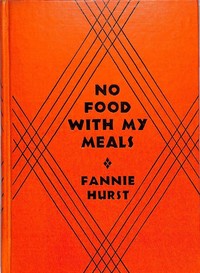
No food with my meals
by Fannie Hurst
Language: en477 downloads on Project Gutenberg
Subjects
Public-domain ebook sourced from Project Gutenberg #78225.
Public-domain ebook
by Fannie Hurst
Language: en477 downloads on Project Gutenberg
Subjects
Public-domain ebook sourced from Project Gutenberg #78225.
The opening · free to read
Not so much upon its frailty, which has been achieved at the cost of no food with my meals, but upon the frailty of the spiritual inhabitant of that envelope.
Regarding that spiritual inhabitant at the restless business of trying to learn to live in her house of clay, faint ironic laughter, the kind apt to be induced by a breakfast of lemon juice and hot water, rumbles along the inner me.
Some women are born frail. Some have frailty thrust upon them. Still others achieve it, and at what price glory!
Trivia, you say?
Not at all.
What is trivia, and what is not?
If, by virtue of its relativity to my concerns, the dahlia in my garden, the color of my tweeds, the nick in my dining-room table, or the market price of strawberries become important, then they are important. Everything or nothing matters.
When even half of one hundred and twenty-three million human beings on a North American continent begins to care passionately about adhering in standards of beauty to formulae concocted somewhere between anywhere and Hollywood, then that state of mind becomes important. Sufficiently so to create neurosis, psychosis, and acidosis.
No state of mind or body flecked with evidence of phobia can remain trivial, no matter how trivial the minds and bodies themselves.
It was about four years ago that the slimming phobia of my sex and era first began to fleck me with its rabies-like foam.
Up to that period, although overweight by a not inconsiderable poundage, I had not given complete rein to the latent unease which sporadically smote me at my abundance.
In fact, overweight from my advent as an eleven-pound baby, there was a brief period around adolescence when my opulence seemed something of an asset.
“Guess how much she weighs,” I can hear my grandfather proudly challenging, as he stood me on the sitting-room table and named a good eight or ten pounds over and above the most conservative estimate.
Ladies called me apple-cheeked, and gentlemen pinched them. I strutted, but even back there, there was unease in that strut.
But generally speaking, up to the time of my acute surrender to my sex’s phobia for slimming, the matter of anatomical distinction or peculiarity was scarcely within the pale of discussion. You were fat or slim, narrow or wide, dark or blond, according to a divine appropriation over which you had little control. To be sure, there was usually a “Fatty” in the schoolroom or on the block, but generally speaking, one did not dwell upon the flesh, or lack of it.
Beauty, had it not been parceled out in your direction, was something that could be brewed within the spirit in a manner to offset the external lack. This you were taught at the parental knee. Although it was not very satisfactory, you let it go at that. Except, why were hearts of gold and curls of gold so rarely supposed to strike simultaneously. How odd of God....
Now take this matter of being a plump little girl. You were apple-cheeked and got pinched for their cuteness, but then, you had to go and be a fat little girl, too. Why couldn’t one be a slender little girl--and apple-cheeked!
If you were unduly slim, you were simultaneously apt not to be apple-cheeked. There God went again, being odd. Slim, your portion was usually the bitter one of cod-liver oil and shoulder braces, whereas in plump reverse, you were called the picture of health and encouraged in your natural predilection for the creamed potatoes and marshmallow fillings which were usually anathema to the slim cod-liver oilers.
There was to come an adult time however, in the life of this narrator, when as the hum of a swarm of locusts over the peace of her mind, the dietary chant of the dieting women began to separate itself into a specific and ominous roar all its own.
Gradually, and oh, so insidiously, the spectacle of you, going your somewhat robust routine of three normal, if perhaps unscientific meals a day, in a state of taken-for-granted health that made it no theme for discussion; gradually you became to yourself a not edifying spectacle.
There was too much of something with you. Yourself.
Awareness, faint as the footsteps of a fly along the back of a neck, began to creep upon you so lightly at first that it was scarcely more than a tickling across your consciousness.
It began from who knows what remote scratchings of unease, in a changing attitude toward such cardinal institutions as breakfast.
There had recently arrived a newcomer in our Middle West midst, a Mrs. de Lisle from New York, a slim, pretty little lady much criticized by the impeccable housewives on the pretty residential street of our pretty city, for lax housekeeping, and who was openly known to have her breakfast (roll and coffee) in bed.
Now you take what has since become this more or less national institution of roll and coffee in the morning. It has its points æsthetically and doubtless gastronomically. But along about ten-thirty in the affairs of a busy morning those points, during the first period of the transition from more substantial matinal fare, begin to reside chiefly in the aching void at the pit of the stomach.
Breakfast tradition dies hard, particularly if that tradition happens to have been born and bred in the Middle West.
We lived not on a farm mind you, in these years of my late teens when too much of the corporeal me first began to seem too much with me, but in a large Middle West metropolis of urban habits of a most complicated nature. We ate our corn on cob from silver end-pieces, traveled east in a manner your Easterner seldom traveled west, and were among the first of the American communities to be stricken with such respective epidemics as burnt wood, honitan, ping-pong, Kinloch telephones, horseless carriages and hobble skirts.
At seven-thirty o’clock during the first eighteen years of my life spent there, a family of three, consisting of my father, the president of a fair sized shoe factory, but who nevertheless, punctiliously slid back his roll-top desk at eight o’clock; an alert and brainy housekeeper, my mother, and a slightly overweight youngster, myself, sat down to a breakfast worthy of the name. Literally we broke fast. Oatmeal in a covered dish was served out with plentiful additions of butter, sugar and yellowish cream. A platter of bacon and eggs, the eggs not necessarily portioned out along the conventional lines of two per person. My father was not adverse to a third, the frailer members of the family usually contenting themselves with two. Toast or hot biscuits or both arrived in a wicker basket, all tucked in under a red-and-white napkin with a fringed edge. There was usually hominy or grits or stacks of griddle cakes with apple jelly or molasses. Coffee and plenty of it in a beautiful old “Meissen” china pot with a gilt snout, and, more often than not, crumb coffee cake, still hot, and thickly sprinkled with cinnamon and sugar.
You ate, aided and abetted, it is true, by maternal duress of the most insistent nature, to have more of this, and another helping of that, on the respective suppositions that a business man was facing a long and exacting day, a growing child her school, and a housekeeper her arduous routine.
You ate! And thereby were to become susceptible for life to a tickling of the nostrils at the smell of frying bacon rushing up from the servant’s quarters as you, in your bedroom, sip black unsweetened coffee or gulp orange juice.
I was reared to like breakfast. I still like breakfast. Heaven my witness, I have not eaten a breakfast in twelve years.
Because it was about twelve years ago that the first whirrings of the dietary chant of the dieting women began to assail my ears. In fact, glancing back, it becomes apparent that about the time rolls-and-coffee became synonymous for the old noun breakfast, was launched the dietary era of my life.
It was all insidious, it was all as the humming of locusts, it was all as the fluty wings of the voice of my sex.
What had hitherto been only the vague unease at the poor, or rather the ample, showing put up by my externalities of figure; an unease which had been sweetly soothed by parents, now began to assert itself more positively.
Suddenly, or so it seemed to a languidly awakened awareness, the biology of my entire sisterhood seemed to have undergone an evolution. Female silhouettes began to take on the concavity of the letter C. Curves, only as they collapsed inward upon the anatomy, were apparently fit to be visible to the naked eye of the beholder. The bust measurements of the potential and actual mothers of the race dropped to the proportions of their young sons and brothers. The old, well-nourished ideal of the Venus de Milo became a lummox. Something actually rodential began to characterize the upper lips of the women of the slimming era as they gnawed at the raw carrot and the herbaceous green.
Out of the stuff of enameled rolling-pins for kneading too, too solid lady-flesh, rubber reducing girdles, bathroom scales to match any color scheme, reduction salts in the pastel shades, electric-light cabinets, rowing-machines, et al., new industries were born. Restaurateurs became Melba toast, spinach, and saccharine conscious. Spas began to find obesity, real and imagined, more profitable than liver complaint, gall stones, and gout rolled in one. Came the dawn of a dark hour when public opinion demanded that a grand-opera diva must be able to look down and see her own toes.
Such diet-derivative expressions as incompatibility, mental cruelty, fanaticism, irritability, cussedness, began more and more to creep into the phraseology of the divorce courts.
Overnight, as it were, that quick barometer, the show girl, achieved the biological phenomenon of shedding her hips, and measurements fluctuated more violently than a falling stock market. Figures began to slump and tip the scales at far below the Venus de Milo par. The way to compute your approach to the norm of the current ideal of beauty was to divide Lillian Russell’s adult weight by two, her measurements by three, and her vitality by four.
A favorite hypothesis has it that, in the main, women dress and adorn themselves primarily for the appraising eye of women. It is then also fair to assume that women reduce for women. Until his eye and arm became trained to the lesser lines of his womanhood, the male-in-the-streets’ reaction was scarcely nothing at all.
You’re all right as you are. What you want to reduce for? What’s the idea? You look good to me. Never did like skinny women. Cut out the dieting.
The book keeps going
Reading is free forever. Sign up and watch scenes appear while you read.



Scenes Storieta drew for other classics.
New illustrated classics
Once or twice a month: the latest books to get full character casts, scene art, and free comic editions. No account needed.