Public-domain ebook
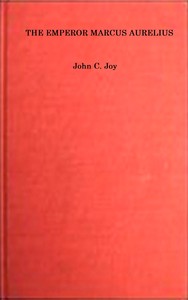
The Emperor Marcus Aurelius: A study in ideals
by John C. Joy
Language: en2,663 downloads on Project Gutenberg
Subjects
Public-domain ebook sourced from Project Gutenberg #78320.
Public-domain ebook
by John C. Joy
Language: en2,663 downloads on Project Gutenberg
Subjects
Public-domain ebook sourced from Project Gutenberg #78320.
The work is a scholarly study that treats the Roman emperor Marcus Aurelius as a moral exemplar whose life and writings illuminate the clash between pagan virtue and Christian grace. It opens with an extended quotation from Matthew Arnold, positioning the emperor as “the most beautiful figure in history” and arguing that his ideals resonate with modern readers because he lived in a society that, in many ways, mirrors our own. From there the author frames the investigation within a Catholic perspective, noting the relevance of Aurelius’s “high natural ideals” and contrasting them with the teachings of early martyrs, while also invoking contemporary thinkers such as F. H. Myers and the Catholic Truth Society to underscore the study’s theological and philosophical stakes.
The prose is dense and nineteenth‑century in tone, blending erudite commentary with a moral‑philosophical agenda. Its style reflects the period’s penchant for elaborate argumentation and a reverent, almost devotional, approach to historical figures. Readers who enjoy rigorous intellectual history, especially those interested in the intersection of Stoic philosophy, early Christianity, and Victorian‑era moral discourse, will find this book rewarding. It appeals to scholars of ancient Rome, students of religious thought, and anyone drawn to a reflective exploration of how a pagan emperor can still provoke ethical contemplation today.
“Marcus Aurelius is perhaps the most beautiful figure in history. He is one of those consoling and hope-inspiring marks which stand for ever to remind our weak and easily discouraged race how high human goodness and perseverance have once been carried and may be carried again. The interest of mankind is peculiarly attracted by examples of signal goodness in high places; for that testimony to the worth of goodness is the most striking which is borne by those to whom all the means of pleasure and self-indulgence lay open, by those who had at their command the kingdoms of the world and the glory of them. Marcus Aurelius was the ruler of the grandest of Empires and he was one of the best of men. Besides him history presents one or two other sovereigns eminent for their goodness, such as Saint Louis and Alfred. …
Keep reading free · chapter 1 needs no account